NRM has released data from thousands of soil samples, which suggests that land management has a significant impact on soil organic matter (SOM) levels. Overall, the less soil disturbance and less intensive farming practices tend to improve SOM levels over time.
NRM has been collecting soil analysis data since 1995. For the first time, the company has published consolidated, anonymised data on SOM gathered from over 11,000 samples analysed from June 2023 to May 2024. This data will help farmers design and implement insightful management plans to help improve soil health and optimise crop production whilst transitioning towards more sustainable agricultural practices.
‘An interesting finding from our SOM data was that, while the interquartile range for arable soils lies between 3.6% and 6.3%, showing relatively moderate SOM levels, grassland soils exhibit a significantly higher range of 7.3% to 12.9%,’ said Sajjad Awan, Agronomy Manager at NRM. ‘This really emphasises the impact of land use on SOM content—adding organic inputs or disturbing your soil less can boost SOM levels, giving you a step up in terms of soil health. The broader SOM range we found in grasslands is likely due to system factors such as cutting frequency, grazing intensity, and plant diversity. In contrast, the narrower SOM range found in arable soils suggests that, even though levels tend to be more uniform, intensive farming practices tend to reduce SOM over time.’
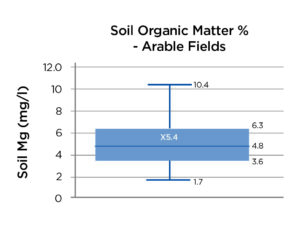
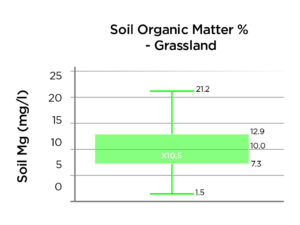
Very few farmers test for SOM
‘Whilst around 90% of arable farmers regularly book our standard soil tests, only around 17% test for organic matter. This gap is significant, as SOM influences everything from fertility and water retention to soil aeration, root penetration and bulk density. By understanding and managing SOM levels alongside nutrient analysis, growers and advisors can make more insightful management decisions. Better decision-making leads to improved soil health and compliance with sustainability objectives, both of which help to bolster the resilience of farming businesses.’
NRM’s SOM analysis can be easily added to its standard soil package. Our standard soil package provides soil indices based on RB209 guidance and an analysis of crop-available phosphorus, potassium, magnesium, and soil pH.
Up-to-date SOM analysis is vital to meet the requirements of the Sustainable Farming Incentive (SFI)’s SAM1 action for soils. Not all standard soil testing includes SOM analysis, so growers may not qualify even if they have soil nutrient analysis results from the last 5 years.
‘There are plenty of advantages to SOM analysis,’ continued Sajjad. ‘Benchmarking SOM levels will enable you to assess the effect of any management changes and help you not only improve soil health and learn how to withstand extreme or unexpected weather conditions, but it’ll also help you meet sustainability targets. So, adding SOM to your regular standard soil testing is vital if we are to improve sustainable productivity and protect the natural environment agriculture relies on —something the whole industry should be striving toward.’
Read our soil summary here for more information and insights.
With Christmas only a few weeks away, we would like to take this opportunity to thank all our customers for their business during 2024, and to let you know our operating plans for the holiday period.
Our laboratory and courier arrangements for Christmas and New Year are listed below. Please note that, while many of our business units close for a short period over the holidays, we also have specific cut off dates for the receipt of some sample types. Please check the details for each business unit.
For any enquiries, or to book in your samples, please speak to your usual Cawood contact.
NRM
Closed from Tuesday 24th December at 12:30pm and reopening on Thursday 2nd January. For full details of our laboratory and courier arrangements over the holiday period, click here.
Sciantec
Closed from Tuesday 24th December at 12:30pm and reopening on Friday 27th December. For full details of our laboratory and courier arrangements over the holiday period, click here.
Sci-Tech (IRE)
Closed from Tuesday 24th December at 12:30pm and reopening at 8:30am on Thursday 2nd January. For full details of our laboratory arrangements over the holiday period, click here.
IAS
Closed from Tuesday 24th December at 12:30pm and reopening on Thursday 2nd January. Full details of our laboratory and courier arrangements over the holiday period, click here.
Marchwood (Manchester)
Closed from Tuesday 24th December at 12:30pm and reopening on Thursday 2nd January. For full details of our laboratory and courier arrangements over the holiday period, click here.
Marchwood (Southampton)
Closed from Tuesday 24th December at 12:30pm and reopening on Thursday 2nd January. For full details of our laboratory and courier arrangements over the holiday period, click here.
Enitial
All services running as usual.
Chemtech
Closed from Tuesday 24th December and reopening on Tuesday 2nd January. For full details of our laboratory and courier arrangements over the holiday period, click here.
It is with profound sadness that we acknowledge the sudden and untimely death of our dear friend and former colleague, David O’Connell. As we come to terms with this loss, we reflect on David’s life and his remarkable journey with IAS Laboratories and Cawood, as well as the mark he left on the agricultural and environmental sectors in Ireland.
David joined IAS Laboratories in the early 1990s as an agricultural graduate. With his characteristic drive and passion, he quickly worked his way up to a consultant, eventually becoming an integral member of the technical sales team under the leadership of then Managing Director, John Britton. His dedication to agricultural science, particularly in the areas of soil, forage, milk, and blood analysis, was instrumental in diagnosing and addressing fertility and production issues on dairy farms and within the equine industry in Ireland.
David’s reputation for expertise and innovation within agriculture grew quickly. In 1998, he founded his own consultancy business, OCAE Consultants. From his offices in Ballinderry House, Enfield, Co. Meath, David managed this successful business while running a 200-acre mixed tillage farm and pursuing his passion for breeding National Hunt horses. Despite his entrepreneurial success, David remained closely connected to IAS Laboratories, contributing as a trusted advisor and loyal customer.
‘Whenever David visited the lab to drop off samples, he would always stick around to chat about new technology and analytical techniques,’ said Mick Hogan, Technical Sales Manager at IAS and long-time colleague of David. ‘He always showed a keen interest in how the lab operated. Of course, this would become very handy for us at IAS in the future!’
In 2010, David seized the opportunity to return to IAS. The business had grown significantly and been put up for sale, and the team wanted it to be bought by someone who would continue to run it in the local area and with similar values. Along with his business partner, Mark McGarry, David acquired the laboratory and relocated it to Royal Oak Business Park, Bagenalstown, Co. Carlow.
Under his leadership, IAS flourished. His vision for the company was clear: to be at the forefront of agricultural and environmental laboratory analysis. He meticulously believed in the benefit of sustainable agriculture, and he thrived on providing consultancy to clients off the back of results he confidently stood over. Through David’s meticulous dedication, IAS expanded its team, modernised its facilities, and adopted cutting-edge technologies, ensuring the lab became a leader in scientific analysis in Ireland.
David played a pivotal role in the agricultural community, exemplified by his management of the Irish Department of Agriculture, Food, and Marine’s (DAFM) soil sampling contract whilst at IAS. The programme, which is the largest of its kind in Ireland and globally unique, was a monumental success under David’s guidance. His expertise in logistics, sample processing, and analysis was essential in bringing this project to fruition.
In 2021, David made the decision to sell IAS Laboratories to Cawood, allowing him to focus on OCAE Consultants and spend more time with his family. However, his commitment to IAS continued, as he stayed on as General Manager until March 2023, ensuring a smooth transition and furthering the company’s success.
‘David’s passing has left a void felt by everyone who had the privilege of knowing and working with him,’ continued Mick. ‘He was not only a visionary leader, but also a true gentleman to all who knew and worked with him on his journey. I am proud to have called him a dear friend.’
We extend our deepest condolences to his family, friends, and colleagues. David O’Connell’s legacy will continue to inspire those of us who had the honour of working alongside him, and his contributions to the field of agricultural science in Ireland will have a lasting impact for years to come.