


The latest in porcine veterinary diagnostics analysis #2

Sci-Tech
Agriculture
If you’re a livestock farmer or vet, you know there are several tests that are available to help you monitor and prevent diseases spreading through the herd or flock. PCR screening is the most beneficial method for identifying and monitoring porcine diseases.
In my previous blog, I discussed how veterinary diagnostics benefits vets and producers, and looked into how serology screening via ELISA works. Read on to learn more about PCR screening, why and how we carry it out, the importance of using an accredited laboratory, and some top tips for submitting samples for reliable and accurate results.
What is PCR screening and how do you carry it out?
PCR, or Polymerase Chain Reaction, is the process where DNA is amplified via copying into a specific target sequence. This will then allow the multiplication of target DNA present in a sample so that it rises to an identifiable level. This allows us to detect the presence of harmful pathogens.
At Sci-Tech, we use probe-based, real-time PCR as it is sensitive and produces quantitative results. In addition to primers, which is also used in conventional, slower PCR methods, it uses fluorescent markers or “probes” which emit light as they amplify specific regions of DNA in a given section. If there is more target DNA present, the sooner the signal from the fluorescence will be detectable by the thermocycler.
The real-time PCR method has many other benefits: it’s safer to use, it’s quicker, we can sample for both EU and NA variants of PRRS on the same run, it prevents contamination as no amplified DNA is released into the lab, samples are easy to collect, different probes allow multiplexing so less sample is needed, and pathogens can be detected at very low levels as this doesn’t rely on an immune response.
To carry out PCR screening reliably and accurately, we require samples to be sent as rayon-tipped sterile swabs with plastic applicators (avoiding wood and charcoal). Swabs should be kept free from faeces and other environmental contamination, including the sampler’s skin. Then, they must be placed back into the plastic applicator and closed tight.
We require a maximum of 5 oral-pharyngeal swabs pooled per PCR reaction as, whilst PCR is expensive, it is less likely to give false positives, so less replicates are required.
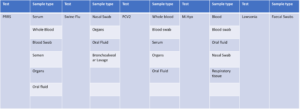
Porcine PCR tests and sample types accepted
How do labs prevent PCR sample contamination?
To prevent contamination of samples, we apply strict rules to our PCR protocols, including:
- Continuously following strict cleaning and decontamination procedures
- Setting up all PCR reagents in a controlled DNA-free clean room
- Ensuring all team members are fully trained and regularly assessed on competency
- Testing negative controls for every PCR experiment
- Weekly PCR testing of swabs from the lab environment.
This helps us maintain the quality of our samples for accurate and reliable results, enabling us to uphold our stellar reputation in veterinary diagnostics analysis and inspire confidence from our customers. It also supports our status as a UKAS accredited specialist laboratory for businesses in the livestock sector.
Why should I use a UKAS accredited laboratory?
Using a UKAS accredited laboratory to undertake veterinary diagnostics analysis is necessary to guarantee confidence in results. ISO17025 specifically is the mark of quality and is a world-recognised standard for a lab quality system. The implementation of this system ensures that any results from the lab have complied with the quality system, and as such can be marked with the UKAS symbol.
Having UKAS accreditation shows to our customers and the industry that we maintain high quality standards, shows we are competitive in the market, and inspires our customers to have confidence in our results. It is also necessary for international trade, so that everyone is assured of the quality they will be receiving.
Whilst not all the tests we provide at Sci-Tech are UKAS accredited, being a UKAS accredited lab means that all our tests adhere to the same stringent quality checks that are required. These are audited on an annual basis by a specialist auditor.
To enable us to retain our accreditation, we have the following controls:
- Participation in External International Ring Trials and PT Schemes (EQA)
- Internal Quality Control (retesting of % of submitted samples)
- Monitoring of kit controls, in-house controls, and equipment performance
- Auditing of test procedures and technicians.
- Retesting positive samples to rule out errors on unvaccinated animals.
Top tips for sample submission
Samples must be taken and sent to the laboratory using best practice to ensure reliable, accurate results. We have 4 top tips to help customers get the most useful results possible to help them maintain productivity and keep animal diseases at bay.
- Take high quality samples. This involves avoiding contaminating the sample through good farming hygiene practices, as well as using optimal tools for sample collection. For example, rayon swabs are better than cotton, as the latter retains the sample more and so will provide us with less of the sample during extraction.
- Fully complete submission forms. This helps to prevent sample queries and analysis delays.
- Provide replicate samples. This means we can test several samples at once, giving better coverage of results. Additionally, the cost per sample can decrease if we are sent multiple.
- Send samples directly to the laboratory after sampling. This helps to prevent delays. This is important for oral fluids in particular, as they can become inhibited by bacterial growth if the sample is stored at an ambient or elevated temperatures.
Sci-Tech’s UKAS accredited microbiological and serological analysis services cover all aspects of poultry, porcine and gamebird production. To learn more about the importance of veterinary diagnostics and serology testing, read part one of my blog here.
To send in your samples for testing, contact us today.
Visit Sci-Tech