


Soil mineral nitrogen levels and their contribution to soil nitrogen supply

NRM
Agriculture
This season NRM has seen an increase in soil mineral nitrogen (SMN) samples for analysis. There are many reasons for this, but the drive for better nitrogen utilisation and importantly, making the fertiliser purchase go further, are both huge incentives. Knowing what supply is coming from the soil is the start point, as discussed in my previous blog, to improve Nitrogen Use Efficiency, reduce costs, and to protect the natural environment.
This year’s results make for interesting reading but are not hugely dissimilar from proportionate levels measured in 2022. That said, what is measured in the soil is only part of the story. Accounting for the amount of nitrogen the crop captured over the previous autumn and winter is critical in determining Soil Nitrogen Supply (SNS) and crop nitrogen requirement.
Soil Nitrogen Supply (SNS)
There are three components that make up SNS: soil mineral nitrogen, soil organic nitrogen, and spring crop nitrogen. All three components can be sizeable in a situation of high fertility, and/or the amounts vary depending on the crop type, previous management, soil type and over winter rainfall. The overall SNS can vary tremendously in crops such as winter sown oilseed rape. Larger canopied crops can contain upwards of 100-150kg N/ha and in those situations deplete the level of SMN measured in late winter.
However, this doesn’t mean the overall SNS is reduced. The nitrogen supply hasn’t necessarily disappeared, but has more likely moved from the soil into the crop. This doesn’t impact on the total amount of nitrogen required to grow the crop, but it can impact the timing of nitrogen. In the case of oilseed rape, judging when to apply the first nitrogen dressing to avoid building an over large canopy will be dependent on canopy size and how much nitrogen is in the soil. An early application of nitrogen might not be necessary and delaying until later in spring might be the best option to ensure crop performance.
Green Area Index (GAI)
The easiest way to estimate how much nitrogen is contained in an oilseed rape crop is to measure the GAI. BASF developed a handy mobile tool that works out the size of the GAI from a photograph of the crop. The pictures below show the difference in spring canopy size and the amount of nitrogen they contain.
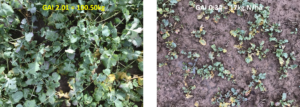
These two crops could both have the same SNS, or they could be incredibly different. It all depends on what is measured in the soil.
The nitrogen contained in winter sown cereals by spring is generally a lot less but the principle and importance of accounting for crop nitrogen remains. The easiest way to make an assessment is by counting tillers in a known area, typically a square metre. For every 500 tillers/m2 the crop is estimated to contain 15kg N/ha. RB209 contains all the information to guide estimating spring crop nitrogen in both cereals and oilseed rape.
2023 SMN results
This year the proportion of samples measured within SMN categories has not been dissimilar to the levels measured in spring 2022. The following chart describes the distribution of SMN levels measured in more than 1500 samples.
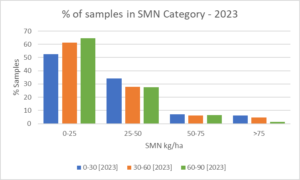
Most of the samples (87%) measured between 0 and 50kg N/ha, in the 0-30cm soil profile compared to 89% in 2022. The proportion of samples measured between 0 and 50kg N/ha increased as the sample depth increased. Very few SMN samples analysed so far have measured beyond 50kg N/ha (8%). In 2022 13% of the samples analysed were ≥50kg N/ha.
Across the three soil depths (0-30, 30-60, 60-90 cm) a total SMN value of 84kg N/ha was measured compared to 92kg N/ha in 2022. At a nitrogen price of £1.70p/kg this has a high fertiliser replacement value equating to £142/ha. Financially it makes sense to account for the nitrogen supplied by the soil.
As we progress into spring and the soil begins to warm up, soil nitrogen mineralised from the organic pool will increase the amount of SMN available for crop uptake. Soil texture has a large influence on the rate of mineralisation and the mineralisation capacity. Lighter textured soils do warm up earlier in the spring which in turn stimulates earlier plant growth. Heavier texture soils take longer to warm up in the spring, but they have a bigger capacity to mineralise nitrogen as they warm up because they contain more clay and tend to have a higher soil organic matter content.
To capitalise on the nitrogen in your soil, contact NRM or speak to your adviser about our N-Check and N-Check Plus services.
References
Visit NRM