


Soil nitrogen supply: measure to manage successfully in 2023

NRM
Agriculture
Understanding soil nitrogen supply (SNS) and its contribution to the overall nitrogen need of a crop is incredibly important in ensuring crop demand is met and excess nitrogen isn’t applied. Soil nitrogen can supply up to half of a crop’s annual requirement, but for some, optimising applied nitrogen based on what has been measured in the soil is a risk.
Nitrogen is the main yield driver for crops and deviating from what has been applied in the past can be a step too far for some growers. However, the recent economic pressures of growing crops have encouraged many growers to look again at measuring soil nitrogen supply in the hope of better targeting inputs and redistributing nitrogen fertiliser more effectively across the rotation.
Understanding the factors that affect soil nitrogen supply is the best way to ensure that you get the most out of soil nitrogen analysis. The most obvious factor to consider is the impact of over winter rainfall. How much it has rained over this time and the subsequent effect on spring soil mineral nitrogen (SMN) levels is usually a focus of debate between farmers and agronomists, particularly when comparing between seasons.
How does weather affect soil nitrogen?
In autumn 2022, temperatures were unseasonably mild, resulting in the third warmest autumn on record. With warmer soil and air temperatures persisting, many crops established well ahead of a very wet November in some parts of the country. Overall, the UK experienced 30% more rain in November than on average. In just 5 days, parts of Aberdeenshire recorded 150% of the normal monthly rainfall, causing flooding in the worst affected areas.
The weather then switched in the weeks running up to Christmas and temperatures plummeted. We saw widespread snow in Scotland and in parts of the South of England. Icy conditions continued and were widespread across the British Isles. These changeable weather patterns will have introduced even more variability in spring soil nitrogen supply, but analysis can help you manage changes in supply.
The temperature of the soil in early spring has an impact on the biological populations that are involved in the release and mobilisation of soil nitrogen from organic matter and the soil matrix. At soil temperatures of less than 5°C, soil biological activity reduces and slows the mineralisation of organic nitrogen. This coincides with the slowing of plant growth. A prolonged cold snap can mean that some soil textures contain a generous soil nitrogen supply in spring, due to nitrogen being maintained in its organic form. Soil textures which are lighter in nature tend to warm up quicker and earlier in spring, encouraging mineralisation and plant growth. However, soil mineral nitrogen is incredibly mobile, so prolonged periods of rainfall increase the risk of nitrate-N leaching down the soil profile out of reach of young plant roots.
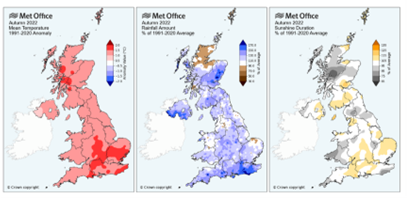
Figure 1: In the UK, autumn 2022 was the warmest in history but it was also wetter than average (Met Office, 2022)
How does field history and management impact soil nitrogen?
Farms that grow forage crops within the rotation and/or grassland and have a long history of manure use tend to maintain higher levels of soil nitrogen supply. This is because the soil has a higher soil organic matter (SOM) content. SOM content strongly influences fertility and organic nitrogen release within the soil matrix. Building SOM levels helps to improve fertility and increase soil nitrogen supply, but how you manage your soils within and between cropping seasons has an influence on the capacity of soils to supply nitrogen year after year.
The impact of previous management and seasonal weather conditions does have a bearing on future cropping performance and influences the variation in soil nitrogen supply. Measuring soil nitrogen supply helps to identify and reduce the potential severity of seasonal variation.
The RB209 nutrient management guide provides advice on determining soil nitrogen supply through a series of index tables that are based on regional rainfall, previous crop, and soil type. This is called the field assessment method. However, this methodology cannot account for all the variables that occur between and within farms that effect seasonal differences in soil nitrogen supply. This is when measurement becomes a useful tool in helping to calibrate soil nitrogen supply across the farm or cropping area.
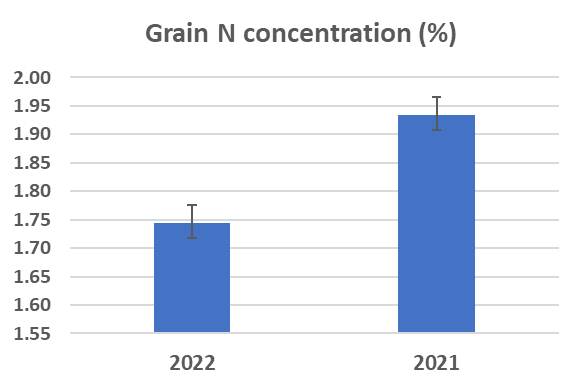
In the autumn of 2022, NRM examined grain analysis data to understand the trends in nutrient removal for N P and K. This makes for interesting reading as we learnt that the majority of samples recovered far less N P K than standard figures assume. In terms of a retrospective review of nutrient management, grain analysis can be a useful tool in determining how well the previous crop was supplied and recovered nitrogen. Typically, a feed wheat crop at harvest should contain 1.9% grain nitrogen. The recent analysis made by NRM based on 500 samples suggested a 0.19% reduction in recovered grain nitrogen. You can see this illustrated in the chart below.
This difference could be due to:
- A reduction in applied nitrogen due to fertiliser price increases
- An assumed overestimate of soil nitrogen supply
- An assumed overestimate of nitrogen from organic inputs
- The impact of dry weather on nitrogen recovery from the soil and applied inputs
- The very hot weather during June and July.
Assuming soil nitrogen supply and not accounting fully for the nutrients contained in organic inputs can mean we either under or overestimate what needs to be applied as fertiliser. This leads to a poorer crop performance than we would hope for. Measuring soil nitrogen supply and the nutrients contained in organic inputs can help to minimise the variation in the nitrogen supplied so we can better match the fertiliser needs of the crop.
Drought conditions and very hot temperatures affect the availability of nutrients within the soil and the subsequent performance of crops. These conditions seem to be occurring more frequently as our climate changes. Adapting how we manage our soils by building more resilience into the soil crop system will help. Additions of soil organic matter, increased landscape/rotational diversity, and/or reduced cultivations, for example, will increase the functionality of the soil, improving how they respond when challenging conditions such as periods of prolonged drought occur.
How does soil texture influence soil nitrogen supply?
The nitrogen content of lighter textured soils is influenced by higher rates of rainfall over winter. It is also often reduced in spring compared with a more clay rich soil, particularly if fields are left bare over winter. However, farms between and within regions don’t all receive the same amounts of rainfall, and nitrogen content in the lighter soil isn’t always as low as we might expect.
Variation in nitrogen content naturally occurs within soil textures of all types. Lighter textured soils warm up faster in early spring and begin to mineralise nitrogen earlier than those with a higher clay content. So, nitrogen management plans for autumn or spring sown crops on these types should be adapted to account for this natural variation.
The chart below describes the characteristics which determine a soil’s textural class. Knowing the proportion of clay, silt and sand is important if we are to better manage soil nitrogen supplies, as these characteristics influence nitrogen retention and overall supply.

Is measuring spring crop nitrogen content important?
The soil nitrogen supply calculation includes not only the proportion of available soil mineral nitrogen and the organic nitrogen a soil contains in spring, but also how much of it the crop has recovered over the preceding autumn and winter months. Cereal crops sown in the autumn have often not taken up much nitrogen by spring—the very forward crops may have taken up 30-40kg N/ha, but it’s typically less. However, it is still important that this contribution is included in the soil nitrogen supply estimation as it can make the difference between a soil being categorised in a higher or lower SNS index, affecting the crop nitrogen requirement.
Assessing the spring crop nitrogen content of winter oilseed rape is critically important. Larger canopied oilseed rape crops can easily contain more than 100kg N/ha by early spring, and understanding how much remains in the soil is important because it influences the management and timing of applied nitrogen. It may be that the crop canopy is large, and so the soil is depleted, or that the supply remains high. On the other hand, a crop canopy can be small with a high or low soil nitrogen supply. These combinations can occur within the same field and/or between fields.
It is important to note that the soil nitrogen supply can still be large when the soil nitrogen content is low because both components contribute to SNS assessment. Nitrogen is found either in the (autumn sown) crop or in the soil, and each component must be included for an accurate estimation of soil nitrogen supply.
How can I measure soil nitrogen supply?
NRM offers two services for assessing soil nitrogen supply: N-Check and N-Check Plus. Whilst both measure soil mineral nitrogen, N-Check Plus also includes soil organic matter analysis. Measuring soil organic matter enables an estimate of organic nitrogen to be determined and, by following the RB 209 field measurement method, the SNS index can be reported if an estimate of spring crop nitrogen has been supplied.
N-Check Plus is best for mineral soils. Sampling to a soil depth of at least 60cm in 30cm intervals, the rooting depth for shallower rooting crops, or topsoil depth for shallow soils will provide the best assessment of soil nitrogen supply. N-Check is best targeted to silt and peat/peaty soils, and it is best to sample at least to 90cm or the rooting depth of shallower rooting crops.
To better manage your soil nitrogen supply, please contact your agronomist or NRM directly to find out which service is best for your cropping/soil circumstances. Get in touch here.
References
RB 209 – Nutrient Management Guide (RB209) | AHDB
Met Office – UK climate – Met Office
Visit NRM