Beyond the index scale #4: understanding soil pH

NRM
Agriculture
In this final blog of the series, we turn our attention to understanding soil pH, which is a key driver of nutrient availability, diverse soil biology, and long-term soil health. Here, we explore pH data measured by NRM over the past twelve months from samples collected across the Southwest, East, and Southeast of England, and highlight why regular monitoring and management remain essential.
To read our first three blogs in the series, click below:
- Beyond the index scale: NRM’s soil summary 2024-2025
- Beyond the index scale #2: building soil indices
- Beyond the index scale #3: how to manage excess nutrients
Why does understanding soil pH matter?
Correcting soil pH offers clear benefits in terms of nutrient availability, crop resilience, and overall soil health. Yet, it remains one of the most overlooked aspects of soil management. The reasons for this oversight remain unclear: perhaps there are concerns over cost, time constraints, or competing management issues, but the consequences of neglect can be significant.
Growers often recognise that phosphorus (P) availability can be significantly affected when soil pH is either too low or too high. A suboptimal pH can affect all major and trace nutrients essential for healthy plant growth, influencing plant health, rooting, and yield potential.
The charts below illustrate how pH affects the availability of key nutrients.
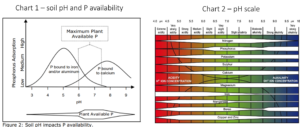
Chart 1 shows how pH affects plant-available P in mineral soils:
- As soil pH rises above 7.5, available P is less likely to form complexes with elements like iron or aluminium and more likely to bind with free calcium.
- Levels below or above 6.0–7.5 cause more plant-available P to become locked in the soil system.
- Low pH reduces the availability of nitrogen (N), potassium (K), magnesium (Mg), and calcium (Ca).
- Many trace elements become less available in higher pH soils.
Crop sensitivity and recommended soil pH values
Many plants are sensitive to wide shifts in soil pH, and crop species vary in their tolerance to acidity or alkalinity. It is not possible to maintain the entire range of crop-specific pH values across a rotation, but fortunately, there is a generous overlap between the pH range that supports healthy crop growth and the range that maximises nutrient availability.
Therefore, the advice for UK soils and in most other countries is to maintain soil pH values at optimal values of 6.5 (5.8 in peaty soils) for cropped land and 6.0 (5.3 in peaty soils) for grassland.
Minimum pH tolerances for healthy crop growth
| Crop | Critical soil pH | Forages | Critical soil pH |
| Wheat | 5.5 | Maize | 5.5 |
| Barley | 5.9 | Lucerne | 6.2 |
| Oat | 5.3 | Timothy | 5.3 |
| Oilseed rape | 5.6 | Fescue | 4.7 |
| Potato | 4.9 | Red Clover | 5.9 |
Understanding soil pH, liming, and carbon sequestration
Research published by Rothamsted Research and others supports the idea that regular liming can help mitigate climate change.
Long-term experiments (since 1856) revealed that net carbon sequestration in limed soils (0-23 cm depth) over varying time intervals, since 1856, was 2 to 20 times greater than in unlimed plots. This was despite higher respiration rates.
This is because:
- Improved pH boosts crop growth, increasing residue returns
- Enhanced biological activity helps incorporate crop carbon inputs into soil organic matter.
This all highlights another reason (in addition to nutrient availability) to maintain optimal soil pH.
What did our data show?
The following summarises the proportion of soil samples falling within different pH ranges.
Cereal crops
The soil samples tested for most cereal crops fell between pH 6.0 and 8.0, which is encouraging considering that a decade ago 40% of arable soils were below 6.0, demonstrating improvement. However, some bias may exist in the NRM dataset due to sample distribution and the prevalence of calcareous soils.
That said, and somewhat surprisingly, 4.2% of arable land had pH levels below 6.0 and therefore would benefit from lime applications.
| 1Arable Crops
Southeast & East of England |
2Grazing (G) & 3Silage (S)
Southwest of England |
||||||||||
| pH range | pH range | ||||||||||
| <6.0 | >6.0-<7.5 | >7.5-<8.5 | >8.5 | <5.5 | >5.5-<6.0 | >6.0-<7.5 | >7.5 | ||||
| % | % | ||||||||||
| 4.2 | 41 | 53.8 | 0.3 | G | S | G | S | G | S | G | S |
| 1includes cereals, straw removed.2grass, defined as grazing, frequency unknown. 3silage includes one or more cuts | 10.4 | 4.5 | 37.0 | 26.0 | 47.0 | 60.5 | 6.0 | 9.0 | |||
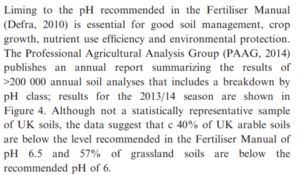
A significant proportion of results – 84% of grazing land and 86% of silage fields – fell within pH 5.5 and 7.5. 10% of grazing land and 4.5% of land cut for silage were below 5.5, and these soils would benefit from being limed to improve nutrient availability and productivity.
High pH soils: challenges and management
Many UK soils are inherently calcareous (contain free calcium carbonate) due to limestone or chalk parent material, giving them naturally high pH and strong buffering capacity. In fact, in our dataset, nearly 40% of soils had a pH between 7.5 and 8.5, with almost 24% of these between 8.0 and 8.5.
This means that lowering pH long-term is usually not possible, even with acidifying amendments, due to high buffering capacity (the soil’s resistance to pH changes). Additionally, high pH can immobilise phosphorus and trace elements, reducing their availability to crops.
Growers often address this through:
- Seed dressings or slow-release phosphorus fertilisers, ensuring sufficient P early in crop development.
- Elemental sulphur, which provides temporary acidification as microbes convert it to sulphuric acid.
While these approaches help, they cannot overcome the buffering of calcareous soils.
How NRM can help
NRM offers a range of services that can help you identify potential issues in your soils and crops, allowing you to take prompt action to rectify them. Contact us to learn about how analysis can help you manage your business.
References
RB209 Section 1 Principles of nutrient management and fertiliser use | AHDB
Soil acidification and the importance of liming agricultural soils with particular reference to the United Kingdom. K. W. T. GOULDING, Department of Sustainable Soils and Grassland Systems, Rothamsted Research, Harpenden AL5 2JQ, UK