


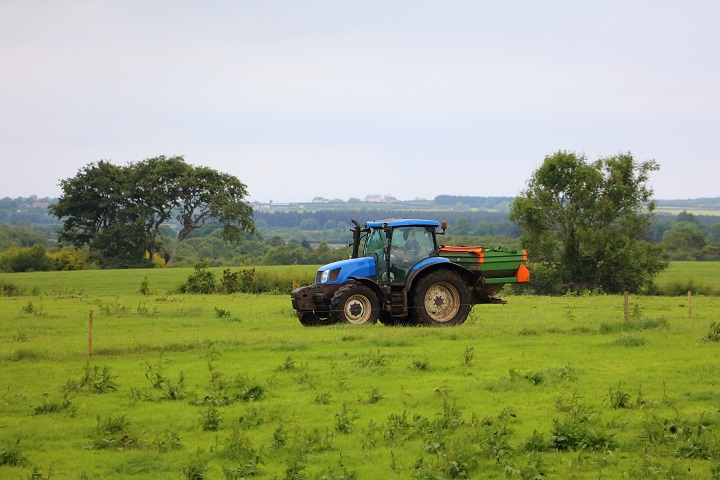
Why global conflicts like the war in Iran means farmers should invest in soil analysis

NRM
Agriculture
Global conflicts like the war in Iran may be taking place thousands of miles away, but their effects are often widespread. Not only are we experiencing fuel shortages and price spikes, but farmers are also seeing the impact on global fertiliser supply.
Since fertiliser manufacturing has practically ceased in the UK, British farmers now rely more on imported fertiliser products and the imported raw materials used for blending fertilisers in the remaining UK plants.
This war is the latest example of how geopolitical instability can disrupt fertiliser supply chains, exposing a critical weakness in modern agriculture: our heavy reliance on synthetic input.
For UK farmers already facing tight margins and the impacts of climate change causing unpredictable weather (with January to March being the third wettest in the last decade), global conflicts like the war in Iran poses a direct challenge to agricultural productivity, profitability, and long-term resilience.
We’re here to help. For a limited time only, we’re offering 25% off our A218 Standard Soil & Organic Matter analysis package and 10% off our A001 Standard Soil analysis package – click the link at the end of this blog to learn more.
Global conflicts & fertiliser disruptions: a growing risk for farmers
Fertiliser production and distribution depend heavily on global energy markets and international trade routes. The Strait of Hormuz, a waterway between the Persian Gulf and the Gulf of Oman, is currently being blockaded, which is a huge issue for global exports. With about 46% of global seaborne urea transit and around 30% of global ammonia transit from Persian Gulf countries moving through the Strait every year, it’s clear why fertiliser prices have shot up in the last couple of months.
In fact, imported ammonium nitrate nitrogen fertiliser alone jumped from £399 in January to £533 in April – the biggest increase we have seen in recent years.
When conflict arises, such as the war in Iran, it can:
- Drive up fertiliser prices
- Limit availability
- Disrupt supply chains
As the new fertiliser purchasing season approaches in May-June, all farmers will face limited product options and higher prices unless global stability returns.
This kind of disruption puts pressure on both individual farms and the entire food system. The risk of reduced crop yields and rising input costs ultimately feeds through to food security and market stability.

The underlying problem (and the solution)
Since the 1960s, modern farming systems have become increasingly dependent on manufactured fertilisers to grow crops and livestock. While revolutionary in effectiveness, this reliance means that global disruptions can greatly upset the system, leaving farmers with few reliable solutions.
Global conflicts like the war in Iran highlight the need for a shift in approach. Rather than relying entirely on imported inputs, farmers should focus on building resilience from the ground up, reducing the impact of disruptions before they escalate into major problems. This starts with monitoring and improving soil health.
The solution: monitoring and improving soil health
Improving soil health is one of the most effective ways to reduce reliance on manufactured fertilisers while maintaining productivity. Healthy soils naturally cycle nutrients, retain moisture, and support plant growth. Applied inputs should balance the nutrient supply that the natural system can’t provide.
Key benefits of improving soil health include:
- Reduced fertiliser requirements
- Improved nutrient use efficiency (NUE), which reduces the amount of fertiliser needed
- Improved natural soil fertility
- Better water retention, increasing drought resilience
- Reduced erosion and nutrient loss
- Enhanced biodiversity and ecosystem health
- Carbon sequestration, helping mitigate climate change
- Stronger long-term food security
Ultimately, healthier soils create more stable, productive farming systems.
Soil analysis is the key to more resilient soils
Many farmers are already adopting regenerative practices to improve soil health, from cover cropping and reduced or no-tillage systems to planting hedgerows and field margins. While these approaches help build soil organic matter, improve soil structure, and enhance biological activity, they are only part of the solution to a healthier food system.
To truly optimise soil health and reduce dependency on manufactured fertilisers, farmers need accurate data to inform their decisions. This is where soil analysis becomes vital.
By understanding exactly what’s happening beneath the surface, farmers can:
- Gather a baseline of the nutrients in their soil, allowing them to apply nutrients more precisely
- Avoid over- or under-application of fertilisers
- Track improvements in soil health over time
- Make informed decisions about the transition towards regenerative practices.
- A mechanism to value the greatest asset on the farm – the soil.
The importance of this has only increased following the closure of the 2025 Sustainable Farming Incentive (SFI) scheme in March.
With less direct policy support for soil analysis, farmers must not underestimate the benefits of investing in soil analysis, as it is one of the most practical and cost-effective ways to build a resilient farming strategy.
NRM’s standard soil & soil organic matter analysis
With global conflicts like the war in Iran disrupting fertiliser supply chains, it is even more important than ever to understand the soil, the most valuable asset on your farm.
Soil analysis provides data to plan effectively, build resilience, and ensure soil is in the right condition to support efficient crop production in the face of modern-day challenges.
At NRM, we offer:
- Our standard soil analysis package (A001), which provides pH and key (macro) nutrient data for a basic fertility assessment.
- Our standard soil plus organic matter analysis package (A218) adds organic matter analysis by LOI for improved soil structure and nutrient retention insights. The addition of organic matter analysis also helps to support sustainable crop production.
Additionally, NRM offers manure and slurry analytical services. By analysing the organic materials imported or already on-farm, farmers can ensure they account for the nutrients they contain and only apply enough fertiliser to supply what the crop requires.
By combining these insights, farmers can move away from blanket fertiliser applications and towards a more targeted, efficient approach.
Act now to get 25% off our A218 Standard Soil & Soil Organic Matter analysis before the end of May
Your soil holds the answers. If you haven’t yet sampled, it’s important to do so now.
Soil organic matter (SOM) has a huge influence on the fertility of soil. In mineral soils, once SOM levels exceed 4%, every additional percentage point can deliver an extra 10kg of crop available nitrogen (RB209). In a year where there is pressure to reduce fertiliser spend, knowing how best to target applications to where they are needed most and where applications could be reduced is more critical than ever.
Soil analysis provides data to plan effectively, build resilience, and ensure soil is in the right condition to support efficient crop production in the face of modern day challenges.
For a limited time only, we’re offering 25% off our A218 Standard Soil & Organic Matter analysis package and 10% off our A001 Standard Soil analysis package.
Click here to sign up for your discount code.
Fertiliser disruptions may be unavoidable, but their impact doesn’t have to be. By prioritising soil health and investing in soil analysis, farmers can take back the control by building systems that are productive, sustainable, and resilient, no matter what’s happening around the world.
For more information on our soil analysis packages, contact us today.
Resources
https://carnegieendowment.org/russia-eurasia/politika/2026/03/russia-new-fertilizer-export
Visit NRM