


What does the removal of RPS 250 mean for the C&D waste wood industry?

Marchwood
Environment
The waste wood industry has been under Regulatory Position Statement (RPS) 250 since 2021, which applied to hazardous waste wood removed from domestic premises and demolition sites and its route of disposal. On 1st September 2023, RPS 250 was removed, leading to changes in waste wood handling regulations. What does this mean for waste wood operators?
Read on to find out more about RPS 250 and how it has shaped the waste wood landscape, why testing waste wood is important, why RPS 250 was removed, what this means for waste wood operators, and how Marchwood can help.
How has RPS 250 shaped the waste wood landscape?
RPS 250 enabled operators to continue disposing of construction and demolition (C&D) wood waste at waste transfer stations, and/or mix hazardous with non-hazardous waste wood at a processing site, for the past two years. This meant that it could be disposed of under a mirror non-hazardous waste code.
The Environment Agency implemented this on 31st August 2021, giving the waste wood industry two years to understand the quantities and types of hazardous waste wood arising from construction and demolition activity. This also allowed waste wood storage and processing businesses to apply for a permit variation to accept hazardous waste wood if there is a market need.
In response to this, the Wood Recyclers Association (WRA) was proactive in encouraging its members to sample waste wood and submit it for analysis. This aimed to determine how hazardous our waste wood really is in the UK in general and determine the market requirement for alternative disposal options.
The EA identified two wood waste streams as containing potentially hazardous materials: household recycled wood (such as fenceposts and decking) and C&D wood from pre-2007 buildings (including barge boards, fascia board, soffit board, external joinery from wooden windows and conservatories, external doors, roof timbers, tiling battens, cladding battens, timber frames, and timber joists).
To identify hazardous materials in waste wood, the WRA, using WM3 technical guidance, created test suites for both waste streams that target the contaminants of concern.
- WRA01: specific to household recycled wood. Focuses only on moisture content and select heavy metals. Household materials (such as fenceposts and decking) are covered separately by RPS 249, which will remain in place until April 2024.
- WRA02: for C&D wood. Includes the same analysis for moisture content and select heavy metals, as well as polyaromatic hydrocarbons and select organochlorine pesticides.
Why is testing waste wood important?
What’s all the fuss about?
The EA is concerned that, as pre-2007 homes are renovated or demolished, the wood that ends up at waste transfer stations could be treated with creosote, or other varnishes and paints containing heavy metals and pesticides, which are harmful to human health and the environment. Whilst there is now guidance that prohibits dangerous chemicals being used in the manufacture of wood treatment products, the EA has to ensure that wood from pre-2007 buildings is disposed of properly to avoid these products entering our environment. The same applies to household recycled waste wood.
By classifying waste wood, we can identify which items are hazardous in accordance with WM3 guidance and ensure they are dealt with appropriately and safely. This also helps producers, carriers and disposers maintain compliance whilst protecting the environment.
Why was RPS 250 removed and what does this mean for waste operators?
The WRA funded the trial analysis of samples collected by its members. Whilst a significant amount of data was collected for household fence posts and decking (which is still ongoing), the WRA did not receive enough C&D derived wood to determine concentrations of hazardous substances in this waste stream. As a result, the EA withdrew RPS 250 as planned on 1st September 2023.
This means that certain waste wood categories, which would have previously been sent to wood recyclers, will now need to be classified as hazardous waste unless analysed to prove that it is non-hazardous. If it is classified as hazardous, it will need to be disposed of at a suitably permitted facility.
As of 1st September 2023, the WRA02 test suite is now mandatory to ensure the correct disposal route for all potentially hazardous C&D waste wood items. Essentially, all demolition waste wood will now be classified as hazardous unless analysed to prove otherwise—meaning that there’s a lot more testing required for the waste wood sector.
Marchwood actively encourages all wood waste producers to share data with the WRA, whether you are a member or not. This ensures that sufficient evidence can be collated to accurately determine the presence of hazardous properties in the wood waste stream, so that this new legislation can be reviewed at a later date by the EA.
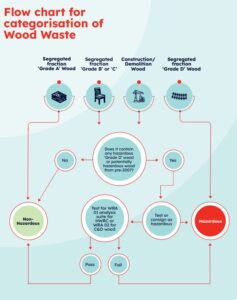
Biffa, 2023
How Marchwood can help
Marchwood is one of only three WRA member laboratories who offer both the WRA01 and WRA02 test suites. Our analytical suites, including heavy metals and wood treatment chemicals analysis, are UKAS accredited to ensure reliable, accurate results.
Please contact me, Ben Rowe, Business Development Manager at Marchwood, for a quotation at ben.rowe@marchwood-scientific.co.uk.