



Unveiling regional soil nutrient trends: data insights across Yorkshire and the South East

NRM
Agriculture
Local and regional soil variations play a crucial role in shaping crop agronomy and nutrient management strategies. Differences in soil texture, structure, pH, organic matter content, and nutrient availability directly affect crop growth, influencing water retention, aeration, and the ability of roots to access nutrients.
These variations also affect how farmers tailor agronomic practices, such as fertiliser rates, timing, and the choice of soil amendments. Local soil conditions influence the availability of nutrients like phosphorus, which may become less accessible in high-pH soils, or potassium, which is lost in sandy soils under heavy rainfall.
Therefore, understanding and managing these variations is essential to optimise nutrient use efficiency, maximise yields, and minimise environmental impacts such as runoff and leaching. Soil testing and region-specific recommendations are vital tools for addressing these differences and supporting sustainable agricultural practices.
NRM: delivering annual soil insights since 1995
NRM creates a soil summary report every year to help farmers improve soil health and optimise crop production. This annual summary is supplemented by an interactive map, allowing farmers and advisers to view detailed regional and county-level data on soil nutrients such as phosphorus, potassium, magnesium, and pH. The data is segmented by arable and grassland usage and is summarised according to the latest RB209 recommendations on nutrient management.
The interactive soil map facilitates benchmarking by enabling users to compare their soil nutrient profiles against regional averages, supporting better decision-making for farm management. It consolidates anonymised data collected from thousands of soil samples taken across the UK, making it a valuable resource for improving productivity and sustainability in farming practices.
Click here to take a look at our interactive soil map.
Figure 1: Interactive soil summary map of the UK 2023-24

Insights from regional soil pH and nutrient variations
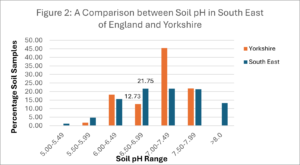
The bar chart in figure 2 shows the soil pH distributions for arable soils in Yorkshire and the South East of England. It categorises soils into pH ranges, highlighting regional differences likely to be influenced by climate, soil management, and geology.
The recommended pH for most arable crops is between 6.5 to 7.
Our data shows that the soil in the South East has greater pH variability than in Yorkshire. It also shows that much higher percentage of soils, approximately 21.75% of those from the South East, fall within this range, compared to 12.73% in Yorkshire.
What is causing these marked pH differences?
The soil pH differences seen between these regions can be partly attributed to their underlying geology, particularly the presence or absence of limestone. Yorkshire’s soils are heavily influenced by limestone-rich bedrock. Limestone contains calcium carbonate, a natural buffer against soil acidity, which explains the higher prevalence of neutral to slightly alkaline soils (pH 6.5–7.99) observed in the region.
In contrast, the soils in the South East are typically derived from more varied parent materials, including sandstone and clay, which are naturally more acidic. While there are pockets of calcareous soils in the chalk regions, much of the arable land in this region is more susceptible to leaching due to lighter soil texture, particularly in areas with high winter rainfall. This contributes to the higher proportion of acidic soils (pH < 6.5) in the South East, requiring regular liming to neutralise acidity and maintain productivity.
The interplay of geology, climate, and land management underscores the importance of tailoring soil management practices to regional conditions to optimise soil health and agricultural output.
Large regional soil variation in phosphorus levels
The graph in figure 3 compares soil phosphorus levels in Yorkshire and the South East of England. The data here reveals significant regional differences in nutrient distribution, influenced by geological factors, land management, crop and nutrient management practices.
Yorkshire soils predominantly fall into Index 2, with over 52% of soils in this range. This suggests that the available phosphorus levels are generally lower in Yorkshire, potentially due to the region’s higher soil pH. This can be explained as a result of chalky boulder soils reducing soil phosphorus availability, as the nutrient becomes locked up with calcium and less accessible to crops.
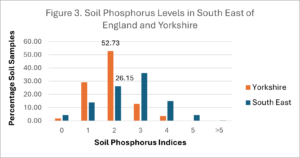
In contrast, soils in the South East show a broader spread across phosphorus indices, with 36% of soils in Index 3 and a notable proportion in higher indices (4 and 5). This likely reflects more frequent fertiliser use, probably driven by the need to support high-value cropping systems.
These trends emphasise the need for region ad site-specific nutrient management strategies. Yorkshire may require targeted phosphorus replenishment through fertilisers or manures, while the South East must balance nutrient supply with environmental considerations, such as preventing runoff and eutrophication risks.
A high proportion of soils meet target potassium levels
A significant proportion of soils in both regions meet the recommended potassium level (Index 2-), with 40% in Yorkshire and 31.74% in the South East. Yorkshire shows a slightly greater proportion of soils at this optimal level, as heavier clay soils with potassium-retaining properties are commonly found in the region. The South East, while maintaining a substantial proportion within this range, also exhibits higher variability in potassium levels, influenced by differences in soil texture and cropping systems.
Soils below the recommended levels (Indices 0 and 1) are slightly higher in the South East, with 21% of soils in Index 1. This indicates that potassium depletion may be a concern in the region, likely due to light textured sandy soils that are prone to leaching during wetter winters. Additionally, the higher potassium crop offtake exacerbates nutrient depletion in light textured soils. In comparison, Yorkshire soils demonstrate lower proportions in these categories, most likely because they benefit from heavy textured soils that retain potassium more effectively.
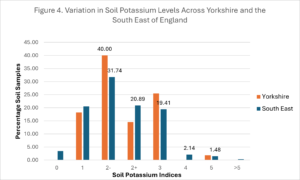
Soils exceeding the recommended potassium levels (Indices 2+, 3, and above) are slightly more prevalent in the South East, possibly due to a higher proportion of farmers switching to regenerative farming practices, leaving a higher proportion of crop residue in the field. It could also be due to high-value crops grown in arable rotations with typically higher nutrient applications or due to more samples originating from fields with higher proportion of clay soils with more available potassium.
These regional differences underscore the importance of tailored potassium management strategies. Farmers in the South East should focus on regular monitoring and replenishment of potassium, particularly on lighter soils, to avoid deficiencies. Meanwhile, in Yorkshire, the priority should be maintaining optimal potassium levels and avoiding excessive applications to prevent nutrient imbalances. These insights are crucial for optimising crop productivity while safeguarding soil health and minimising environmental impacts.
How NRM can help
Both our soil summary for 2023-2024 and our updated interactive map emphasise the importance of region/site-specific recommendations to optimise nutrient use efficiency, maximise yields, and minimise environmental impacts such as nutrient runoff and leaching. By utilising these tools alongside our soil and crop analyses, farmers can make informed decisions to address these variations, ensuring both sustainable agricultural practices and improved crop performance. This tailored approach is vital for meeting modern agronomic challenges while safeguarding soil health for future generations.
For more information on our services, contact us.
Visit NRM