


The power of zoo poo: testing waste for biomass from Marwell Zoo

Marchwood
Environment
Biomass is a renewable, low carbon fuel that brings a variety of environmental and social benefits. When compared with fossil fuels, it can deliver a significant reduction in net carbon emissions—and the best news is, it’s widely available.
Biomass is usually obtained from organic matter including agrarian leftovers, animal waste residues, industrial waste, forestry crops and residues, and industrial solid waste. The majority is gathered from wood and animal waste, making organisations like farms and zoos a fantastic source of readily available energy from waste.
Read on to find out more about the benefits of using biomass for energy, why it’s important to test biomass, and a case study of biomass analysis services undertaken by Marchwood for Marwell Zoo.
What are the benefits of using biomass for energy?
Net zero and sustainable business practices are at the forefront of environmental policy in the UK and beyond. Looking for sustainable, eco-friendly energy sources that can be easily obtained is an effective way to reduce reliance on fossil fuels and lower carbon emissions.
While biomass fuels are usually required in higher quantities to generate as much energy as fossil fuels, they produce a fraction of the carbon emissions. As biomass can be sourced locally and indefinitely, needing higher quantities does not pose a problem, and its supply is much more secure. In fact, all regions within the UK can produce biomass, which not only creates local business opportunities and supports the rural economy but minimises transport and environmental costs. There’s also an economic incentive to manage woodland if businesses choose to utilise wood as biomass, which helps to improve biodiversity.
Additionally, if biomass residues, co-products and waste are not used, they will usually rot. Not only will this generate CO2, negating the advantage of using biomass over fossil fuels in the first place, but it may also produce methane (CH4), a greenhouse gas 21 times more potent than CO2.
Ultimately, biomass is a readily available, lower-cost, eco-friendly solution that should be used to help achieve a more sustainable future. For organisations like zoos, it’s also an effective, cheaper way of disposing the animal waste that would have to be dealt with either way.
Why is it important to test biomass?
Not all biomass is created equal. Laboratories like Marchwood conduct analysis services to test the usability of these fuels, helping organisations identify sources of green energy from their daily operations. Testing allows them to be certain how much energy can be generated from the biomass for more effective and efficient eco-friendly practices. This allows an industry, which ultimately focusses on protecting wildlife, to develop in a sustainable and practical way.
Biomass testing is also required to check the fuel’s specification and composition to ensure high quality and efficacy. Additionally, when biofuels are stored in large quantities for a long time, they can spontaneously ignite, or sometimes even explode. Testing, as well as ensuring the effective and safe storage of biofuels, enables organisations to adhere to safety requirements and analyse any risks.
Marwell Zoo: a wild way to generate energy from waste
Until 2021, 600 tonnes of animal waste were swept up and taken off site to be composted every year at Marwell Zoo in Winchester. Not only did this incur significant transport and disposal costs, but also released the equivalent of 220 tonnes of CO2 every year. As part of its ISO14001 certified Environmental Management System, Marwell Zoo identified a strategy for sustainable improvement for implementation before the 2023 carbon neutral target.
Marwell contacted Marchwood to request animal biomass analysis to determine its effectiveness as fuel to support its plans to introduce a biomass heating system. The laboratory tested soiled hay and straw-based bedding from all the zoo’s animal enclosures to establish the samples’ percentage moisture/dry matter content. Once the dried samples were milled and prepared, the team tested them as products of combustion, and then determined their energy potential (calorific value in KJ/kg) by bomb calorimetry. The samples that had lower moisture content and higher energy capacity were deemed to provide the most efficient fuel sources for the biomass heater.
Marchwood found that giraffe and rhino waste produced the highest calorific value. However, as the rhinos’ bedding had a higher moisture content, it was concluded that giraffe waste provided the most energy efficient biomass as it contained the highest levels of dry matter. This helped Marwell Zoo prioritise the most efficient samples for producing biomass and calculate how much is required to power their buildings.
Results
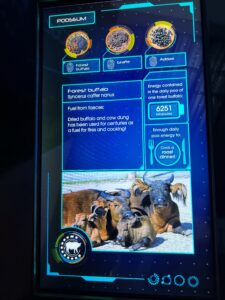
As a result of Marchwood’s moisture and calorific value testing services, Marwell Zoo became the first organisation in the UK—and likely the world—to generate renewable energy using animal waste. Each morning, the keepers sweep up the waste from the paddocks and enclosures for a mini refuse truck to collect it and transport it to the zoo’s Energy Centre. The combination of manure and bedding is transferred to a shredder for mixing, which is then dried and pressed into biomass briquettes. These generate low carbon heat in a purpose-built biomass heating system. Ash produced from combustion is added to the zoo’s compost process and returned to the land.
The generated biomass not only provides heating to Marwell House and the staff quarters, but also maintains tropical conditions in the Energy For Life Tropical House. This is home to a plethora of bird and plant species which are currently threatened by the effects of global warming in the wild, and an interactive exhibit of Marwell’s energy from waste process.
Marchwood’s analysis services have also contributed to Marwell’s goal of becoming a carbon neutral organisation by 2023, as converting waste from its own animals into biofuel has hugely reduced their carbon footprint. These services have also resulted in a reduction of the cost of waste disposal of soiled animal bedding in the medium-to-long-term.
Marchwood’s biomass testing services can help zoos and wildlife parks in the British and Irish Association of Zoos and Aquariums (BIAZA) to reflect Marwell’s success in minimising their impact on the environment and significantly reducing long-term costs. Marchwood have since worked with other UK zoos to deliver the same service, and hope to join BIAZA as an associate member in 2023, to reach the wider zoo and animal park market.
For more information or to book your tests now, contact us.
Resources
https://www.marwell.org.uk/zoo-news/our-world-first-initiative-harnesses-the-power-of-poo/