


The importance of routine analysis for decision-making in agriculture

NRM
Agriculture
Soil, crop, manure and slurry, and grain analyses are the key to optimising crop nutrition. Most importantly, understanding what’s in your soil through routine analysis and taking informed steps to improve practices is vital to help drive soil health, nutrient availability, and crop performance.
Read on to find out more about the importance of routine analysis for decision-making in agriculture, how analysis can help farmers comply with environmental schemes, some top tips and best practices for taking soil samples to help manage nutrients, and how NRM can help.
Why is routine analysis a critical tool for decision-making?
Routine analysis is vital for all farming businesses committed to operating sustainably, both from an agronomical and financial standpoint.
It’s widely accepted that economically sustainable farm businesses tend to manage their land in a way that integrates natural processes. These businesses acknowledge that working with the natural environment offers far greater benefits than attempting to control or dominate its resources. Soil analysis is a fantastic way to assess the soil’s ability to support crops while ensuring its long-term functionality for future generations. Routine analysis is the vital first step towards maintaining this functionality and preventing degradation.
Typically, standard soil analysis (pH, P, K and Mg) is conducted on farms every 3 to 5 years, although some opt for annual testing on a rotational basis. Rotational sampling is particularly advantageous because nutritional imbalances can be detected and remedied much sooner, spreading cashflow instead of sampling the entire farm once every five years.
This approach also gives farmers the opportunity and time to conduct a deeper investigation into soil health on other parts of the farm. Examining soil organic matter (SOM) content, soil organic carbon (SOC) levels and biological activity provides key insights into soil health, directly influencing crop performance. High SOM and SOC levels generally enhance soil structure, water retention, and nutrient availability, promoting better crop growth. On the other hand, low levels of SOM and SOC can signal degradation, poor fertility, and reduced microbial activity, all of which are likely to impact crop production.
Enhancing the soil environment to increase biological indicators such as microbial populations and earthworms is essential as they promote nutrient cycling and increase soil aeration and overall functionality. Reduced levels of SOM and SOC suggest a change in management practice should be considered, such as increased additions of organic matter, minimal tillage, or introducing more crop biodiversity. This type of knowledge, therefore, empowers farmers to make decisions to help restore some aspects of soil health and provides a crucial benchmark for measuring change over time.
Whilst farmers should regularly measure SOM and SOC content as part of good agricultural practice to improve their systems, benchmarking levels can provide extra benefits, such as being a prerequisite for entering carbon offsetting schemes. Some actions within the Sustainable Farming Incentive (SFI) scheme also require SOM measurements, offering farmers further incentives to track and improve soil health.
Soil analysis is also necessary in establishing specific crop nutrient requirements. The UK’s national recommendation system, RB209, relies on analytical data that describes the status of nutrients such as phosphate, potash and magnesium in the soil. The RB209 system categorises nutrient concentrations using a soil index that has been in place for over 50 years, allowing us to determine the crop’s nutrient requirement based on soil nutrient concentration. This helps ensure optimal crop yield and quality.
Without this index system and the routine analysis, it relies on, we risk all sorts of inefficiencies creeping into our food system.
The importance of routine analysis for environmental schemes
The introduction of government schemes, such as the Sustainable Farming Scheme (SFI) in England, has offered additional encouragement for farmers to engage in more comprehensive soil analysis and better manage farmland. Similar initiatives will be introduced in Wales but currently the Welsh government offers subsidised soil analysis through Farming Connect, and in Scotland, soil analysis is encouraged by government incentives (Preparing for Sustainable Farming) as they move away from the EU Basic Payment Scheme (BPS).
The financial incentives these schemes offer make it easier than ever for farmers to transition toward sustainable farming. All these schemes promote the better use of organic inputs to help reduce the reliance on inorganic fertilisers which, in turn, reduces the carbon intensity and footprint of food production.
Top tips: taking soil samples for effective analysis
The importance of agricultural analysis is far-reaching for our farms. However, if the correct steps are not taken when sampling for analysis, then quality analytical data will not be produced.
Here are our top tips for taking the very best samples for quality results.
- Timing: sample at the same time of year at the same time in the rotation when soils are still warm and moist.
- Autumn or Spring are ideal times, but if sampling in Spring, ensure that soil temperatures have increased sufficiently.
- Delay sampling by 6 to 8 weeks if organic manures have been applied to land.
- Frequency: sample once in every 3rd or 5th year, or rotationally sample 25% of the land each year.
- Prioritise new or underperforming land where nutrient status is unknown.
- Send samples to the lab as soon as possible. This will help you maintain the quality of the sample.
Best practices for taking soil samples
- Know the correct sampling depth. For example, for standard soil analysis:
- Arable soils: sample at 15cm (or 23cm if minimum cultivations)
- Grassland soils: sample at 7.5cm (or 15cm if reseeded or short-term leys under 5 years)
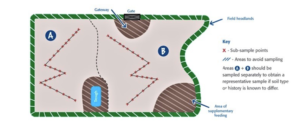
- Walk in a W or M pattern across the field, taking at least 20 individual soil cores.
- Avoid sampling unrepresentative field areas, such as headlands and field gateways, or areas near water troughs, where livestock may congregate.
- Sample larger fields separately: for fields larger than 4 hectares (~10 acres), take more than one sample. If areas within fields have different characteristics such as soil texture or management history, sample those areas separately.
- Mix and sub-sample: after taking 20 cores, mix the soil thoroughly in a clean bucket and sub-sample approximately 300 grams for laboratory analysis.
Including adequate information with your samples
It is crucial to ensure that the information on the laboratory paperwork accurately matches the details on the sample bags. Providing detailed agronomic information about previous crops, straw management, and current conditions ensures laboratories can offer precise nutrient recommendations based on the analysis. The more agronomic information submitted with the sample, the better the interpretation of the result.
For example, when booking your analysis with NRM, please ensure you clearly list the following information with your samples:
- Client code: your unique code with one letter followed by 3 numbers. This tells us who the samples belong to and where to send the results.
You receive a client code when you make an account with us. If you are already a customer and aren’t sure of your client code, you can find it on any communication you have had with us, such as old reports or quotes.
- The analysis required: either a quote reference (if we have sent you a quote regarding this analysis), package/analysis code (you can find this on old correspondence from us if you have ordered this analysis before), or a list of tests required.
It would be most useful to specify the analysis code (if known), e.g. “A001 standard soil” or “standard soil + organic matter” instead of simply “soil analysis”.
If you aren’t sure which tests you require, our Customer Services team is happy to help.
- Your sample references: please make sure you give each sample a name or other identifying reference, so it is clear which result belongs to each sample. This also confirms what you have sent and what we have received (e.g. “top field”, “old heap”, “34678”, etc).
- Additional information you want on the report: e.g. your client’s name & address, any job number, site reference, etc.
- Purchase Order (PO) number: the unique number that confirms legal intent of purchase. Required if you need this to appear on the advice note (the breakdown of testing that accompanies the invoice).
These simple but important checks will help prevent delays in analysis.
How NRM can help
As the UK’s largest provider of agronomic analytical services, we offer reliable, accurate analysis to help farmers and advisors make informed decisions. Get in touch today or speak to your agronomist.
Visit NRM