



The end of “averages”? How growers can make significant gains with soil carbon analysis

NRM
Agriculture
Average figures are incredibly helpful in giving farmers and advisors a general idea that they are moving in the right direction in predicting crop requirements. However, when you drill down to individual farms and regions, it’s clear that our soils have far greater variability in terms of structure, nutrient availability, and utilisation—meaning we need to take a more case-by-case approach. It’s easy to take steps towards significant gains with soil carbon analysis.
NRM’s five-year study of nearly 500,000 soil samples from the UK shows that there are five key areas where growers could make significant gains:
- Soil carbon
- Grain nutrient offtakes
- Nutrient utilisation in the face of unpredictable weather conditions
- Soil pH
- Organic manure utilisation, including taking magnesium into account.
Today, we’re talking about soil carbon.
If you haven’t read our introductory blog to this series discussing the importance of laboratory analysis and adapting sustainable practices, click here.
Otherwise, read on to find out more about the importance of benchmarking and raising soil carbon levels, and how NRM’s CarbonCheck analysis service can help you optimise crop production and make improvements to your practices year-on-year.
Benchmarking and raising soil carbon levels to help make significant gains
Measuring carbon levels is a fantastic indicator of the overall organic matter levels in soils. There are lots of benefits to raising organic matter levels, such as higher resilience to rapidly changing weather conditions by increasing soil water holding capacity, aeration, and soil microbial activity.
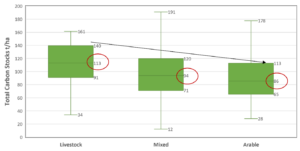
Generally speaking, we’re seeing arable land containing 24% less soil carbon than that used for livestock, but within all soils there is tremendous variation.
Our CarbonCheck service measures soil carbon levels as well as organic matter analysis. In arable soils, CarbonCheck shows a range of 28-178t/ha for total carbon stock measured at a depth of 30cm, with the median being 86t/ha. For livestock, this is about 113t/ha, and for horticultural soils it’s 122t/ha.
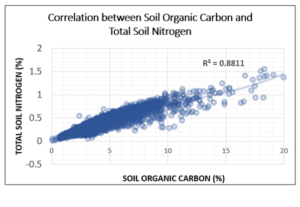
So, if you’re growing crops on land in the lower range on that scale, you’ll be struggling. In fact, soil carbon level correlates highly with soil nitrogen content, meaning high carbon soils are likely to require less inorganic N. They will also process any N that is applied more effectively due to the greater activity of their soil bacteria.
Medium to heavy soils tend to have greater soil carbon content than lighter soils. Whilst a lot can be done to raise levels, this tends to be a long-term project.
Using farmyard manure (FYM) and other organic materials can do much to help, as can reducing the number of cultivations, disturbing the soil less and avoiding soil compaction. There’s a strong relationship between carbon content and the bulk density of soils, too. The higher the carbon level, the lower the bulk density of the soil, and the better protection this gives against compaction.
Soils with low carbon content tend to compact more which damages their structure, makes them less water retentive, and starves plant roots of oxygen. But you need to know where your fields sit on the soil carbon spectrum. Trying to farm in a manner based on an assumed high carbon content when this is actually significantly less can not only reduce productivity, but damage soils and long-term sustainability too.
How NRM can help
NRM is the UK’s largest agronomic analysis independent provider of agronomic and environmental waste analysis for land-based industries. Contact us today or speak to your advisor to book in any of our analytical services to help you optimise crop production and improve soil health.
The other 4 key areas where growers can make significant gains will be discussed in future blogs in this series, which will be posted soon.
This is an updated version of an article published in Crop Production Magazine in March 2023.
Visit NRM