



Sulphur nutrition: the hidden key to crop success?

NRM
Agriculture
Insights from the “Optimising sulphur nutrition” webinar
Sulphur is often overlooked in crop nutrition, but experts at NRM and Rothamsted Research emphasised its vital role in maximising yield and quality during our recent webinar, “Optimising sulphur nutrition to maximise yield and quality”.
For those who missed the live session, you can watch the full webinar recording here. If you want an even deeper dive into sulphur nutrition, as well as valuable scientific insights, analysis of data from 7,000 field samples gathered over 3 years, and practical strategies for managing sulphur effectively in UK soils, read on.
Sulphur nutrition: is sulphur the second most important nutrient?
According to Professor Steve McGrath from Rothamsted Research, sulphur is no longer a secondary consideration: it is the second most critical nutrient after nitrogen.
While nitrogen remains the primary nutrient for plant growth, sulphur is essential for protein synthesis, chlorophyll formation, nitrate uptake efficiency, and, therefore, nitrogen utilisation efficiency. Without sufficient sulphur—in particular, sulphate—crops cannot fully utilise nitrogen, leading to wasted fertiliser inputs and reduced yields.
Why is sulphur deficiency increasing?
One of the major findings shared in the webinar is that sulphur deficiency in UK soils is becoming widespread. Historically, sulphur was deposited naturally via atmospheric emissions from industrial activity. However, clean air policies have significantly reduced sulphur deposition, leaving soils reliant on fertiliser applications.
However, as highlighted in the webinar’s Q&A, it seems that many farmers may not realise that manure applications are not delivering the amount of available sulphur their crops need for the whole season. Additionally, farmers don’t always get offered or purchase fertiliser products containing sulphur, particularly if they are more expensive, leading to further deficiencies.
Sulphate in particular is the central factor in ensuring crop nutrition, as this is the form of sulphur that is available for crops to take up. Plants cannot take up elemental sulphur, as it needs to be oxidised in the soil to be available to the crop. Failing to make sure that the correct levels of sulphate are available during crop growth specifically could hinder yields and quality.
Sulphate is also highly mobile in soil, meaning it can be leached away by heavy rainfall before crops can absorb it. This makes regular soil testing and targeted applications of sulphate-based fertilisers essential to avoid limitation on crop yields at the end of the season.
Diagnosing sulphur deficiency across different crops: Rothamsted trials
Professor McGrath highlighted the clear visual symptoms of sulphur deficiency, including pale yellowing in younger leaves (unlike nitrogen deficiency, which affects older leaves first). However, not all deficiencies are immediately visible, so tissue analysis and soil testing are crucial for accurate diagnosis.
Rothamsted sulphur trials: Broadbalk experiment
Broadbalk is the longest running scientific experiment in the world. It shows that it is possible to maintain or increase yields of wheat over nearly 200 years by testing the effects of different inputs on winter wheat yields.
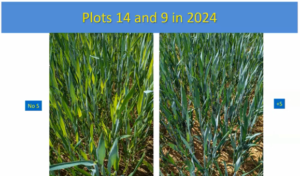
Below shows two of Rothamsted’s plots, which are a part of this experiment. Plot 14 on left hand side has received no sulphur since 2000, whilst plot 9 on the right has received sulphur, as well as the same amount of the other key nutrients (nitrogen, phosphorus and potassium) as 14.
As you can see, plot 14 shows sulphur deficiency through the light green top leaves, whilst plot 9 shows much darker leaves. Visual symptoms can clearly be apparent, and can, in the end, lead to big differences in growth.
With sulphur, plot 9 saw a mean yield increase over 16 years of 0.62 t/ha. This clearly shows the importance of sufficient sulphur availability in bolstering crop yield.
For more insights into trials and data analysis, you can watch a recording of the webinar here.
Different crops, different needs
The webinar also covered the varying sulphur requirements for different crops, including:
- Cereals: require regular applications, with deficiency leading to poor nitrogen uptake and lower grain quality.
- Winter wheat: between 25 and 50kg of SO3/ha in early Spring up to stem extension.
- Oilseed Rape (OSR): has one of the highest sulphur demands, and trials show significant yield improvements with adequate sulphur at 50-75 kg SO3/ha.
- Grassland: requires 16kg of SO3/ha per cut, but uptake is often underestimated. Many farmers assume organic manure provides enough sulphur, but research shows it is often insufficient. It’s also important to note that this recommendation is per cut, so, for example, if grass is cut twice, growers will need to apply 32kg of SO3.

NRM data confirms widespread sulphur deficiency
Dr Sajjad Awan, Soil & Crop Nutrition Agronomist at NRM, shared the lab’s data compiled of 7,000 field samples collected between 2021 and 2023.
Analysis of this data revealed that:
- Nearly 85% of tested soils had low available sulphur levels
- Plant tissue analysis (CropCheck) showed that even high nitrogen levels did not always translate to higher yields—suggesting sulphur deficiency could be limiting nitrogen efficiency
- Grain analysis (GrainCheck) indicated that over 40% of samples were sulphur-deficient, confirming sulphur’s role in overall crop nutrient balance.
For a deeper dive into this analysis, including trends, correlations, and how we should be utilising laboratory analysis to adjust nutrition plans for optimal crop production, you can watch a recording of the webinar here.
Sulphur nutrition in response to climate variability
Dr Awan also stressed that climate variability requires a more adaptive approach to sulphur fertilisation. For example, in years that we have dry Spring seasons, fertiliser may not be absorbed effectively into the soil, reducing sulphur availability.
On the other hand, in wet, cold Springs (like we’ve had recently), excess rain can leach sulphur from the soil, depriving crops at critical growth stages.
What’s the solution?
Both Dr Awan and Professor McGrath recommend analysing all year round with soil, tissue, and grain analysis to track sulphur levels, diagnose deficiencies, and adjust fertilisation plans accordingly. This will all help growers optimise crop production.
Practical recommendations: managing sulphur nutrition for optimal crop yield
Knowing that sulphur deficiencies are widespread throughout the UK, what do our experts suggest farmers do to improve their soils?
- Annual sulphur applications are necessary due to sulphate’s high mobility in soil, as well as extreme or unexpected weather conditions that can make sulphur less available to crops
- Ensure fertilisers provide sufficient levels of sulphate, the form of sulphur that is available for crops to take up
- Combine nitrogen and sulphur applications to ensure nitrogen is properly utilised by the crop
- Analyse all year round with soil, plant tissue (CropCheck), and grain (GrainCheck) analysis to help provide a complete picture of sulphur status and soil health
- Consider application timing. Splitting applications or adjusting them based on weather conditions can prevent nutrient losses.
How NRM can help
Our “Optimising sulphur nutrition” webinar reinforced that sulphur is an essential yet often neglected nutrient. With decreased atmospheric inputs and changing weather patterns, it is more important than ever to take a data-driven approach to sulphur management.
By prioritising routine testing and precise sulphur applications, growers can optimise nutrient availability, improve nitrogen use efficiency, and ultimately enhance crop yields and quality. Contact NRM for more information on all our analytical services.
Missed the webinar? Watch the full recording here.
For more insights and guidance on nutrient management, you can read our sulphur webinar Q&A blogs.
Click here for the questions answered in the webinar.
Check here for the unanswered questions here.
Visit NRM