


Poultry Vaccination #2: a sharp new solution

Sci-Tech
Agriculture
Incorporating poultry vaccination into screening and disease prevention programmes is vital in controlling contagious diseases in flocks. It is also incredibly useful to be able to differentiate between vaccinal and wild strains of Salmonella with a vaccine differentiation test. It allows farmers to determine whether they can continue to trade or must get rid of the current batch and start over. This helps them save time and money, comply with the Lion Code, and safeguard public health.
Salmonella vaccination is a requirement for poultry farmers. All eggs sold in supermarkets must be stamped with the Lion Code to show that they have been produced to the highest possible standards. Successful mass application methods are very effective in helping poultry farmers maintain profitability and remain compliant. Preventing diseases from spreading throughout the flock also avoids a drop in production due to bird illness. It also means that farmers do not need to spend time and resources treating diseases before they become an issue.
In part 1 of this series, we looked at poultry vaccination methods, the types of poultry vaccines that are available, and the importance of clean drinking water when administering vaccines. Read on to learn about the poultry disease screening tests available, bacterial screening for Salmonella vaccines, and how Sci-Tech helps safeguard public and animal health with innovative vaccine differentiation tests.
What poultry disease screening tests are there?
Poultry disease screening tests in the laboratory are used to detect the presence of vaccinations or of the disease itself. The chosen technique all depends on the experience of the person looking after the birds.
A veterinary diagnostic laboratory like Sci-Tech typically carries out the following:
Haemagglutinin Inhibition (HI)
This low-cost test detects antigens. It is very useful for screening serum samples using a measurement of the inhibition of the serum, which agglutinates in the presence of specific antigens. Antigens that can be detected using this method include Newcastle Disease (ND), egg drop syndrome (EDS/76), avian paramyxovirus type 3, PMV3, and infectious bronchitis variants IBM41, IB793B, IBD274, IBD1466, IB755 (ITALIAN 02), and IBD388(QX). These variants need to be very specific to detect the responses to the known vaccine variants.
RSAT (Rapid Slide Agglutination Test)
This very fast test looks for an antigen reaction, resulting in an agglutination of the serum. It gives a clear positive or negative result for the presence of the antigen.
ELISA (Enzyme Linked Immune Sorbent Assay)
ELISA tests are used specifically for detecting antibodies or antigens of various diseases that are common in chickens. A blood sample is prepared and added to a plate, and is then coated with a specific antibody. As ELISA measures the antibody/antigen levels in a bird’s body, it gives us a good indication of its antibody response and therefore immunity.
However, ELISA is less specific than HI as it does not differentiate between the maternal antibody level and the immune response from the vaccine. It is still very useful when used in conjunction with routine screening of the flock.
PCR screening
As a key building block for life on earth, DNA (deoxyribonucleic acid) is present in all living organisms. Fundamental work on DNA by Crick and Watson in the 1950s enabled us to look at the structure and coding of life. Recent developments in technique since has led to the design of a PCR screening test that allows for the amplification of a specific DNA sequence. This detects the presence of the target virus or bacterium.
The selectivity of this method is due to specific primer sequences that bind to the DNA via the PCR process in the thermocycler. The DNA/RNA is extracted from the sample and is then split and replicated using repeated cycles to increase the numbers of target DNA present. This poultry disease screening test means that diseases are detected the laboratory completely accurately and reliably.
What is a Salmonella vaccine differentiation test?
A method for the detection of vaccine strains for the presence of Salmonella has recently been developed. Poultry farmers must implement a Salmonella vaccination programme to both protect the birds and limit the presence of Salmonella in the layer colonies. Strain tests are available to detect the presence of the vaccine and therefore determine if the vaccination process has been successful. There are two species that are particularly dangerous: Salmonella Enteritidis and Salmonella Typhimurium.
Sci-Tech’s Salmonella vaccine differentiation test is used to determine whether the strain of Enteritidis is vaccinal or wild. If no Salmonella is found, or the strain is vaccinal, then the farmer can continue to trade. If a wild strain is identified, then the farmer will have to get rid of the current batch and start over. So, a rapid test to differentiate between the strains is imperative to help farmers save time and money whilst safeguarding public health.
Sci-Tech is at the forefront of livestock diagnostic solutions for our customers in the UK. Our team used its extensive expertise in microbiological and serological testing services and culture of continuous improvement to successfully validate the Salmonella vaccine differentiation test using media from the vaccine manufacturer.
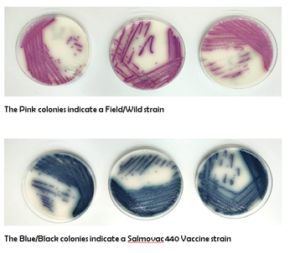
We used a mixture of Salmonella serotypes and known vaccine strains to enable clear differentiation between the presence of the Salmonella Enteritidis vaccine strain and a wild strain. The test detects the Salmonella Enteritidis vaccine using a chromogenic reaction. Any samples that have a positive Salmonella Enteritidis result can be further screened in the laboratory for differentiation. Results are available within 48 hours to allow action to be taken as quickly as possible if required.
The illustrations below indicate the reactions recorded by the laboratory.
Sci-Tech’s UKAS accredited microbiological and serological analysis services cover all aspects of poultry, livestock and gamebird production. To learn more about the Salmonella vaccination differentiation test, click here.
To send in your samples for testing, contact us here.
Visit Sci-Tech