


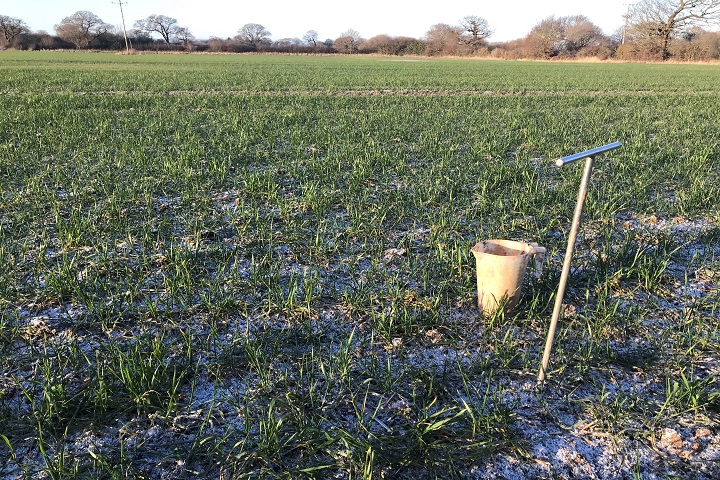
N-Check: it’s time to think about soil nitrogen

NRM
Agriculture
Yet again the time is nearly upon us, and I don’t mean Christmas (although that is also around the corner!). Very soon, we’ll need to start thinking about how we should manage nitrogen for the spring.
In recent weeks, we have seen unprecedented levels of rainfall in some regions of the UK. So much so, in fact, that land previously drilled with winter crops was flooded as fields were quickly up to and over field capacity. In some areas this resulted in very patchy crop establishment, whilst in others we saw the worst-case scenario of crops being washed away entirely.
Over winter rainfall can also have a major influence on the amount of spring-available soil nitrogen. After these extensive rainfall events, the only option is to measure what remains.
In terms of managing inputs economically and environmentally, our understanding of soil nitrogen supply (SNS) is always improved if we use laboratory analysis rather than rely on the field assessment method (FAM) in RB209. The FAM calculates the SNS index based on previous crop, soil type and rainfall. Whilst this is a good starting point, the index is based on typical regional rainfall values which might not be as typical to your crop and region this season. A large study looking into how well different methods of estimating SNS compare was funded by the AHDB back in 2012. It concluded that the FAM system only correctly predicted a crop’s SNS approximately a third of the time. This suggests that, for two thirds of the time, the FAM system is either over or underestimating what is available from the soil.
Whilst measuring the SNS isn’t a silver bullet, it’s a huge improvement on the FAM. This is because it is a physical measurement, and if done correctly, it provides much better insights in terms of how much nitrogen is really left in the soil after the autumn and winter period.
When we think about managing nitrogen, the end game is to maximise the amount a crop can recover in the season from all sources and convert that into yield. Whilst the recovery of nitrogen is dependent on many farm and weather factors during the crop’s life, using soil analysis to calculate a crops initial fertiliser need has many benefits. It also demonstrates the adoption of a sustainable tailored approach.
What affects soil nitrogen supply?
Rainfall is the most obvious weather event that affects SNS, but soil temperature throughout autumn and winter also has an impact on residual soil nitrogen content.
Autumn-sown crops that established well will grow right into the latter end of the year until air and soil temperatures begin to reduce: an indicator for plants to close down for winter. Soil processes also persist well into autumn, particularly where soil temperatures remain above 6-8oC.
Under milder autumn weather conditions, the soil biology continues to mineralise organic nitrogen into a plant available form, ready for uptake. However, if heavy rainfall coincides with poor crop establishment or lack of autumn crop cover, then the risk of nitrogen leaching increases.
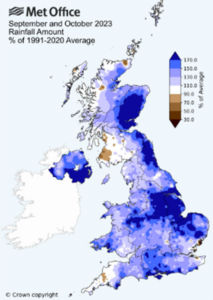
According to the MET Office, the UK provisionally documented its equal-sixth wettest October and eastern Scotland experienced its wettest October on record. Angus, Dundee, Fife, and Kincardineshire recorded their wettest October and Staffordshire, Nottinghamshire, the Isle of Wight, and the counties of Armagh and Down in Northern Ireland received well over twice the average rainfall for the month.
In summary, the overall UK totals were 131% of the average rainfall in September and 140% in October.
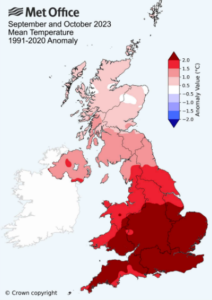
Temperature wise, in September we experienced well above average values, with anomalies of +2.5 to +3.5°C across England and Wales—the warmest on record. In fact, the UK experienced a heatwave in early September where we saw consecutive days hitting 30°C.
The balmy weather continued into October in England, whereas Scotland’s temperatures were near normal. Overall, the UK recorded temperature anomalies of 2.2°C in September and 1.0°C in October.
What does this mean for 2023 drilled crops ?
Due to the much milder temperatures, it is fair to surmise that soil nitrogen mineralisation is likely to have persisted during the autumn of 2023. And, unless autumn-sown crops managed to capture that nitrogen, a chunk would have been at risk of leaching, particularly in regions where rainfall in October was significant.
Autumn soil mineral nitrogen (SMN) and mineralised organic nitrogen is important and does aid crop establishment and increase green area index, and it’s the nitrogen captured in the autumn/winter crop biomass that we mustn’t overlook when assessing the SNS in spring. The SNS is a combination of the soil mineral nitrogen (crop available), an estimate of organic nitrogen likely to be mineralised and, importantly, the nitrogen contained in the biomass in spring.
These three SNS factors not only describe how large or small the SNS is likely to be in spring, but also where the nitrogen is. This is important in terms of nutrient management planning and decision making.
Lots of SMN may suggest delaying when the first fertiliser application is made. If a large proportion of the overall supply is organic nitrogen, it’s probably beneficial to adjust input rates planned for later in spring. If the majority of the SNS is made up of crop nitrogen and very little remains in the soil, then gauging when to make the first application depends on the crop’s canopy size. For example, a large oilseed rape canopy needs to be managed to its optimal size by delaying the first and maybe second applications. If all three SNS components are large, then happy days! Keep the fertiliser in the shed for another day.
The type of soil also determines how retentive and resistant it might be to over winter nitrate leaching, where more medium-to-heavy soils tend to hang onto soil residual nitrogen compared to lighter textured soils. The soil organic matter (SOM) content also indicates the overall size of the SNS: low SOM equals low nitrogen status, and high SOM, high nitrogen status. Soil organic matter content governs the size and drives the mineralisation engine which, in turn, determines the amount of crop available nitrogen. Building SOM has lots of advantages and benefits, one of which being a greater nitrogen supply, reducing the amount of nitrogen input required to grow optimal crop yields.
Once we have made it some way into the new year and the team at NRM has analysed enough samples, another soil nitrogen blog will be published! At that point we’ll share how the soil mineral nitrogen levels are shaping up: are they up, down, or similar to levels measured in spring 2023?
How NRM can help
Again, the picture looks highly variable in terms of residual nitrogen levels, so measurement is the only way to know for sure. NRM offers two SMN packages, N-Check and N-Check Plus, that can help you understand what remains in the soil next spring.
It’s time to get organised ahead of the sampling season. Click here to order your free sample kit, and click here to learn more about our N-Check services.
References
Microsoft Word – Seasonal Assessment – SepOct23.docx (metoffice.gov.uk)
Establishing best practice for estimation of Soil N Supply | AHDB
Want to be notified whenever we publish a new blog?
Give us your email address and click submit to sign up for notifications once a month.