


Measuring trace elements in grain: data analysis 2020-2024

NRM
Agriculture
Managing the nutrient demands of crops extends far beyond ensuring they recover adequate levels of major nutrients. Trace elements—micronutrients including zinc (Zn), iron (Fe), copper (Cu), boron (B), and manganese (Mn)—play an essential role in plant development, but the importance of measuring how much is taken up by the grain at harvest is often overlooked. Using other types of analysis, including tissue analysis to identify trace element deficiency up and following up with grain analysis can reveal how successful any earlier treatments were. This analytically connected approach can ultimately help farmers adjust how they manage future crops to ensure they capture the optimal levels of nutrition for healthy growth.
Today, we are exploring trace element content measured in grain from 2020 to 2024, delving into factors affecting their uptake, and offering guidance to improve crop nutrition and yield.
Trace elements in grain: challenges in measuring response
Tracking a crop’s economic response to trace elements is challenging, often due to agronomic variations within and between seasons, as well as the magnitude of the response. Field trials designed to test trace element yield responses sometimes struggle to detect significant differences, due to the often small size of the response. The typical ‘least significant differences (LSD)’ in yield from conventional plot experiments are typically 0.3 to 0.5 t/ha, whilst the cost of applying trace elements can be recovered by a yield response of less than 0.1 t/ha, which is very difficult to detect in experiments.
As a result, economically viable trace element benefits often go unnoticed or underreported as experiments often fail to detect economic yield responses to treatments. Click here to view the ADAS report funded by AHDB on trace element nutrition and crop response for a detailed review.
Why availability of trace elements in soil may be limiting grain content at harvest
We know that the availability of trace elements is significantly affected by soil conditions. Specifically, the soil pH must be kept within a range that reduces the risk of the element being complexed within the soil matrix. Even when present in the soil, elements may not be accessible to the crop, resulting in a temporary or more permanent deficiency.
Some factors that affect trace element availability include:
- Very dry or waterlogged soils
- Impeded drainage
- Low soil temperature
- Soil compaction (reduced porosity)
- Root damage from pests
- Disease infection
- Suboptimal soil pH.
Maintaining an optimal pH range is critical for nutrient availability and an easy low-cost fix. The problem when pH levels stray too far from the ideal range is that trace elements can become chemically complexed, reducing their availability.
How to improve trace element availability for optimal wheat grain content
Liming is a simple management strategy that is often overlooked or postponed, but it can make the difference between producing a good and a bad-yielding crop. Correcting soil pH not only improves availability of major nutrients but also ensures trace elements remain soluble and accessible.
Grain analysis is a good indicator of how well your soil is functioning and can alert you to check the last time you took a sample. If any of your nutrients are low in the grain, then further investigation is warranted. Checking the soil nutrient status is good to rule out any imbalances in pH or other nutrients.
The chart below illustrates how the availability of nutrients changes across the pH range, with the thickness of the bar denoting the availability of the nutrient in the soil. For example, the chart indicates that boron (B) availability is reduced at high soil pH, potentially limiting crop performance. However, does this matter for all crops that might be grown in the rotation?
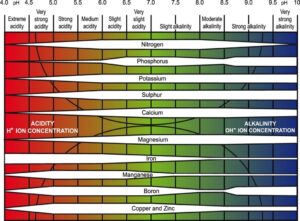
If a crop needs a specific trace element for its growth, and soil availablility is limited, then crop uptake and its assimilation into the grain is affected. On the flip side, an excess of some trace elements for some crops can cause toxicity issues. Therefore, knowing both the crop’s needs and the soil’s capacity to supply trace elements helps you avoid problems.
For example, boron’s availability varies seasonally, and deficiencies are more often observed in a dry summer following a cool, wet spring. This is particularly true if growing conditions improve rapidly after a dry period. B is also toxic to some plants, including cereals, at levels only a little above those required for optimal growth for crops such as oilseed rape. So, care must be taken to ensure that excessive amounts of B applied to correct potential deficiency in one crop do not present a potential toxicity risk to other crops in the rotation.
The following table illustrates the sensitivity of crops to the availability of trace elements in the soil. It is always helpful to be reminded of the essential nutrients that crops require, so you can ensure they are adequately supplied and that their availability is optimised, thereby avoiding potential issues.
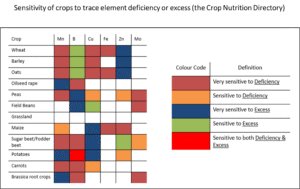
Redrawn – The Crop Nutrition Directory
NRM data analysis: trace elements in wheat grain
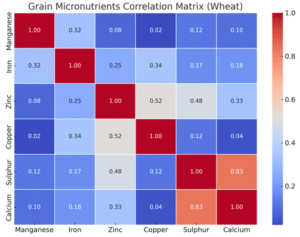
NRM analysed over 4,000 wheat grain samples from 2020 to 2024 and uncovered correlations between different nutrient concentrations in the grain. By applying the Pearson correlation coefficient, NRM has assessed the strength and direction of relationships between grain nutrient concentrations across paired datasets.
Key findings and interesting trends include:
- Strong positive correlations were observed between Zn, Fe and Cu. This suggests they share nutrient uptake pathways and high nutrient synchrony between the plant biomass and the grain, indicating good soil fertility and/or balanced nutrition.
- Grain sulphur also showed positive correlations between Zn, Fe and Cu, suggesting that trace element accumulations may be enhanced when sulphur is available to the crop.
- Calcium correlated strongly with S, but not other trace elements.
- Grain manganese exhibited minimal correlation with most other trace elements, apart from a fairly positive correlation with Fe. This suggests that its concentration is more affected by agronomic factors than nutrient synchrony, such as its chemical form in the soil, high organic matter content, soil microbial activity, or a puffy/unconsolidated seedbed.
The matrix table below summarises the strength of correlation between nutrient concentrations in wheat grain. Key points to note include:
- A value closest to 1 (or 100%) indicates a very strong positive relationship.
- Values closer to 0 suggest a weak correlation or the absence of one.
- Where negative correlations occur, minus values are calculated. This indicates that a nutrient concentration might be antagonistic and could be reduced in the presence of another, but in this dataset, the antagonistic relationships were not prominent within the observed grain nutrient concentrations.
Grain analysis for balanced crop nutrition
Aiming for balanced nutrition throughout the growing season is the intention of most growers. Unfortunately, the weather does have a habit of throwing curveballs, which can scupper our best-laid plans. Farmers can only control what they can control, so getting the basics right, including soil pH, structure, and organic matter, is crucial. Working with nature, not against it, and building resilience into our farming systems is crucial to support future harvests.
What farmers decide to do after harvest will influence what can be achieved going forward. Utilising grain analysis for the purpose of benchmarking nutrient levels, diagnosing trace element deficiencies, and informing future input strategies can help guide your management decisions, keeping you on track to achieve better and more profitable, sustainable outcomes.
How NRM can help
NRM’s GrainCheck and GrainCheck Plus services provide precise analysis of grain nutrient content, helping you make informed management decisions. Whether you’re addressing a specific deficiency or building a long-term nutrient strategy, grain analysis is a powerful tool.
Get in touch with your agronomist or contact us by clicking here to learn more about how GrainCheck can benefit you and your business.
References
A review of the non-NPKS nutrient requirements of UK cereals and oilseed rape | AHDB
Visit NRM