


Safety first: working with hydrofluoric acid in stacks analysis

Marchwood
Environment
Although hydrofluoric acid (HF) is classified as a relatively weak acid, it is the most dangerous chemical you will find at Marchwood. It is used in the extraction of samples for metals analysis in line with method BSEN 14385, helping to monitor the limits for stack emissions. Once extracted by HF, the samples are neutralised with boric acid and analysed on ICP/MS instrumentation.
Stack emissions are substances that are released from the smokestack after the incineration process and are a key source of air pollution. Air pollution has a devastating impact on people all around the world, resulting in ill health and even death.
Regulatory monitoring of stacks is a legal requirement for all industrial and power generation facilities, which are all provided with an environmental permit. This outlines the substances that need to be monitored and the limits that must be adhered to. HF is an important tool in stacks analysis, which helps these facilities demonstrate compliance and safeguard people and the environment.
Read on to find out more about hydrofluoric acid, its dangers, how to handle it safely in a laboratory setting, and its role in stacks analysis.
Hydrofluoric acid and its dangers
HF is the precursor to nearly all fluorine compounds, including pharmaceuticals. Regardless, it does not completely dissociate in water, resulting in its ‘weak’ classification. The acid is very effective in attacking silicates and oxides, enabling it to dissolve silicate minerals. Using a mix of acids allows for the silicates and salts to be dissolved, which is how HF can be used to extract samples and detect all metals of interest.
Weak HF is highly corrosive and a powerful contact poison, as seen in its ability to penetrate tissue. Poisoning can readily occur through exposure to the skin, eyes, or when inhaled or swallowed. It is corrosive on the surface as a result of the presence of Hydron ions (H+), and toxic at depth due to the deep penetration of the fluorine ions (F-).
HF decalcifies bones when it penetrates the skin. This leads to tissue necrosis which, in some circumstances, can result in amputation and even death. Even moderate exposure may rapidly progress to a fatal injury if not treated immediately. Symptoms of exposure may be delayed in some cases for several hours, so immediate medical attention is necessary even in the absence of any symptoms.
Handling hydrofluoric acid safely
As HF is classed as a hazardous substance, we must comply with the Control of Substances Hazardous to Health Regulations 2005 to have it on site. We follow stringent health and safety procedures at Marchwood for its handling and storage.
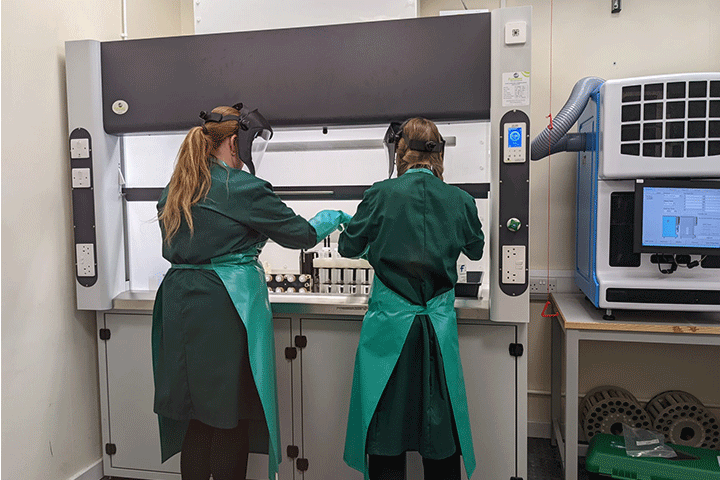
Our brand new, state-of-the-art laboratory includes an area dedicated to working with HF. Access to this area is controlled and limited to fully trained staff. This lab houses a water scrubbed fume cupboard for safe handling of HF, and a “buddy system” is always in place for when it is being used in analysis procedures. One fully trained, competent team member handles the HF, and another trained and competent team member observes for any potential drips, spills, or exposure.
If you or your colleagues are exposed to any HF, you must call 999 immediately, and tell the call handler that HF is involved. All local hospitals and fire stations are aware that HF is used on site in case of any accidents, so they will know what to do.
If you are splashed with HF, remove all contaminated clothing, shoes, undergarments, and jewelry immediately whilst they and you are hosed down with a Hexafluorine portable shower. Hexafluorine stops the penetration as well as the corrosive and toxic action. It can also be used on the skin and the eyes to help avoid long-lasting damage.
For a small splash, you need to apply calcium gluconate directly to the affected area within the first minute. This is used to ‘fix’ the fluorine, favour the regeneration of calcium, and reduce hypocalcemia, which occurs when you have too little calcium in the blood. The calcium also moderates the heart rate to reduce the risk of a heart attack.
If you have an accident due to concentrated HF exposure, you should:
- Wash the area with water within 15 minutes
- Apply calcium gluconate (IV and gel) to the area
One case of this type of accident led to hypocalcemia and ventricular fibrillation, 4 resuscitations, and resulted in 1 year of work loss. Stringent health and safety practices are so important when dealing with HF so avoid catastrophes such as this.
Marchwood’s expert stack emissions analysis services
Ultimately, working with HF should be undertaken by highly trained experts with specialist knowledge of the procedures in place to handle it. Marchwood, the UK’s leading air quality analysis business, has the expertise and operating processes to use HF safely and effectively. This provides companies with one convenient and comprehensive service for occupational hygiene and stack emissions services.
Marchwood has invested in high-end instrumentation to provide an industry-leading standard 7 working day turnaround on stack emissions analysis. Analysis for particulate matter, heavy metals, mercury, acidic vapours, ammonia, VOCs, PAHs, dioxins, furans, and PCBs, and brominated dioxins are available separately or as part of a comprehensive package.
For more information or to book in your samples, contact us.