


How to make the best use of manures this season #3: using slurry additives

NRM
Agriculture
For years, farmers throughout Europe have intentionally been acidifying slurries to improve its nutrient composition. In recent years, this has included adding biological amendments to slurry stores with the aim of changing both the composition and nutrient profile of the manure. These biological amendments are meant to make slurry more homogenous by breaking down the dry matter solids in it. This increases the liquid nature of the material and the availability of nutrients.
In countries such as Denmark, farming systems have existed for decades where acid is added to slurry storage to alter the chemical composition of nutrients into a more plant available form and to reduce the rate of gaseous losses. This adoption is mainly down to legislation, which restricts how much fertiliser can be used and how manures are applied on farm. Slurries that aren’t acidified have to be injected or rapidly incorporated after application, limiting farm business expansion. Many farmers have invested in this treatment to avoid these enforced restrictions.
In my previous two blogs, I touched on the nutrient content of manures and its variation in composition compared with standard values. It was clear that slurries can be incredibly variable. In this blog, I will review the impact of these amendments and how they work.
Slurry acidification
There is good evidence that adding acid amendments to slurry decreases the pH level, and it’s the pH reduction caused by the acid that affects characteristics such as the solubility and bio availability of nitrogen, phosphorus, trace elements and carbon. Gaseous emissions associated with slurry (i.e. methane and hydrogen sulphide) are also reported as mostly positively reduced by acidification.

From a crop perspective, the advantage of acidifying slurry is the maintenance of nitrogen in its NH4-N (ammonium-N) form for longer, particularly at application. The process of acidification lowering the pH of the slurry to between 4.5 and 6.8 (regarded range) reduces NH3-N (ammonia-N) emissions by 40-60% because the nitrogen is held in its NH4-N form and not all is converted to NH3-N. This leads to a more consistent nutrient supply reaching the crop and reduces the risk of unutilised nitrogen enriching unintended areas of the environment.
Studies have also reported phosphate availability increases to 85%, compared to 60%, and calcium availability increases to 80% compared to 8-22% for typical slurry.
The following table shows the impact of acidification on the nutrient content of pig slurry.
| Measurement | Control Slurry (g/kg DM) | Acidified Slurry (g/kg DM) |
| pH | 7.11 | 5.33 |
| Dry Matter (g/kg) | 91 | 83 |
| Volatile solids | 780 | 760 |
| Total inorganic carbon | 90 | 10 |
| Total P | 17.4 | 12.6 |
| Available P | 1.4 | 11 |
| Total S | 6.4 | 53 |
| Available S | 1.4 | 11 |
| Total Mg | 9.2 | 7.5 |
| Available Mg | 0.3 | 7.5 |
| Total Ca | 25.7 | 20.3 |
| Available Ca | 5.7 | 16 |
Adapted from Hjorth et al., 2015
Slurry can be acidified by a number of different additives, but sulphuric acid is the most common. An obvious issue is the handling and storage of a potentially dangerous and very corrosive substance on farm, and the required need for a closed automatic system for its safe use. This may explain, despite the many benefits, why not many farms in the UK have adopted the process.
The effects on crop productivity and the risk of pollution have also been tested in a number of experiments. In the majority of studies, crops receiving acidified slurry treatments increased their yield. However, in some studies, the risk of nitrate leaching also increased, particularly when applied at times where crop demand was low. Additionally, according to Fangueiro et al. (2015), the long-term impacts on soil health and quality are not currently well researched. Ongoing studies, conducted by Langley et al. (at Bangor University and funded by Defra), are looking into the impact of acidified slurry on crop and soil health. Click here to find out more about this study.
Other biological amendments
Biological substances such as biochar, a carbon rich substance that is produced when biomass is subjected to high temperature in an oxygen depleted environment, can also be added and is being investigated in a number of studies.
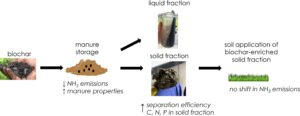
In a recent study conducted by Viaene J et al. (2023), biochar was added to cattle slurry during storage. It was found that NH3-N emissions reduced by 12%. They also combined biochar with a compound named clinoptilolite, a porous mineral with high absorbency and ion-exchange capacity, and elemental sulphur. This combined amendment decreased the emission further to 20%.
Critically, when the solid fraction of the slurry was applied, the nitrogen adsorbed by the biochar was not released, and the mineral nitrogen was not made crop available during the first 28 days. The researchers also found that the biochar-enriched solid fractions contained more carbon, total and organic N and water-available P, which was slowly released. Click here to read more.
The market is full of bacterial and enzyme-based additives that claim to break down the solids contained within livestock slurries when added to storage vessels. This makes the slurry freer flowing, homogenous, and more enriched with crop-available nutrients. Anecdotal evidence provided by many farmers who use these materials seem to support the benefits claimed and say they make a noticeable difference to nutrient availability that allows their businesses to reduce the reliance on carbon-rich, expensive, inorganic fertiliser. Using amended slurries instead is one way of helping growers decrease their overall carbon footprint. However, I have struggled to find any peer-reviewed scientific papers that independently quantify their benefit and describe their mode of action. If anyone can point me in the right direction, I would be most grateful and very interested.
The Innovative Farmers initiative run by the Soil Association funds a number of farmer-led trials on subjects proposed by farmers. A project currently underway is looking at the process of Bokashi and how it can affect the composition of livestock manures. Bokashi is the Japanese word for “well-fermented organic matter”. It is used as a manure treatment, where a liquid containing microorganisms is applied to animal bedding and dung. This breaks the manure down, increasing the crop-available nutrient content of the manure. It also purportedly improves animal welfare by creating drier bedding, reducing odour and fly populations.
It must be mentioned that there is little-to-zero published work to prove these claims. As part of an Innovative Farmers’ field lab, two farmers in Scotland are evaluating the potential benefits of Bokashi treated manures compared with untreated manures. Click here to follow their progress and learn how to get involved with Innovative Farmers field labs.
How NRM can help
If you are interested in using slurry amendments, measuring the nutrient content after treatment will be essential to understand the benefits. NRM offers a range of analytical services and can help you get the most out of your livestock and organic manures.
To understand more about how analysis can help, speak to your advisor or contact NRM direct. You can request sampling supplies on our website here.
References
Hjorth, M., Cocolo, G., Jonassen, K., Abildgaard, L. and Sommer, S.G. (2015). Continuous in-house acidification affecting animal slurry composition. Biosystem Engineering. 132, 56-60.
775 (2015) David Fangueiro, Sonia Surgy, Irene Fraga, Emesto Vasconcelos, Joao Countinho Acid treatment of animal slurries potential and limitations. International Fertiliser Society proceeding 775.
Current Research Projects at Henfaes | School of Natural Sciences | Bangor University
UK Biochar Research Centre | What is Biochar?
Viaene J, et al (2023) Biochar amendment to cattle slurry reduces NH3 emissions during storage without risk of higher NH3 emissions after soil application of the solid fraction. Waste Management, Volume 167, 15 July 2023, Pages 39-45 https://doi.org/10.1016/j.wasman.2023.05.023
Evaluating Bokashi Manure Treatment in housed cattle systems. (innovativefarmers.org)
Visit NRM