


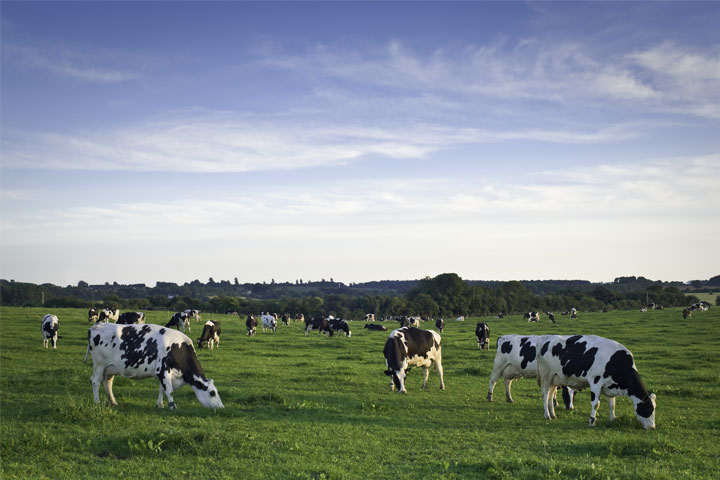
Does your grazing pasture contain all the trace elements needed for your livestock?

NRM
Agriculture
There is greater focus today on the trace elements required for crop and forage production, but the additional trace elements required for grazing livestock can be overlooked. Mineral supplements can cover a wide range of the necessary trace elements but how do we ensure the correct balance is being provided to our stock? A good way to check is to send grass and clover samples to be analysed and the two elements worth checking are Selenium (Se) and Cobalt (Co) as these are not essential for plant nutrition.
Selenium
Recognised as an essential trace element for cattle to ensure normal growth and fertility, Selenium forms part of a number of enzymes and other proteins in animal tissue, helping to prevent disorders such as mastitis and calf scours. Other signs of deficiency are reduced milk yields and poor fertility, along with premature and weak calves. In more severe cases, poor thriftiness and chronic diarrhoea can be seen as well as retention of winter coats. In younger animals, you may notice a stiff gait and the inability to stand up. When there is a deficiency of selenium, harmful free radicals are generated which damage muscle tissue, especially of the heart and limbs, leading to ‘White muscle disease’. Animals at the greatest risk are calving cows and young calves.
Selenium is found in all soils but at varying quantities, and availability is also restricted in acid soils, so keeping soil pH levels over 6 is important. Uptake of selenium is dependent on forage species as well as fertilizer applications and rainfall. To diagnose the risk of deficiencies, soil analysis is a poor guide, but laboratory analysis of forages and other feeds will highlight risks. Where symptoms in livestock are seen, blood tests should be taken by your vet.
When livestock consume selenium, it is only stored for a short time in the liver, so a continuous supply is necessary. Livestock requirements are very small but essential and should not be exceeded. Where forage is found to be low in selenium, it can be supplemented by adding it to fertilizers, which enables a consistent supply for livestock. There are other ways to supplement selenium and your vet will advise on the most suitable methods.
Cobalt
Sheep are more susceptible to cobalt deficiency than cattle, with symptoms including weepy eyes with damp matted wool below. Affected ewes are prone to produce small lambs. In both cattle and sheep symptoms include lack of appetite, lack of thrift and anaemia. Cattle can display rough pale coats, reduced milk production and scours. Infected cattle may attempt to eat bark, leaves and dirt.
Risks of cobalt deficiency are greatest on deep sand, gravelly sand or loamy sand soils, especially in high rainfall areas. Deficiencies usually occur in rapidly growing grass pastures with less than 20% clover as grasses contain about half the amount of cobalt found in clovers.
Lambs and calves are at greatest risk. Although colostrum provides cobalt early in life, as milk has low levels, they soon require supplementation in high-risk areas, so young animals should be treated with injectable vitamin B12 under veterinary advice. As young animals in high-risk areas are also susceptible to worm infestations, they should be grazed on clean worm free pastures
Again, testing soils is an unreliable method of assessing the risk of cobalt deficiency, however analysing forages will provide an indication of cobalt availability. Individual animals can also be blood tested if deficiency is suspected. To reduce the risk of deficiency and boost cobalt levels in the forage cobalt can be added to fertilizers. Other methods of control comprise the use of drenches and licks or, for longer term protection in older livestock, rumen bullets can be used.
To identify the risk of deficiencies, you can send forage samples to Sciantec for the Dietary Mineral suite of analysis which includes Cobalt and Selenium. Analysing all forages for both nutritional value and mineral content will allow deficiency risks to be identified and correct supplementation to be planned as part of an animal nutrition package in consultation with your vet or nutritionist. To order sample kits for forage testing, contact our friendly Customer Services Team on 01757 242400
Visit NRM