


CropCheck: insights from 3 years of tissue sample analysis on key crop nutrients in the UK

NRM
Agriculture
Environment
Crop nutrient requirements for wheat vary through the foundation, construction, and production growth phases. The nutrients needed during each phase are influenced by soil nutrient supply, weather patterns, soil conditions, and the farming system.
Tissue analysis helps to assess crop nutrient availability and uptake at each of these phases. Understanding this process ensures optimal plant growth and development by quickly identifying any sub-clinical deficiencies or excesses in nutrient supply. Knowing this information enables timely adjustments to nutrient management strategies, akin to a health check-up for plants!
CropCheck is NRM‘s innovative plant tissue analysis package for cereals that connects nutrient concentrations to critical growth stages that align with spring fertiliser applications. It provides insights into how your crop’s nutrient levels compare from the target at GS30 (pseudostem erect and ear at just 1cm) to GS37 (flag leaf just visible). This timely analysis allows you to tweak your fertiliser plans and better manage your nutrients, potentially saving you money and helping to protect the environment.
Insights from winter wheat tissue analysis
The availability of nutrients to crops is significantly influenced by key soil factors, including:
- pH
- Texture
- Organic matter content
- Soil structure
- Soil moisture levels.
All these factors can interact and affect both nutrient availability and the ability of plant roots to recover them. Other influences such as soil and air temperature, rainfall sunlight, wind, and all these in combination play a role in soil microbial activity and impact crop nutrient mineralisation and uptake. Managing these conditions can be a major challenge in terms of optimising soil nutrient supply, but attempting to do so is essential for maximising plant nutrition and promoting healthy crop growth.
Tissue nitrogen status between GS30 to GS37
Nitrogen has a significant role in controlling canopy size, as it influences shoot number, which is closely tied to canopy expansion. During the grain-filling stage, a significant proportion of the nitrogen stored in leaves and stems is redistributed to the grain as it develops.
Nitrogen uptake in crops occurs throughout the season, but peak uptake typically occurs in May. In arable rotations, soils usually provide sufficient nitrogen for wheat to achieve around half of its maximum yield potential. To fill the yield gap, nitrogen needs to be applied. Approximately 40% of the yield is delivered from the first nitrogen application and a further 10% from the second.
A third of crops had too high nitrogen content between GS30-31
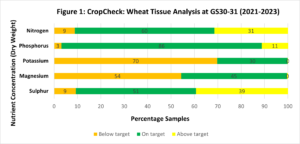
The following charts describe the percentage of analysed CropCheck samples (2021-2023) that were categorised as either below target, on target, or above target compared to known critical nutrient benchmarks for the respective growth stages.
According to the tissue analysis data from winter wheat averaged across the 3 years, approximately:
- 60% of the crops were within the target range
- 31% showed higher-than-target nitrogen concentrations
- 9% of samples were lower than the target.
This indicates that crops are receiving more nitrogen than they need at GS30 and GS31 on average.
Samples deficient in nitrogen increased at GS32-37
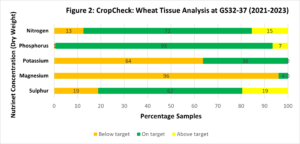
At GS32-37 the proportion of crops with excessive nitrogen reduced by half, from 31% to 15%. This suggests that some of the nitrogen was redistributed due to rapid growth during late spring as the soil and air temperature rose.
The proportion of crops deficient in nitrogen also slightly increased from 9% to 13%.
It’s fair to say that the effects of climate change are generally resulting in drier springs. Talking about drier soil conditions may seem irrelevant just now when the country is dealing with serious water excesses, but it’s important to note that managing soil moisture retention, as well as infiltration, is critical as climate change predictions suggest springs and summers are due to get drier.
This could be one of the reasons for a reduction in crop nitrogen levels at growth stages 32-37. There may well be sufficient nitrogen in the soil, but lack of soil moisture is likely to have restricted its uptake and mobility within the plant.
Key techniques to help improve soil water retention and infiltration are:
- Adding organic matter
- Reducing compaction by minimising tillage
- Controlling trafficking
- Incorporating crop residues
- Introducing cover crops
- Increasing biodiversity
Tissue potassium and magnesium levels were significantly low throughout GS30-37
Generally, as the crop matures, the benchmark targets for nutrient levels reduce. For crops measured at the later growth stages 32-37, the earlier trends at growth stages 30-31 continued for nitrogen, potassium, and magnesium. On average wheat crops contained nitrogen levels at the target for growth stage 32-37 (72%) and only 15% were above the target range (see Figure 2 below).
Most of the samples (93%) analysed at growth stages 30-31 met the target benchmark for phosphorus, indicating a balanced supply matching the crop’s demand. At GS30-31, only 11% of samples and 7% at GS32-37 contained excessive amounts of phosphorus.
However, the trends for potassium and magnesium were contrary to phosphorus and tended to be below the target levels. This could imply that nutrient supplies are not optimal, or factors such as weather or soil conditions and/or imbalance of nutrients within the soil might have influenced the results and affected the concentrations.
At GS30-31, nearly three-quarters of the samples analysed were found to be deficient in potassium and only 30% of samples were within the target range (Figure 1). This trend continued at GS32-37 for both potassium and magnesium, where more samples continued to contain below-target concentrations (Figure 2).
Various factors affect potassium availability in plants. Weather conditions such as heavy rainfall or irrigation on lighter or shallow chalky soils can lead to leaching, whilst drought conditions reduce nutrient availability and crop uptake. Acidic soils and soils with a high clay content can immobilise potassium, making it less plant available. The environmental and seasonal conditions also influence potassium concentrations in crops.
Similarly, many factors affect how plants recover magnesium, including soil pH, moisture levels, temperature, aeration, soil texture, organic matter, and the presence of other ions like calcium and potassium. When soil nutrients are imbalanced or environmental conditions aren’t favourable, it can hinder magnesium uptake, potentially causing deficiencies or toxicities in plants.
How NRM can help
Plant analysis is a crucial tool for evaluating the effectiveness of in-season nutrient management. Regular crop sampling in spring or at well-defined points within the season provides insight into the nutrient status of crops. This information is invaluable for refining nutrient strategies and helping to better match the requirements needed to support soil indices and crop need.
By combining soil analysis data with plant analysis, farmers and advisers can understand how to better manage the nutrient needs of the crop to benefit productivity and profitability whilst protecting the environment.
NRM’s innovative plant tissue analysis service CropCheck drives efficiency by helping farmers and their advisors assess the growth of the plant as it develops. Measuring the nutrients the plant contains at key growth stages gives an indication of nutrient adequacy in time to act if required. Interpretation is also provided to guide why nutrients might be high or low. This service is for a broad range of cereal crops, with growth stages ranging from GS30 to GS37.
For a quote on any of our services or for more information, contact us today.
Want to be notified whenever we publish a new blog?
Give us your email address and click submit to sign up for notifications once a month.