


Soil Organic Matter #7: Agriculture Bill and transition in Scotland

NRM
Agriculture
Since leaving the EU, Scotland, like England and Wales, is having to devise and consult on an Agriculture Bill to facilitate the replacement of EU direct payments. The Scottish government must introduce national legislation to enable it to continue providing financial support. Whilst the new Agriculture Bill is being developed, legislation has already been put in place to allow existing CAP payments and schemes to continue until 2025. This keeps things simple and ensures a period of stability for farmers and crofters in Scotland.
The new Agriculture Bill will enable the Scottish Vision for Agriculture, the government’s new policy proposal, to become a reality, moving farmers towards more sustainable methods of producing food and managing the environment. The policy broadly aligns with the new EU CAP objectives, mirroring the flexible and results-based approach that the EU is following. The bill is expected to go through parliament in 2023 and farmers are invited to get involved by providing feedback, which you can do here.
Scotland’s national test programme: leading in sustainable and regenerative farming
Back in October 2021, the Scottish government announced the development of a National Testing Programme to support farmers and crofters becoming leaders in sustainable and regenerative agriculture. The testing programme went live in spring this year (2022) and is designed to balance the needs of industry whilst recognising the urgency in adopting better land management practices. The test programme takes a ‘twin track approach’:
Track 1: Understanding the baseline
- Encourage farms to improve their knowledge of current environmental performance and efficiency.
- Support to incentivise businesses to engage and adopt measures to create a baseline of information and understanding of sustainable agriculture.
- Open to all farmers, crofters and land managers.
Track 2: Testing processes, tools, support, benefits and measurable outcomes
- Design, test and standardise the tools, support, and process necessary to claim rewards for climate and biodiversity delivered outcomes.
- Understanding how best to link and apply new activities or conditions to ensure the delivery of environmental outcomes.
- Detailed testing of the tools and advice farmers will have access to, to record and report the delivered benefits to climate and nature.
Taking a phased approach
The programme is a phased roll out of measures for those currently in receipt of farm support payments. It is intended that these measures will become mandatory for all those wanting to continue receiving support.
The Scottish government suggests that this approach will enable the shift to at least half of all payments being made conditional within current payment schemes and will inform the design of types and levels of conditionality in future payment schemes. Conditionality means that, in the future, climate mitigation and the management and enhancement of biodiversity by businesses, will be a “condition of business” that must be met to receive agricultural support payments.
Phase One: Preparing for Sustainable Farming (PSF)
Preparing for Sustainable Farming (PSF) is the first phase of the programme and is designed to ensure that when the new rural support regime is introduced, enhanced conditionalities are integrated for at least half of all funding that farmers and crofters receive by 2025. With the application of these conditions, recipients of support are expected to deliver targeted outcomes for biodiversity and low emission production.
The two options currently being funded in PSF are carbon audits, soil sampling and analysis. Additional access to new tools is also being made available for suckler beef producers. Farmers and crofters wanting to participate and claim funding now for soil sampling arable and improved grassland, classed within land region 1 (R1 Basic Payment Scheme eligible land classification), must be eligible. Read our summary below, but to read the full guidance, click here.
- Sample soil from:
- 20% of land area if larger landowners (farmers)
- 10% of land area – for smaller landowners (crofters)
- Make a claim for time to take samples (if appropriate)
- Laboratory analysis for:
- pH, P and K
- Specifies Modified Morgans P extraction unless soil is calcareous in nature where Olsen P extraction should be requested
- Mg and other trace minerals are recommended to be tested but aren’t eligible for funding
- Carbon analysis either by
- LOI or
- Dumas analysis
- Development payment
- Make a claim for nutrient management & planning advice
- Paying particular attention to carbon and how to manage it
If the soil analysis does not include these four elements, then the claim won’t be processed, and payment will be refused.
Carbon audits and payments
The purpose of the carbon audit option is to encourage farmers and crofters to be aware of the impact of their farming practices on climate performance. It will identify the sources and quantities of on farm GHG and identify where changes to management practices can lead to improved efficiencies, reduced operating costs and emissions.
The government promotes the use of recognised (accredited to PAS2050 standard) tools such as AgreCalc to make these calculations and will pay £500 to cover time for collecting data, completing the audit itself and receiving analysis and advice from an accredited advisor.
In year one only, farmers claiming for soil analysis can also claim a “development payment”. This is worth £250 and is a payment for time. It is meant to encourage best practice learning connected to nutrient management planning, carbon, and systems that lead to the better management of soil organic matter.
The process of co-design with farmers, crofters and stakeholders has been central to the design of the new support scheme. This is set to continue as the industry transitions from the testing phase to full implementation of the transformed support system. The government insists that it is committed to a more streamlined process that allows for national baselining, benchmarking, assessment, and analysis of success.
Additional key themes, such as biodiversity audits, GHG analysis, animal health and welfare and nutrient/forage plans are also being tested within the National Test Programme to understand how best to manage them and what conditions should apply within each theme.
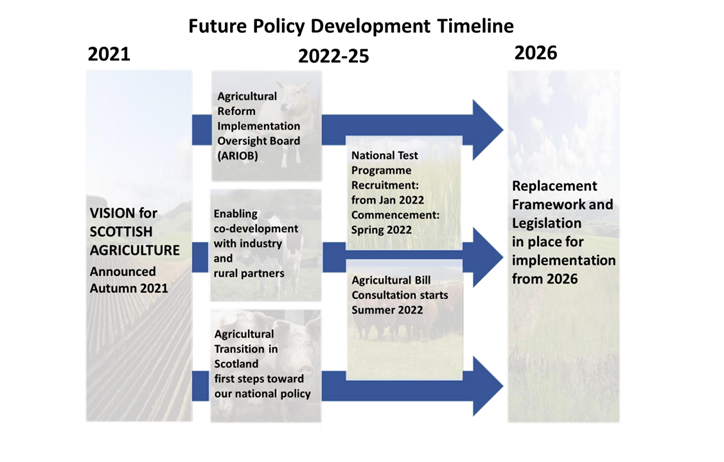
The Scottish government has published a diagram describing the policy timeline, so for more information on your eligibility to participate in PSF and to get a better understanding of what is currently available please click here.
Scottish Government Policy Timeline
NRM offers all the soil testing required by the PSF, including carbon testing by LOI and Dumas. Talk to your agronomist or contact us here.
References
https://www.gov.scot/policies/agriculture-payments/
Farming for a Better Climate – Farming for a Better Climate
Preparing for Sustainable Farming (PSF) (ruralpayments.org)
Visit NRM