Sciantec has launched a new grass silage analytical service exclusively for livestock farmers in Northern Ireland. This service presents grass silage results and interpretation based on the AFBI advisory system, giving farmers the necessary insight to adjust livestock nutrition effectively for optimal productivity.
‘By providing customer-specific interpretation based on AFBI’s advisory system, we are helping farmers in Northern Ireland make more informed decisions around livestock nutrition,’ says Mike Whitfield, Business Development Manager at Sciantec. ‘For example, if you’re a dairy farmer, your results are used to calculate the silage and feed required for optimal production—in this case, milk yield. Not only will this help these farmers ensure peak animal productivity, but the knowledge will also save them money and reduce the incidences of nutrition-related diseases.’
Sciantec has recently invested in new NIR instrumentation for quality forage and silage analysis. This state-of-the-art equipment has an updated configured sample interface and a wider wavelength range, enabling scanning of a greater area and better reproducibility over non-homogenous samples such as silage.
‘Our nutritional results are available within 24 hours, with individual result reports for each sample,’ continued Mike. ‘This fast turnaround enables our customers to utilise results as soon as possible to help adjust rations and take variability of nutritional quality within a clamp into account. We also provide our silage analysis kit free of charge as part of our package. This fast and easy service is very important for our customers, who often require rapid turnaround of results to help them diagnose problems on-farm, such as a reduction in milk output, so they can adjust rations accordingly.’
This new service with additional interpretation is suitable exclusively for grass silage. Sciantec also offers a variety of other forage and silage testing services, including fresh grass, maize silage, whole crop, alkalage, lucerne silage, hay, haylage, and crimped cereals. These analytical packages help customers determine the nutritional quality of forage and silage to allow herd nutrition, crop nutrition, and fertiliser programmes to be tailored for improved animal welfare, productivity, and profitability.
‘This investment in new analyses and state-of-the-art instrumentation is part of our commitment at Cawood Agriculture to continuously improve our services for our customers,’ said Sean Stevenson, Commercial Director of Cawood Agriculture. ‘The team has worked very hard to develop these improvements, continuing to cement Sciantec as one of the UK’s largest providers of specialist forage and animal feed analysis.’
For more information, contact us today.
Marchwood has added respirable crystalline silica analysis to its already comprehensive range of UKAS accredited occupational hygiene analytical tests. This test enables businesses to meet HSE regulations, reduce exposure levels, and safeguard employees.
‘Exposure to respirable crystalline silica, or RCS, causes hundreds of thousands of deaths across the world every year,’ said Jenny Wraith, Business Development Manager at Marchwood. ‘This makes RCS exposure similar to asbestos exposure, particularly as these substances are only dangerous when disturbed, they affect workers in similar industries, and they target the lungs. However, RCS may be worse than asbestos. Whilst asbestos tends to affect those going into retirement, RCS affects young workers with dependent children and their whole working lives ahead of them. This is why we found it important to gain UKAS accreditation for this test. Ensuring businesses protect their employees and meet HSE regulations as accurately and reliably as possible will help customers’ workforces stay healthy throughout their lives.’
Marchwood’s decades of expertise and investment in state-of-the-art equipment provides customers with high quality, accurate analytical services for occupational hygiene and air quality. All occupational hygiene analysis services, including RCS analysis, come with free sample media, comprising equipment unique to the service ordered, and pre-paid return labels and bags. This makes the sampling process as easy and efficient as possible.
‘We actually have the lowest limit of detection (LOD) for RCS exposure in the industry,’ continued Jenny. ‘Occupational hygienists and businesses must test regularly to ensure the workplace exposure limit (WEL) does not exceed 0.1mg/m3 in the UK, or 0.05mg/m3 in Ireland. Our LOD is 0.005mg/m3, which not only helps businesses safeguard their employees far more effectively, but it also means that we don’t have to sample for as long, saving our customers money and time.’
Exposure to RCS causes many adverse health effects, including asthma, chronic obstructive pulmonary disease (COPD), and silicosis. In In 1996, the International Agency for Research on Cancer classified crystalline silica in the form of quartz or cristobalite dust as a Group 1 carcinogen. Due to these health risks, taking steps to monitor and control the risks of RCS exposure, as well as to review control methods, is required by law.
‘The team has worked exceptionally hard to become UKAS accredited for this service, as well as to provide customers with the lowest LOD in the industry,’ said Declan Burns, Managing Director of Cawood Environment. ‘We are focussed on providing reliable and accurate analytical services to help our customers meet and maintain compliance whilst supporting a safer, healthier planet. This accreditation also serves to further cement Marchwood’s position as the UK’s leading specialise laboratory for occupational hygiene and air quality analysis.’
For more information on our occupational hygiene analysis services, contact us.
NRM was featured on BBC’s Countryfile on Sunday 6th August. Sean Stevenson, Commercial Director of Cawood Agriculture, discussed the importance of soil analysis in both increasing productivity and adopting sustainable farming practices, as well as the Northern Ireland soil sampling project. He and the team also demonstrated the innovative equipment that we use to help farmers and agronomists across the UK optimise sustainable crop production.
‘95% of our food is grown in soil, so analysis undertaken by an accredited lab is very important,’ said Sean. ‘We test for a range of things, but pH is the most important thing to get right, then major nutrients like phosphorus and potassium, so we include these in our standard soil analytical package. By determining what is already in the soil, we can make adjustments where necessary to improve crop production in a sustainable way. We’re still going to need to manage inputs to a certain degree, but it’s all about managing the soil as opposed to managing what we’re putting into it. This week’s Countryfile did a fantastic job at explaining all this and showing how we at NRM can help.’
Adam Henson, Gloucestershire farmer and Countryfile presenter, visited NRM’s Bracknell site in July 2023 to learn more about our agronomic analysis services. Sean took him through the laboratory to teach him about soil analysis and its various stages and discuss sustainable farming practices. Adam was taught how to dry and prepare the soil samples for analysis, including mixing the sample in the solution, filtering it, extracting it, and measuring the solution into test tubes ready for analysis. He was also introduced to the lab’s organic matter analyser by Alison White, Soil Analytical Manager at NRM.
‘Organic matter is important for nutrient retention and water-holding capacity as well as being a food source for the organisms active in the soil,’ continued Sean. ‘Information gleaned from analysis is key, as the advice going back onto the land will assist the soil and what it can produce. NRM’s team of experts generate a variety of soil analysis reports that provide insightful data and guidance to help improve yield, minimise the inputs that may need to be added to the field, and ultimately increase profits for the farmer.’
Adam and the team at NRM also discussed the Northern Ireland national soil sampling project. As the first nation in the world to survey soil across the entire country, Northern Ireland is testing over 700,000 fields over the next 4 years to help improve its soil health. Cawood Agriculture plays a key role in this, with all soil samples being sent to its laboratories in Bracknell and Swaffham for analysis. Expert advice is then given to help farmers across the UK improve agricultural and environmental sustainability as well as productivity.
‘It’s fantastic to see Sean and the other team members at NRM be given a platform to inform the general public about the importance of soil analysis and how we can help,’ said Julian Salazar, Managing Director of Cawood Agriculture. ‘Our expert agronomists, alongside our team of specialist technicians, provide accurate data to farmers across the UK as well as expert, specialist advice and interpretation on their results. As shown by Sean, Alison and Adam, this value-added service helps farmers and their advisors to make insightful management decisions. This will help them optimise crop production and manage operating costs, whilst supporting farming practices that address the environmental challenges and market opportunities they care most about.’
NRM was featured in Countryfile’s episode, “Dumfries House”, on BBC One at 7pm on Sunday 6th August. You can watch the episode on catch up here, or tune into BBC Two at 7:05pm on Sunday 13th August.
For more information on our services, contact us.
Sajjad Awan, Soil and Crop Nutrition Agronomist, and Alli Grundy, Agronomy Manager at NRM, advised farmers and other attendees of Down to Earth to start with soil analysis on their journey towards a sustainable farming system. They asserted that a return to healthier soils is fundamental if we are to produce food more sustainably in a changing climate, and that laboratory analysis plays a vital role in the transition towards more regenerative practices and in the success of farming systems in general.
‘Measuring and monitoring plays an important part in all farming systems, as they enable us to understand the impact of our management and if we need to do something different,’ said Sajjad. ‘Analysis is also very useful when assessing the benefits of transitioning between one systems approach to another. It’s part of the benchmarking ethos, allowing us to see a direction of travel and assess whether we need to adjust our plans to improve productivity and profitability whilst transitioning to sustainable practices. Analysis also helps us increase efficiency and sustainability in our farming practices, minimising waste of expensive inputs and pollution of our environment through run off and leaching. So, the real strength of analysis is that it’s used to support and justify changing management decisions, particularly when adjusting to regenerative agriculture principles.’
The events’ theme, “Regenerative Farming: From The Ground Up”, is incredibly useful for growers wishing to adopt sustainable farming practices without compromising on profits. Sajjad spoke on 21st June in Somerset, whilst Alli’s talk was on 6th July in Cumbria. They were joined by other experts to discuss the benefits of regenerative agriculture, how sustainable practices work within different systems, and how to improve farm sustainability and resilience in our soils.
‘Acting on results can sometimes feel like a leap of faith—particularly when receiving unexpected results. However, it’s critical that advice given by trusted experts is taken to help make most out of your data,’ said Alli. ‘This will help growers see a true return and benefit from analysis. Occasionally, this involves breaking away from traditional practices, but analysis is there to support management decisions and provide the evidence that something is or isn’t working. Ultimately, understanding the data and adopting regenerative agriculture practices will, in the longer term, benefit everyone, with the true value in the transition towards “restoring the balance” shown in the accumulation of the marginal gains made over time.’
NRM analyses over half a million soil samples across all farm types every year. Our various analysis services, including CarbonCheck for soil carbon analysis, CropCheck for plant tissue testing, GrainCheck for grain analysis, and N-Check for soil nitrogen analysis, help customers check they are on course throughout the season. These tools help farmers increase performance and profitability whilst committing to sustainable, resilient practices to help them stay productive.
For more information on our analysis services, contact us.
At KWS’ recent Business Briefing, Sajjad Awan, Soil and Crop Nutrition Agronomist at NRM, told over 100 agricultural professionals that the best way to improve crop resilience and nutrient use efficiency is to focus on their own production data and move away from using standard industry figures.
‘Farming by averages is no longer enough,’ he said. ‘We’re dealing with much more on-farm variability than previously realised. A look at the key metrics from NRM’s analysis of crop nutrition data shows we need to be more granular in our crop management approach to build resilience in farming practices. Using analysis to check carbon levels in the soil, for example, helps maintain soil health for greater resilience, whilst analysing nitrogen levels helps avoid excessive applications of fertiliser, which will not only help you save money but will also prevent harm to the environment.’
The conference theme, “Building resilience into rotations” is highly topical given the extent to which climate unpredictability is affecting crop production. Dr Kirsty Richards, KWS’ Cereals Product Manager, James Webster, The Andersons Centre’s Senior Analyst, and Olivia Potter, KWS’ Technical Specialist, discussed how to choose the most suitable crops, focusing on incremental gains rather than one large change with varietal choice.
‘Building greater resilience in agriculture is crucial,’ said Sajjad. ‘Routine testing is one way growers can improve farm management, whether it be analysis of soil organic matter, soil nutrient status, or nitrogen offtake in harvested crops. Understanding the data will not only improve production across individual farms, but improve performance across the industry as a whole.’
NRM analyses over half a million soil samples across all farm types every year. Our various analysis services, including CarbonCheck for soil carbon analysis, CropCheck for plant tissue testing, GrainCheck for grain analysis, and N-Check for soil nitrogen analysis, help customers check they are on course throughout the season. These tools help farmers increase performance and profitability whilst committing to sustainable, resilient practices to help them stay productive.
For more information on our soil analysis services, contact us.
At MSD’s recent Respiratory Health Conference, David Petrie-Dolphin, Business Development Manager at Sci-Tech, told livestock farmers and veterinary professionals that robust laboratory analysis is the best way to diagnose and screen porcine diseases for optimal health and production.
‘Carrying out analysis for veterinary diagnostics is key to verifying the disease status of the herd, to confirm suspected illness after clinical observations have taken place, and to provide an independent evidence source,’ David said. ‘Serology and PCR screening allow rapid detection of specific antibodies or antibody-like substances that appear in association with certain diseases. Results can be used by vets and producers to diagnose the disease, determine animal vaccination status, prevent further spread of pathogens, and apply for transportation or export certificates.
‘Ultimately, the best thing livestock producers can do is to set a baseline for their farm with regular, UKAS accredited analysis. This will allow them to trend their farm’s performance based on certain disease characteristics over time and effectively improve productivity and profitability.’
The conference educated producers and vets on recent vaccination and animal health developments for the porcine industry. It was held on 26th & 27th April 2023 in at MSD’s UK headquarters in Milton Keynes. David spoke alongside other specialists and experts in the animal health fields, including Monika Ptaszynska-Sutton, Specialist Immunologist at MSD, who discussed antibody mechanisms and responses in animals. David’s lecture followed on perfectly, talking about how to detect these responses through the laboratory diagnostics services undertaken by Sci-Tech’s site in Dungannon.
‘Helping our customers better understand the best ways to take and submit samples, as well as the role of veterinary diagnostics analysis as a whole, is vital,’ said David. ‘Many vets and producers are interested in how best to supply samples, the best types to submit, and in sample stability. Getting a chance to talk to current and potential customers directly about how sample handling for different analysis can influence the results achieved was a great opportunity. This gives a better understanding and will help improve the precision and reliability of results. We are happy to discuss the sampling requirements and the aims of the customer to enable them to get the best solution for their needs. This will help customers accurately diagnose diseases and take action quickly, helping to improve animal health and productivity overall.’
Sci-Tech has decades of experience in specialist diagnostics analysis. The business’ UKAS accredited services include Salmonella screening, mineral and potable water screening, PCR screening, serology, and digestate and compost testing. These help vets and livestock farmers monitor their animals and take decisive action before any disease impacts the flock or herd, potentially affecting animal welfare and public health as well as productivity and profitability.
For more information, contact us.
Marchwood has added sulphur dioxide analysis to its already comprehensive range of MCERTS accredited stacks analytical tests. This test, which is to BS EN 14791, helps customers maintain compliance and safeguard public health.
‘We are working towards getting as many of our services accredited as possible to further demonstrate our competency to national and internationally recognised standards,’ said Jenny Wraith, Business Development Manager at Marchwood. ‘Our specialist Manchester-based laboratory with state-of-the-art technology means that we can offer stack emissions analysis services just like this on a 7 day turnaround, which we have found is of great value to our customers.’
Sulphur dioxide (SO2) is produced as part of the combustion process of fuels containing sulphur, such as coal, biomass, oil, and biogas. As a key air pollutant and a major source of acid rain, SO2 can adversely affect human health and the environment. By measuring SO2 in stacks after combustion to BS EN 14791, we are helping producers adhere to acceptable levels, protect the planet, and maintain compliance.
‘Adding SO2 analysis to our comprehensive range of MCERTS accredited tests gives our customers full confidence that their results are accurate and robust,’ continued Jenny. ‘This is increasingly important, not just to help customers adhere fully to regulations, but to ensure we are all contributing towards supporting a safer, healthier planet.’
Marchwood provides sampling media free of charge, and offers a complimentary courier pick up service. To book your tests or for more details on our stack emissions offerings, contact us.
NRM has updated its interactive soil map alongside its annual soil summary report for last year. This allows farmers to drill down into crop type and nutrient summaries for their region and county for more relevant data.
The interactive map follows the recent publication of NRM’s 2021-2022 soil summary with consolidated, anonymised data from thousands of soil samples from farms across the UK collected between June 2021 to May 2022. The interactive map allows farmers and their advisors to select a region and then a county to localise their nutrient summary. Data for phosphorus, potassium, magnesium and pH is split out by arable and grassland and summarised according to the 9th edition of the RB209.
‘This soil summary has once again confirmed a trend that we’ve observed for the last 30 years: that most soils are deficient in the three key nutrients,’ said Sajjad Awan, Soil and Crop Nutrition Agronomist at NRM. ‘It’s also interesting to look at trends and variations across the different regions in the UK to see how we’re doing on a more specific level. For example, while arable soils in Dorset in the South West of England are high in phosphorus and soil pH, those in Worcestershire in the West Midlands are low in phosphorus and middling in soil pH.’
Viewing the consolidated data in this way is more relevant to farms and their conditions than ever before. By understanding the current nutrient status of their soils and how their farms compare to others in their area, farmers and advisors can use the data to make insightful decisions about the next year of farming and beyond, leading to enhanced performance.
‘At Cawood, we understand the importance of sharing insightful information gathered from farms across the UK with the rest of the industry, as it helps build collective knowledge for widespread improvement,’ said Sean Stevenson, Commercial Director of Cawood Agriculture. ‘As the UK’s leading provider of agronomic analysis in the UK, Cawood is in a unique position to gather a large amount of soil and crop data for representative results. The interactive soil map is a handy, innovative solution for our customers to easily see how they compare with the rest of the UK, help them meet their goals, and transition to more sustainable and productive practices.’
View the interactive soil map here.
NRM has published its annual soil summary report for 2021-2022, with consolidated data from thousands of soil samples across the UK. Results once again show that most soils (two thirds) are deficient in the key nutrients of magnesium, phosphorus and potassium, continuing a trend of almost 30 years.
As the UK’s leading provider of soil analysis, NRM has been gathering soil analysis data since 1995. This year’s soil summary includes data from soil samples collected between June 2021 and May 2022, helping farmers and their advisors understand current nutrients status across the UK, benchmark against other farms with current data, and improve soil health to optimise crop production.
For the first time, NRM has also published consolidated data on plant tissue and grain gathered from its CropCheck and GrainCheck analysis services. This will help farmers optimise production and form a fuller view of how their soils and crops are doing. Early analysis of the data supports the idea that, while sufficient levels are present in the soil, nutrients might not be available for crops to utilise.
‘We’re using our summarised data this year to help farmers and their advisors understand why it’s important to analyse all year round,’ said Sajjad Awan, Agronomy Manager at NRM. ‘One key finding was that wheat crops had almost 10% less nitrogen and a quarter less phosphorus in spring 2022 than in 2021. We had a colder and drier spring in 2022, which prevented soil mineralisation, a necessary process that allows nutrients to be taken up by the crop. The situation was made even worse due to the soil moisture deficit during the hot and dry summer, which was then exacerbated by rapid crop growth. This is why crops couldn’t take up all they needed to thrive.
‘It’s important to keep an eye on weather conditions throughout the year, as you might need to make quick decisions to improve crop performance. This is all made easier with robust laboratory analysis, which reveals how your crops are doing and what you might need to change.’
CropCheck measures the nutrients cereal crops contain at key growth stages that coincide with the fertiliser application window. GrainCheck measures the nutrient levels in grain, which helps farmers calculate the actual crop offtake at harvest. Using both services together with soil analysis helps farmers make better decisions with each new season for optimal crop production and yield.
‘There are some fascinating trends already, and these truly demonstrate the importance of analysing throughout the year to adjust plans before it’s too late,’ continued Sajjad. ‘Not only does this help crop performance, but it also improves nutrient use efficiency. This helps protect our planet by reducing nitrate and phosphate losses to the environment, which can cause a lot of issues. Farming sustainably and transitioning to greener practices actually goes hand in hand with increased productivity. Using innovative crop analysis to guide our management decisions is a huge part of this.’
‘Cawood’s core values involve supporting sustainable food production and a safer, healthier planet,’ said Sean Stevenson, Commercial Director of Cawood Agriculture. ‘As the UK’s leading provider of agronomic analysis in the UK, Cawood is in a unique position to gather a large amount of soil and crop data for representative results. We are strong advocates of sharing this insightful information with the industry to help farmers meet their goals and transition to more sustainable practices.’
View the NRM Soil Summary for 2021-2022 here.
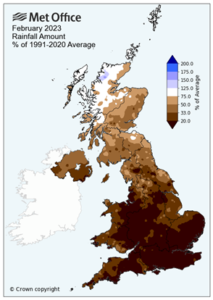
With England seeing its driest February in 30 years, agronomic analysis laboratory NRM advises farmers that they undertake soil mineral nitrogen analysis for more careful fertiliser application planning this season. This will help growers save money on expensive nitrogen fertiliser, improve nitrogen use efficiency (NUE), and optimise crop yield.
‘The Met Office has confirmed that we have had the driest February since 1993,’ said Sajjad Awan, Soil and Crop Nutrition Agronomist at NRM. ‘Drier weather during winter is not necessarily a bad thing, as fewer nutrients are lost through leaching or surface runoff. However, if you’re thinking about nitrogen fertiliser applications, it’s important to consider soil moisture content and soil temperature, as applying at the wrong time can mean failing to get the most out of your fertiliser. It should only be applied when there’s sufficient soil moisture available or there is a chance of (light) rainfall within the next couple of days.’
Although February was the 5th mildest since records began in 1884, March has started off chillier. Sajjad suggests not applying nitrogen when the soil is frozen or there is a high risk of snow or freezing conditions in the coming days.
‘Ideally, the soil in the root zone should be 5oC or higher for rapid uptake of nutrients,’ said Sajjad. ‘This also helps to minimise any nitrogen lost to the environment, improving nitrogen use efficiency (NUE).
‘We also need to ensure that we are putting on the right amount of fertiliser,’ continued Sajjad. ‘These unusual conditions mean that we shouldn’t apply fertiliser without checking nitrogen levels first, as they may be significantly different from what we expect. Measuring your soil mineral nitrogen content before application helps farmers save money on nitrogen fertiliser, improve NUE, and optimise yield.’
NRM’s N-Check services analyse soil for Nitrate-Nitrogen, Ammonium-Nitrogen, soil mineral nitrogen, and give a total value for the combined soil depth. N-Check Plus adds soil organic matter (SOM) analysis to estimate mineralisable nitrogen, Spring crop N to determine the soil nitrogen supply (SNS), and the SNS index based on RB209 guidelines. These services help farmers understand the nitrogen content of their soil to enable informed decision-making about land and crop management.
‘It is important to our customers that they understand the context of their results to help them reach their goals and optimise their crop nutrition plans,’ said Sean Stevenson, Commercial Director of Cawood Agriculture. ‘The expertise of our agronomists, Sajjad and Alli Grundy, means that our customers can tap into the invaluable agronomic experience that they need to have a good understanding and interpretation of their results and make better decisions. This, coupled with our innovative suites of tests, helps to cement our position as the UK’s leading agronomy analysis laboratory.’
NRM’s N-Check services help farmers determine how much nitrogen is left in the soil after harvest and therefore much fertiliser needs to be used, saving unnecessary costs. Learn more and contact us today.