


Harvesting the latest news on oilseed rape

Sciantec
Agriculture
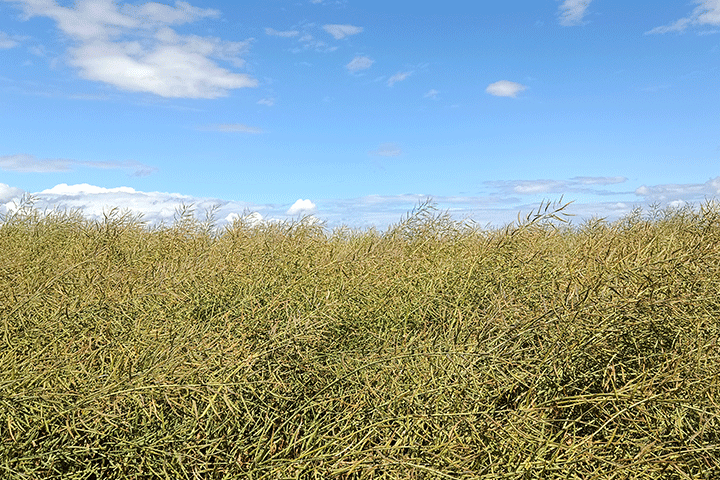
Many people will recognise the fields of dandelion-yellow crops as they travel up and down the UK. This is oilseed rape (OSR), a crop commonly used in the UK as a break crop in the rotation. Break crops prevent weed and pest build-up, taking the pressure off future cereal crop management and enabling yields and profits to be increased.
OSR is crushed to make rapeseed oil, which is used in cooking fats, spreads and margarines. It is also used as a protein-rich addition to animal feed, and some whole seed is used in poultry rations. It is low in saturated fat and high in both omega-3, which provides numerous health benefits including lower blood pressure, and vitamin E, a strong antioxidant.
Between 2012 and 2021, the area of rapeseed planted in Britain more than halved as farmers moved to more profitable crops. However, UK farmers are now starting to utilise it in their rotations once more. Read on to find out more about what happened to OSR, the importance of analysis in determining its quality, and how Sciantec can help.
Oilseed rape: back in fashion
The last decade has seen OSR drop in profitability, leading farmers to utilise other break crops. According to Agronomist and Arable Farmer, in 2012 the area of rape was over 750,000 hectares. It since plummeted to 361,000 hectares—about half of its peak.
This was due to several factors, including the ban of neonicotinoids in certain pesticides, such as ones used to control the Cabbage Stem Flea Beetle (CSFB) in the UK. The CSFB feeds on leafy greens like broccoli and cabbage as well as on OSR. They devastate the plant by eating the entire inside of the stem before emerging to eat the leaves on the outside too, meaning that, without the pesticide to keep them in check, crop yields were reduced and many crops were actually written off altogether. In 2019, our lab technicians at Sciantec would open samples to find literally thousands of beetles crawling out of the sack, showing how dire the situation was. Other countries also had more successful OSR harvests during this time, causing a drop in domestic prices. Farmers seemed justified in abandoning this less profitable crop to focus on others.
However, in 2021, the area of oilseed rape planted began to rise again. Whilst the war in Ukraine has had a significant effect on OSR supply across the world, prices had already started to rise in mid-2020. The value of rapeseed oil had almost doubled before the war in Ukraine threatened to restrict supplies and push the prices even higher in March 2022, already making it a profitable crop to grow even if the yield per hectare was lower than before due to the ban on neonicotinoids.
Ukraine provides 80% of sunflower oil consumed in the UK, and Russia makes up a significant proportion of the remainder. This has resulted in supermarkets like Waitrose having to ration cooking oil in response. A further revival of OSR cultivation over the next few years is therefore very likely based on the crop’s increasing profitability.
In fact, the price for OSR is now close to an unprecedented £900/t—double the price it was at the same time last year. It now out-performs most other break crops, despite huge increases in inputs like fertiliser in recent months. To take full advantage of this, producers must ensure that their OSR is of high quality.
The importance of erucic acid analysis
One of the key characteristics of rapeseed oil designed for consumption is that it must have low levels of erucic acid. As erucic acid is a naturally occurring fatty acid, UK law states that levels must not exceed 5%, but the current maximum level in most contracts is set to 2%. As new areas are drilled and farmers move back to OSR as a crop, it is of critical importance that HEAR rape and OSR crops are not mixed up. HEAR rape is permitted higher levels of erucic acid, so mixing these crops due to volunteer seed and weed contamination can lead to toxic levels of erucic acid and will make the crop worthless to feed and oil manufacturers.
Growers and merchants can check erucic acid, oil, and moisture levels to ensure the grain they buy complies with their contracts. Laboratory analysis is vital in helping producers establish and maintain compliance and safeguard public health.
How Sciantec can help
The industry has developed several different rapid techniques for testing rapeseed for erucic acid during storage, transport, and before crushing. These are mainly NIR based and can struggle to accurately report levels in the key 2-5% range that is required for compliance.
The GC reference method that Sciantec uses gives you confidence in your results in the key 2-5% range. The quick NIR techniques used by the industry at large only gives you an indication if your samples have very high or very low erucic levels.
Sciantec has extensive expertise in analysis services for feedingstuffs, ingredients, and raw materials, and offers a comprehensive quality checking testing service to comply with GMP+, UFAS, and FEMAS quality assurance schemes. We offer fatty acid profiles analysis on OSR using our state-of-the-art gas chromatography system. This accurately determines the composition of the oil extracted from rapeseed. Results are reported down to 0.05% for all fatty acids. We can report on erucic acid separately or as part of a comprehensive profile.
For more information or to book in your samples now, contact us.
References
https://www.aafarmer.co.uk/crops/oilseed-rape-profit-revival.html
https://www.jic.ac.uk/blog/oilseed-rape-and-the-cabbage-stem-flea-beetle/
https://ahdb.org.uk/erucicacid
Visit Sciantec