


Soil Organic Matter #4: beyond the Sustainable Farming Incentive

NRM
Agriculture
Valuing the quality of the soil we farm through measurement and benchmarking goes a lot further than the Sustainable Farming Incentive (SFI) and the financial rewards of the scheme. It’s all about mindset and the willingness to change our behaviour in terms of the advice we receive and the actions we take. The SFI is a means to an end, so every farm and future farming generation can receive the legacy advantage from actions taken before. Understanding a soil quality baseline, good or bad, is central to being able to improve practices and change the direction of travel.
The importance of managing soil organic matter
Taking care of soil organic matter (SOM) is critical because it plays a huge role in the overall quality of the soil. Land can be used for a large variety of purposes, but to be successful, soil quality must be considered. From an environmental perspective, soil quality is described as the “capacity of the soil to promote the growth of plants [productivity], protect watersheds [landscape divides] by regulating the infiltration and partitioning of precipitation, and prevent water and air pollution by buffering potential pollutants such as agricultural chemicals, organic wastes, and industrial chemicals” (Bünemann et al., 2018). It is also critical for the functioning of important natural ecosystems, for improving and enhancing biodiversity, and for habitat protection.
Having a plan on how we manage soil and SOM now and into the future really depends on following a management strategy over the longer term and reviewing it annually. This might involve initially surveying farmland to understand which activities should be implemented and where, to locate any parcels of land being degraded by current actions, and to consider what prevention strategies can be adopted to avoid further degradation.
Soil management planning
A soil management plan involves looking at the physical characteristics of fields and how these can invoke certain risks when managed in a particular way. Soil type, risk of erosion, soil permeability, proximity to a water course, or if they are steeply sloping, are all aspects which need to be considered when deciding how we manage our farmed land. In layman’s terms, these characteristics should determine which management/agronomic actions we take. For example, applying organic materials to steeply sloping fields close to a water course may not be the best option in improving SOM due to the higher risk of nutrient loss from run off.
Soil organic measurements can be a used as a soil quality indicator. Benchmarks will soon be published to help guide the interpretation of SOM results and determine if levels are on target or need to be improved depending on soil texture, climatic conditions, and land use. However, it is important to remember that detecting change in SOM content due to management practices can be difficult, which is why we need to review trends in levels over the whole of the crop rotation.
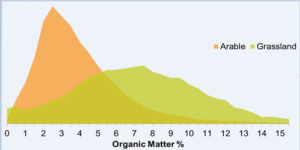
Building organic matter content in some soils is far easier than in others, so understanding the type of soil we farm determines the capacity to which levels can be improved. Informing the soil management plan with SOM data helps determine what we have, what actions we should avoid, and what we are likely to gain if we focus our efforts appropriately and in a targeted way. The chart below illustrates the distribution of SOM levels in arable and grassland soils. This data, based on mineral soils, suggests that arable soils tend to peak around the 3% level and the proportion of soils above 5% reduces as the organic matter content increases. Grassland soils generally peak much higher at around 8%, but the range in content is much broader compared to arable, and many more soils contain organic matter levels beyond 8%.
Typical SOM levels
Nutrient management planning
Nutrient management planning is also informed by understanding the level of SOM. This contains a large proportion of the organic fraction of nutrients, which are steadily processed by the soil biology and converted into a readily available form for crop uptake. Generally, the larger the content of organic matter, the more fertile a soil is. Data from a major fertiliser manufacturer suggests that, typically, a 3% organic matter content soil mineralises around 25kg N/ha compared to an organic matter content soil of 8%, which mineralises around 65kg N/ha.
This information helps us understand why certain fields are more fertile, productive, and workable than others. Fields that contain higher organic matter contents will also benefit from other advantages, such as good soil structure, good water infiltration, and soil moisture retention, making them more resilient to changing growing conditions.
Soil Carbon Code
There is an irrefutable link between SOM and soil carbon but, as explained in my previous blog, the conversion between the two measurements is full of variation. Measuring organic matter gives us an idea about the level of soil carbon, but if the objective is to engage in carbon trading and offsetting, then a direct measure of carbon stocks is required.
To ensure a fair playing field is established, a UK Soil Carbon Code (UKFSCC) is being developed. It aims to give transparency and a set of rules with which markets and farmers engaging with these markets should adhere to. It will also provide a framework and be applicable for different ‘carbon accounting’ purposes—including offset registries, carbon insetters, carbon capture incentive schemes, ecosystem services, and environmental investment products—whether carbon capture will be monetised or not.
NRM’s CarbonCheck service provides all the relevant data to enable participation in future schemes. It measures soil carbon, as well as active carbon, which is a measure of readily available carbon for soil microbes, total carbon, soil inorganic carbon, total nitrogen, C:N ratio, and a calculated organic matter content.
NRM will be at Groundswell in Hertfordshire on 22nd and 23rd June to talk more about our services, so if you’re attending, come and say hi!
Contact NRM to find out more about measuring SOM content or soil carbon, and speak to your adviser/agronomist about soil management planning.
References
Soil Carbon Code | About the Code (sustainablesoils.org)
Soil Quality – A Critical Review, Else K. Bünemann et al. 2018, Soil Biology and Biochemistry
CF Fertilisers UK data
Visit NRM