


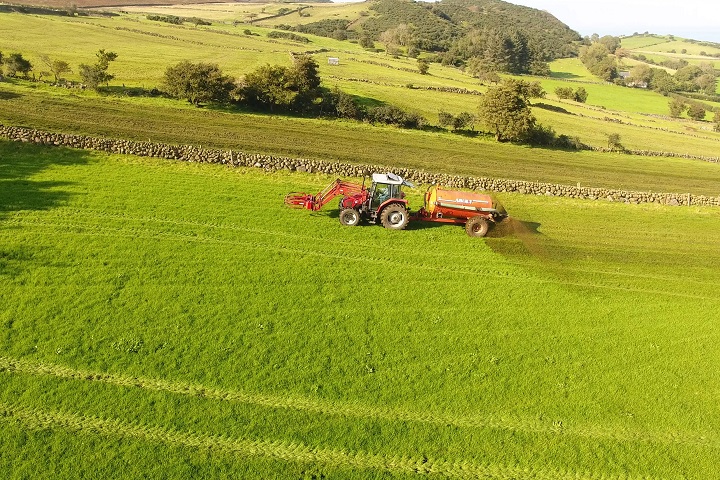
Welsh Autumn slurry spreading: the temporary extension and what this means for you

NRM
Agriculture
The Welsh government has announced a vital lifeline for the agricultural sector: temporary emergency legislation to extend the Welsh Autumn slurry spreading period with high levels of readily available nitrogen (RAN). To ease pressure on Welsh farms, the usual autumn closed periods have been pushed back, giving farmers flexibility until Sunday 15th November 2026.
This decision comes as a direct response to an exceptionally challenging summer drought. The prolonged dry weather significantly reduced grass growth, altering grazing patterns and cutting frequencies and leaving many farmers unable to utilise nutrients effectively during the summer months. The change recognises the risk of reduced winter storage capacity and the problem of heading into autumn and winter with fewer storage options, which could lead to illegal spreading or storage breaches and have a devastating effect on the wider environment.
The following explains what these temporary legislative changes mean for your farming operations, the strict conditions you must follow, and how slurry analysis can help you maximise this opportunity.
Why the rules have changed for Welsh Autumn slurry spreading: the summer drought crisis
Farming in Wales, like the rest of the UK, is heavily affected by the weather. Severe drought conditions in Wales this year brought grass growth to a near halt across most of the country. With little to no grass cover, applying slurry would have led to poor nutrient recovery, a high risk of nitrogen volatilisation, and scorched swards.
As a result, slurry remains unapplied in tanks and lagoons, and as autumn approaches, farmers face storage facilities nearing capacity before winter. Without a regulatory adjustment, farmers faced an impossible choice: violate the law or risk storage breaches. By extending the application window and delaying the closed period, the Welsh Government aims to help farmers safely reduce storage volumes ahead of winter.
The new deadlines for Welsh Autumn slurry spreading: soil types and key dates
The temporary legislation applies across all soil types in Wales, but how it affects your farm depends directly on your specific land classification:
| Soil & Land Type | Standard
Closed Period |
Temporary Autumn 2026
Closed Period |
| Grassland (Sandy/Shallow Soils) | 1 Sept – 31 Dec | 16 Nov – 31 Dec |
| Grassland (All Other Soils) | 15 Oct – 15 Jan | 16 Nov – 15 Jan |
| Tillage (Sandy/Shallow Soils) | 1 Aug – 31 Dec | 16 Nov – 31 Dec |
| Tillage (All Other Soils) | 1 Oct – 31 Jan | 16 Nov – 31 Jan |
Sandy and/or shallow soils (grass & tillage) face a much higher risk of nutrient leaching, but a temporary longer spreading window has been agreed. Spreading will be permitted between 15th October and 15th November, providing these farms an opportunity to manage their storage. For all other soil types, the beginning and mid-October deadline is extended by six or four weeks (this excludes poultry manure).
Strict application limits and safeguards for Welsh Autumn slurry spreading
This extension is not a free pass to spread at will. Because applying high-RAN manures late in the autumn carries an elevated risk of nutrient runoff into watercourses, the Welsh Government and Natural Resources Wales (NRW) have attached strict environmental safeguards to reduce the risk.
- Maximum quantity limits: Farmers are restricted to applying a maximum of 30 cubic metres (30m³) of slurry per hectare during any single application event.
- Three week buffer gaps: There must be a strict minimum gap of at least three weeks between any consecutive slurry applications on the same land.
- Weather and field conditions: The underlying Water Resources regulations still apply. You must not spread slurry if the soil is waterlogged, flooded, frozen, or snow-covered, or if heavy rain is forecast within 48 hours.
How slurry analysis helps farmers better target applications
Operating within a strict single-application limit of 30m³ per hectare means you cannot afford to assume the nutrient content. Utilising laboratory slurry analysis before spreading during this extended window offers operational advantages:
- Targeting diluted slurry: Because most tanks and lagoons aren’t covered, they accumulate water as well as slurry. This affects the dry matter percentage, and therefore standard values can be unreliable. Analysis reveals the actual dry matter and nutrient content of your slurry.
- Optimising the 30m³ limit: If analysis shows your slurry is nutrient-dense, you can precision-target fields with the highest residual autumn grass cover to ensure maximum uptake. On the other hand, if it is highly diluted, you know exactly how little plant-available nutrition you are applying.
- Preventing over-application and leaching: Late autumn soils are vulnerable. Knowing the actual content allows you to better match applications to grass growth, stay legally compliant, and keep valuable nutrients in the soil rather than local streams.
- Reducing next spring’s fertiliser bills: By recording what nutrients have been applied this autumn, you can confidently reduce your applications for the first grassland activity (grazing or cutting) in the following spring if you haven’t cut or grazed in the autumn post slurry-application.
What is excluded for Welsh Autumn slurry spreading?
This temporary legislation applies only to the types of organic manures defined. The temporary extension applies to slurry and liquid high-RAN (Readily Available Manures) manures.
The following are excluded from the extension, and the current standard regulations still apply:
- Poultry manure: Must follow standard winter storage and closed-period restrictions.
- Manufactured nitrogen fertiliser: No changes have been made to chemical fertiliser closed periods.
Best practices for farmers utilising the extension
To ensure your farm is compliant and risks to water quality are minimised, ensure you take the following steps:
- Analyse your slurry: Take a representative sample from your lagoon or tank before spreading to determine its exact dry matter and nutrient content.
- Know your soil texture: Distinguish between sandy/shallow soils and deeper soils so you apply within the correct operational windows.
- Calibrate equipment: Ensure your applicator (trailing shoe, dribble bar, or injection equipment) is fully calibrated to apply the 30m³ per hectare limit.
- Document everything: Keep up-to-date records of your lab analysis results, application dates, volumes, field locations, and weather forecasts to prove compliance during future NRW inspections.
- Remember the new AHDB RB209 guidance: The RB209 recommended waiting period between applying slurry or farmyard manure and taking a soil sample has been increased from 6 weeks to 12 weeks. If you need to sample fields that will receive manure by the extended date of 15th Nov this autumn, leave at least 12 weeks before resampling for soil nutrients.
How NRM can help
NRM provides a range of analytical services to help you get the most out of your livestock and organic manures. With accurate, timely data on manure nutrient content, you can make informed decisions on application rates, saving on fertilisers and boosting productivity.
To understand more about how analysis can help, contact your advisor or speak to us directly. You can find a list of our analytical services here.
References
Welsh Government backs farmers with ‘certainty, flexibility and support’ | Welsh Government News
Visit NRM