


Potash in the soil-plant system: why potassium cycling matters more than ever

NRM
Agriculture
The 2026 growing season will be remembered for prolonged heat, limited rainfall and significant crop stress across many arable regions of the UK. As advisors and growers assess harvest results and begin planning for the next crop, it is worth revisiting one of the most important, yet often underestimated, nutrients in crop production: potash.
The challenges experienced this season have highlighted a critical truth about crop nutrition: nutrient availability is not simply a question of what is present in the soil, but whether the crop can access and utilise those nutrients under increasingly variable and warming weather conditions. Potassium sits at the heart of this challenge. It’s the nutrient most closely linked to water management within the plant and plays a vital role in helping crops withstand periods of heat and moisture deficit.
The first blog in this two-part series explores potassium management in UK arable systems. Here, we set the scene by examining the fundamentals of potassium cycling, from soil reserves and root uptake through to nutrient partitioning within the crop and its behaviour during senescence.
The second article will then focus on the lessons from the 2026 season, exploring how drought may have influenced potassium assimilation, nutrient removal in straw, and soil nutrient status after harvest. It will also look at practical steps advisors and growers can take to build resilience against our changing climate.
Potassium: the nutrient that keeps crops functioning
Unlike nitrogen or phosphorus, potassium (K) does not become part of plant proteins or structural compounds. Instead, it exists primarily as a soluble ion within plant tissues, regulating hundreds of physiological processes.
Potassium is heavily involved in water regulation, stomatal function, nutrient transport, enzyme activation, and carbohydrate movement throughout the plant. A well-supplied crop is generally better equipped to cope with environmental stresses such as drought and heat.
Within the soil, potassium exists in several pools. Only a small proportion is immediately available in soil solution for root uptake. Larger reserves exist as exchangeable potassium attached to the surfaces of clay and organic matter, non-exchangeable potassium trapped within clay minerals, and mineral potassium held within the parent rock. The dynamic movement between these pools is what supports crop growth throughout the season.
When does a cereal crop take up potassium?
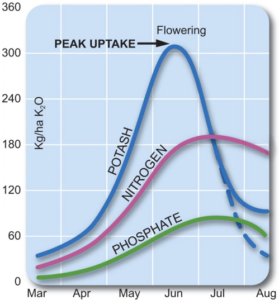
Potassium uptake occurs throughout the growing season, but is typically highest during periods of rapid biomass accumulation. Cereals often accumulate substantial amounts of potassium before grain fill, storing much of it in stems and leaves rather than in the developing grain. Unlike nitrogen, which is actively remobilised into the grain during maturation, potassium remains highly mobile and largely resides in vegetative tissue. This distinction is critically important when considering nutrient offtake and straw management decisions.
The chart below, taken from the Potash Development Association (PDA), shows the uptake pattern during the growing season.
What happens during senescence?
As crops approach maturity, leaves and stems begin to senesce. During this process, nutrients behave differently.
Nitrogen and phosphorus are substantially remobilised into grain, supporting yield and grain quality. Potassium behaves quite differently. Because it remains in ionic form and is not incorporated into complex organic structures, relatively little potassium is permanently locked into grain. Large quantities remain in stems, leaves and straw. Furthermore, potassium can be readily leached from standing crops by rainfall occurring between crop maturity and harvest.
Wet harvests often result in lower straw potassium concentrations because rainfall washes potassium out of senescing stems and leaves before the straw is baled. In effect, rainfall acts as a natural extraction mechanism, transferring potassium from crop residues back onto the soil surface where it can subsequently enter the soil potassium cycle. In contrast, dry summers and harvest conditions limit this leaching, allowing a greater proportion of the crop’s potassium to remain in the straw. This explains why potash levels found in baled straw can vary considerably from year to year.
This has important implications for nutrient management. In years where harvest conditions are dry, straw removed from the field may contain significantly more potassium than growers might expect based on average offtake values. This seasonal variability reinforces the importance of considering both straw management and prevailing weather conditions when estimating potassium removal and planning replacement fertiliser applications.
One field observation from the 2026 season has been the increased incidence of “pink straw” symptoms within cereal crops. The phenomenon is thought to result from enhanced anthocyanin biosynthesis triggered by abiotic stress, particularly drought, high solar radiation and thermal stress, rather than from potassium accumulation per se.
However, these same environmental drivers can alter potassium cycling within the senescing canopy. Under dry conditions, reduced rainfall limits the leaching of soluble potassium from vegetative tissues prior to harvest, increasing the proportion of crop potassium retained within straw residues. Consequently, the occurrence of pink straw may serve as a qualitative indicator of conditions under which straw potassium content, and therefore nutrient removals, could exceed typical values.
With less rainfall available to wash potassium from senescing tissues before baling, pink straw may act as a useful visual indicator that potassium offtakes could be higher than average where straw is removed from the field.
Where is the potassium at harvest?
For many cereal crops, a substantial proportion of total crop potassium remains in the straw rather than the grain. AHDB and PDA nutrient offtake values indicate that winter wheat grain alone removes approximately 5.5 kg K₂O per tonne of grain harvested, whereas grain plus straw removal increases total offtake to around 10.5 kg K₂O per tonne of grain. This demonstrates that approximately half of total crop potassium remains associated with the straw fraction at harvest.
In practical terms, a 9 t/ha wheat crop where straw is baled and removed may export close to 90 kg K₂O/ha or more from the field. Retaining and incorporating straw can therefore significantly influence whole-farm potassium balances.
Why potassium cycling matters
The potassium cycle is inherently efficient where crop residues are retained and returned to the soil. Unlike nitrogen and phosphorus, potassium is not incorporated into complex organic structures and remains largely in a soluble ionic form within plant tissues. Consequently, potassium is released relatively rapidly during residue decomposition and returned to the soil solution and exchangeable potassium pools, where it can contribute to the nutrient supply of subsequent crops.
However, where straw is routinely removed, potassium export can be substantial and may exceed replacement through nutrient inputs or soil reserves. Over time, this can lead to a decline in soil potassium status, particularly in soils with a limited capacity to buffer potassium depletion. This is especially relevant on lighter-textured UK soils, where lower cation exchange capacity and smaller potassium reserves increase the risk of soil K drawdown.
As attention turns to the implications of the 2026 harvest, a robust understanding of potassium partitioning within the crop and its subsequent cycling through the soil-plant system remains essential. Quantifying potassium offtakes, accounting for straw management practices, and monitoring soil potassium status are fundamental to maintaining crop productivity, preserving soil fertility and supporting resilient nutrient management strategies under increasingly variable climatic conditions.
How NRM can help
NRM offers a range of analytical services which can support decision-making. Regular soil testing for pH, phosphate, potash, magnesium, and nitrogen levels remains one of the most effective tools for improving crop performance and nutrient efficiency. If soils have not been analysed within the last four years, now is the time to act.
Now that the rains have started, contact your agronomist, advisor or soil sampling provider to arrange testing.
References
Wang, Y. and Wu, W.-H. (2017) ‘Regulation of potassium transport and signalling in plants’, Current Opinion in Plant Biology, 39, pp. 123–128.
AHDB. Phosphorus and Potassium Requirements of Cereals. Comprehensive review of soil K reserves, crop uptake, timing of application and nutrient replacement strategies.
AHDB. Nutrient Management Guide (RB209) 2026. Sections 1 and 4 provide UK guidance on potassium management, target soil indices and crop requirements.
AHDB. Grain Nutrient Analysis and its Role in Management. Discussion of crop potassium uptake, nutrient capture and factors affecting nutrient use efficiency.
Incidence of pink straw and potash in concentration.
Visit NRM