


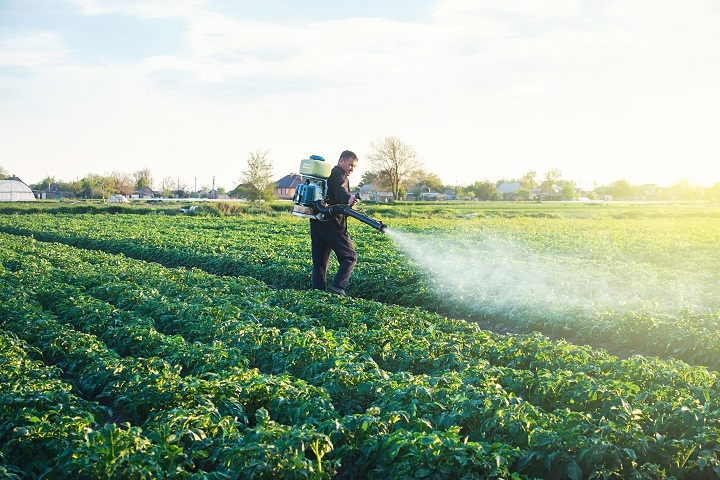
How PFAS reach agricultural land

Marchwood
NRM
Agriculture
Environment
In our first blog on poly- and perfluoroalkyl substances (PFAS), we introduced what PFAS (forever chemicals) are and how the farming industry is becoming more aware of their presence in agricultural systems. Now, we’re going to talk about how PFAS reach agricultural land.
Typically, PFAS don’t originate on most farms. They arise from broader industrial and environmental systems and processes, and research shows they are now widespread in soil, water and air, resulting from multiple entry points.
1. Biosolids (sewage sludge)
One of the most widely discussed pathways in UK agriculture is the application of treated biosolids. Biosolids can contain PFAS that have originated from:
- Household and personal care products
- Industrial waste
- Wastewater treatment processes
Evidence submitted to the UK Parliament indicates that land application of biosolids is a major pathway for PFAS to enter agricultural soils, and that these substances can leach into groundwater or be taken up by crops. More broadly, environmental groups and industry bodies are increasingly raising concerns about long-term accumulation in soils and the transparency of inputs. For farmers, this is currently the most important and debated route of introduction.
2. Water (irrigation, flooding & catchments)
PFAS are now widely detected in UK water systems, including rivers, groundwater, and catchments. Ongoing UK research is exploring how PFAS:
- Move through surface water and groundwater systems
- Accumulate in sediments and biological systems
- Travel across landscapes via catchments
Current research projects, such as one at the University of Portsmouth, are exploring the sources, movement, and impacts of PFAS in soil, water, and living organisms in England. In practice, this involves monitoring farms downstream of urban or industrial zones to assess increased exposure and studying how flooding events might serve as a redistribution mechanism.
3. Agricultural inputs: PFAS from pesticides & and their packaging
Less widely recognised, but increasingly important, is the role of crop protection products as a source of PFAS. In the UK, PFAS are used as active ingredients in pesticides such as Flufenacet, and evidence indicates that at least 31 PFAS substances have been approved for use in Great Britain. These substances are deliberately used because their fluorinated chemistry increases persistence and effectiveness, but this also means they can accumulate in soils, water and ecosystems.
At the same time, regulators highlight a second, less visible pathway: PFAS are widely used in materials and packaging because of their resistance to heat, oil, and chemicals.
Evidence submitted to the UK Parliament notes that PFAS can reach agricultural products not only through pesticides but also through packaging and supply chain processes.
In practice for farmers:
Pesticides are often stored in plastic containers incorporating fluorinated materials. Scientific evidence used in EU risk assessments indicates that PFAS can migrate from packaging materials into pesticides, thereby contributing to human and environmental exposure.
This matters because it creates a dual pathway of PFAS into agriculture:
- Direct: PFAS deliberately added to pesticide formulations.
- Indirect: PFAS entering via packaging, storage and supply chains.
4. Atmospheric and legacy sources
PFAS can also travel through the atmosphere as particles and gases and be deposited over time at distance from the original source. Combined with historical industrial activity, landfill sites, and firefighting foam use, this creates a situation where background contamination is widespread. A recent British Geological Survey study found PFAS present in all sampled English soils, highlighting their widespread nature.
What happens once PFAS are in the soil?
This is where PFAS differ from many other agricultural contaminants.
Persistence
PFAS are extremely stable; they do not break down easily and can remain in soils for decades or longer. This means repeated low-level inputs can lead to gradual accumulation over time.
Movement through soil and water
PFAS binds to soil particles and can move with soil water (depending on the type of PFAS), leaching into groundwater. Their behaviour depends on the soil type and the organic matter content.
The chemical structure of the PFAS matters (short-chain vs long-chain PFAS):
- Short-chain PFAS are smaller, more mobile molecules that do not readily bind to soil particles and are highly water-soluble. Consequently, they can spread easily across and within the environment.
- Long-chain PFAS are larger molecules and tend to more readily stick (adsorb) to soil particles and organic matter. This means they can accumulate in soil and sediment and persist for a long time.
Crop uptake
One of the key questions for agriculture is, do crops take up PFAS?
The answer is: yes, but it varies significantly. Research shows:
- Some PFAS can move from soil into plants via water uptake
- Uptake depends on:
- Crop type
- Soil conditions
- Type of PFAS (short or long chained)
Dietary exposure is considered to be the most significant route for PFAS uptake by people. There is growing evidence that crop consumption (either directly or as feed for livestock) may be a significant contributor, although this is still actively being researched. Importantly, knowledge gaps remain, particularly under real UK field conditions.
How PFAS reach agricultural land: agronomic implications
At this stage, PFAS is not a day-to-day agronomic concern in the same way as soil nutrients or soil pH. However, there are several emerging considerations:
Soil health
Some research suggests PFAS may affect soil microbial communities and influence biological processes linked to nutrient cycling. Although the evidence is still developing, this could have long-term implications for soil function.
Nutrient planning and inputs
The biggest practical consideration is the choice of inputs, particularly biosolid amendments, water sources for crop irrigation, and crop protection products.
Farmers may increasingly need to:
- Understand the origin and treatment of inputs
- Factor contaminant risk alongside nutrient value
Variability and uncertainty
One of the biggest challenges is inconsistency, and this makes risk harder to quantify at the farm scale.
- PFAS levels can vary within a single field
- Distribution can be highly uneven
- Crop uptake can differ widely between species
Balancing risk with practical reality
In the UK, PFAS regulation is still evolving:
- Outside of wider existing environmental and food protection legislation there are no current widespread PFAS specific farm-level restrictions in the UK today.
- Much of the research is still developing and incomplete.
- Actual risk varies significantly between locations and systems.
However, the direction is clear. We are seeing more scrutiny of inputs and pathways, greater emphasis on traceability and transparency, and increasing alignment with environmental and food safety concerns.
Looking ahead
PFAS affects the agricultural system more broadly than it does individual farms. Knowing how PFAS moves through agriculture helps farmers manage risks and adapt commercially and agronomically.
Our final blog will discuss the steps UK farmers can take now to mitigate risks, anticipate regulations, and future-proof their farms – so watch this space!
How we can help
Since 1998, our sister laboratory, Marchwood, has been delivering specialist analysis of Persistent Organic Pollutants (POPs), including PFAS.
Our PFAS analytical services
- Target list of 52 substances
- Matrices: environmental solids, environmental waters, food and feed commodities, waste, industrial processes, and firefighting foams
- Total Oxidisable Precursors (TOP) Assay to identify potential PFAS presence outside of the standard target list
- Low detection limits for challenging environmental samples
- Full, up-to-date compliance with current and upcoming legislation
To understand more about PFAS and how we can help, sign up here.
What the UK research is telling us
Across government, academia, and industry, the UK evidence base is growing.
Key resources include:
- Environment Agency research on PFAS sources and pathways:
PFAS: sources, pathways and environmental data (EA report) - Soil monitoring work from the British Geological Survey:
PFAS in shallow English soils - Ongoing catchment and transport research:
University of Portsmouth PFAS transport study
- Poly- and perfluoroalkyl substances (PFAS): sources, pathways and environmental data: summary
- AIC’s response to the Environmental Audit Committee’s Call for Evidence
https://committees.parliament.uk/writtenevidence/142115/pdf/
- PFAS Free – Farmers Hub
https://pfasfree.org.uk/farmers-hub
- PFAS Free – Farmers Hub
PFAS pesticides in Great Britain & the EU – PFAS
Visit NRM