


When to sample autumn sown cereals in 2026: key growth stages and what they tell you

NRM
Agriculture
When to sample autumn sown cereals in 2026: key growth stages and what they tell you
Understanding the critical windows for CropCheck tissue analysis
As cereal crops move through their life cycle, they continuously shift in both structure and size while steadily accumulating dry matter. These physiological changes are defined by recognised cereal key growth stages (GS) and developmental phases.
While winter cereals follow a broadly predictable pattern, the timing of each growth stage is far from fixed. Weather conditions, drilling date, soil type, and variety all influence how quickly crops develop.
For example, crops with larger canopies going into spring will already have accumulated more nitrogen from the soil over autumn and winter, which makes deciding when to begin spring nitrogen applications more nuanced.
Additionally, autumn-sown cereals drilled in 2025 that established well are generally further ahead in their development and are likely to move quickly through the key growth stages if spring conditions favour growth. For example, winter wheat crops typically exit the tillering stage (GS20-29) and enter the stem extension stage (GS30-31) between late March and mid-April, depending on drilling date, variety, and spring temperatures. GS30-31 is the point where stem extension begins, and the first node becomes detectable, marking a major shift in the crop’s physiology and nutrient demand.
Wherever the crops are, the challenge is striking the right balance between:
- Maintaining a steady nutrient supply
- Managing tiller numbers to ensure the crop produces the optimal number of ears to fulfil the crop’s yield potential.
Understanding when key growth stages occur, and sampling accordingly, is critical to protecting that potential.
Why growth stage timing isn’t just about the calendar
Plant growth and development are strongly governed by thermal time (growing degree days), rather than the calendar date.
A crop progresses through its key growth stages as it accumulates growing degree days from the start of spring. For example, wheat advances when sufficient heat has accumulated to trigger physiological change. As temperatures rise, thermal time builds more quickly, accelerating development towards key milestones such as:
- GS30-31 (start of stem extension)
- GS37-39 (flag-leaf emergence)
In a warm spring, these stages can arrive noticeably earlier, while cooler conditions slow development, even if day length is increasing. This is why two fields sown on the same date can reach the same growth stage at different times: it is the accumulated heat, not the month, that ultimately determines the pace of development.
The following chart, published in the AHDB Wheat Growth Guide, shows the typical timings for winter wheat to reach each developmental stage and the corresponding critical GS.
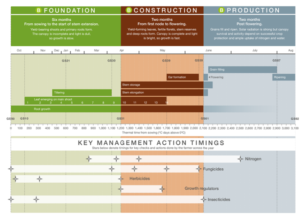
Key growth stages 30-31: the construction phase begins
Knowing when to sample is just as important as knowing why.
When will wheat reach key growth stages 30-31? We don’t have a crystal ball, but these are typical time frames.
Expected timing: Mid‑March to early April 2026
- Early‑drilled crops may hit GS30 in early-mid March
- Later‑drilled crops may reach GS31 closer to early April
- Strong early growth may pull timings forward.
At GS30, the first node becomes detectable.
According to the latest ADAS Crop Action report, winter wheat growth stages currently range from tillering to GS32. Winter barley ranges from GS30 to GS32, and spring-sown crops are emerging to GS12.
Why GS30-31 matters
This is the moment nutrient demand truly switches on. The crop is determining:
- Tiller survival
- Early canopy structure
- Stem development
Deficiencies here threaten ear number, which in turn can limit yield potential. However, there is still ample time to adjust nutrient management plans or apply targeted foliar products before the crop enters the rapid canopy-building phase. CropCheck analysis on a sample taken at GS30-31 confirms whether the crop has the nutrient base it needs for the construction phase.
GS37-39: the production phase
Expected timing: Late April to mid‑May 2026
- Warmer regions may see GS37 in late April
- Cooler northern areas may lag by 7–10 days
Why GS37–39 matters
The flag leaf contributes up to 50% of the final grain fill. Deficiencies at this stage reduce:
- Grain number
- Grain size
- Final yield
CropCheck analysis on a sample taken at GS37-39 ensures the crop has the nutrition to support the production phase (grain fill) and maximise performance.
Weather considerations for 2026
Although this season’s early autumn conditions have been favourable, nutrient dynamics remain weather‑sensitive.
Key risks include:
- Cold soils slowing nutrient mobility
- Dry conditions reducing nutrient uptake
- Wet periods increasing the risk of nitrate leaching
- Rapid spring growth diluting nutrient concentrations and creating transient deficiencies
- High biomass crops placing a greater demand on nutrient reserves.
As climate change drives more frequent extremes, including wetter winters, sudden dry spells, and intense rainfall events, managing crops and soils becomes increasingly about building resilience rather than reacting to stress. These shifts place greater pressure on crop establishment, root development, soil structure and nutrient timing, making it essential to understand how crops respond in real time.
Building resilience through in-season monitoring
Regular soil health assessments and in-season tissue analysis provide growers with the insight needed to adapt farming operations. Investing in soil resilience over time will protect farm productivity and profitability: building and protecting organic matter, maintaining good soil structure, and balancing nutrition creates a buffer against unpredictable weather and helps safeguard farm productivity and profitability for future generations.
Taking the step to invest in NRM’s CropCheck service this season could prove vital for safeguarding yield potential in what is shaping up to be an unpredictable year – already!
How NRM can help
Give your crops the best chance of success this season. Crops will be romping through the growth stages, and sampling at the right time ensures you can correct deficiencies before they impact yield. Book NRM’s CropCheck analysis service now.
Click here to order your sample kits, or speak to your agronomist and plan ahead.
References
Visit NRM