



CropCheck or CropCheck Plus: which tissue analysis package should I choose?

NRM
Agriculture
In-season tissue testing is one of the most reliable ways to understand what’s happening within the crop before visible symptoms are observed in the field. By analysing plant tissue at key growth stages, you gain a clear picture of nutrient uptake, hidden deficiencies, and potential yield limitations before they become costly problems.
NRM’s CropCheck analysis packages are widely used by growers and agronomists who want accurate, actionable insight into crop nutrient status. However, with two services available — CropCheck and CropCheck Plus — you might be wondering which is the most appropriate for you.
The good news is that the difference between the two is simple. Choosing the right option can make your recommendations sharper, more targeted, and ultimately more cost-effective.

What does CropCheck include?
NRM’s standard CropCheck analysis package provides a broad-spectrum nutrient profile, covering the major and micronutrients most commonly used to diagnose deficiencies and guide mid-season management decisions.
Nutrients analysed include:
- Nitrogen (N)
- Sulphur (S)
- N:S ratio
- Phosphorus (P)
- Potassium (K)
- Calcium (Ca)
- Magnesium (Mg)
- Copper (Cu)
- Manganese (Mn)
- Zinc (Zn)
- Iron (Fe)
- Boron (B)
- Sodium (Na)
This suite provides a comprehensive understanding of the nutrient content of crop dry matter, helping identify potential deficiencies before they affect yield or quality.
CropCheck is best suited for:
- Cereals and broadacre crops
- Routine mid-season checks
- Benchmarking nutrient status within and between fields
- Monitoring nitrogen and sulphur balance.
NRM provides growth-stage interpretation specifically for cereal crops, allowing results to be compared with established critical values for more accurate agronomic decisions.
What does CropCheck Plus add?
CropCheck Plus includes everything in the standard CropCheck service, with one important addition:
+ Molybdenum (Mo)
That’s the only difference — but it’s a meaningful one.
Why is molybdenum important in crop nutrition?
Molybdenum may be required only in small amounts, but its role in plant health is significant.
Molybdenum is:
- Essential for nitrate reductase, the enzyme that converts nitrate into usable forms
- Critical for efficient nitrogen metabolism, especially in high nitrogen systems
- Important for legumes and brassicas
- More likely to be deficient on acidic or sandy soils, where crops will suffer
- Involved in overall plant energy processes and stress tolerance.
Without adequate molybdenum, crops may struggle to utilise applied nitrogen efficiently, even when nitrogen levels appear sufficient.
CropCheck Plus is best suited for:
- High-value vegetable crops
- Brassicas and legumes
- Crops grown on low pH soils
- Fields with known molybdenum deficiency risk
- Situations where advisors want a more complete micronutrient picture.
As with the standard service, growth stage-specific interpretation is provided for cereals. However, the additional molybdenum data makes CropCheck Plus valuable across a wider range of crops and soil types.
CropCheck or CropCheck Plus: side-by-side comparison
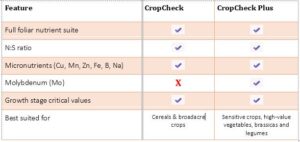
How to decide between CropCheck or CropCheck Plus
Choosing between the two services largely comes down to crop type and soil risk factors.
- Growing cereals or broadacre crops?
CropCheck is usually sufficient for routine nutrient monitoring. - Growing vegetables, brassicas, or legumes?
CropCheck Plus provides additional insight where molybdenum plays a critical role. Please note that GS-specific values aren’t applied for other crops. - Farming low pH or sandy soils?
CropCheck Plus is the safer option due to increased molybdenum deficiency risk. - Seeing unexplained nutrient symptoms?
Molybdenum can sometimes be the missing piece — making CropCheck Plus a valuable diagnostic tool.
The bottom line
Both services deliver reliable, actionable crop nutrient insight through professional tissue testing and growth stage interpretation.
The only difference is molybdenum. In the right crop or soil, that single element can have a significant impact on nitrogen efficiency, crop health, and overall performance.
- If molybdenum risk is low, CropCheck will likely meet your needs.
- If molybdenum could be limiting, CropCheck Plus provides the extra layer of confidence.
How NRM can help
Give your crops the best chance of success this season. Book NRM’s CropCheck analysis service now (when your cereal crops are at GS30-31) to ensure nutrition aligns with crop demand before stem extension accelerates.
Click here to order your sample kits, or speak to your agronomist and plan ahead.
Visit NRM