



Preparing for spring cropping: key agronomic priorities after a challenging season

NRM
Agriculture
After one of the wettest UK winters in recent memory, many growers are heading into spring with more uncertainty than usual. It’s more important than ever to prepare for spring cropping.
A useful way to illustrate just how persistent this winter’s rainfall has been is to look at the number of consecutive wet days recorded across the UK. The Met Office reported that from late December into early February, several observing sites logged extraordinary periods of 37 days or more with measurable rainfall. Read our previous expert blog here to learn more about the weather conditions in autumn 2025.
North Wyke in Devon, Bodmin in Cornwall, and Aston Bank in Herefordshire recorded 40 consecutive wet days between 31st December 2025 and 8th February 2026. Liscombe in Somerset and Camborne in Cornwall each saw 37 straight wet days over a similar period. These persistent sequences highlight how frequently weather fronts have crossed the country and how rarely soils have had the drying intervals needed to recover, reinforcing the challenges growers now face as they prepare for spring fieldwork.
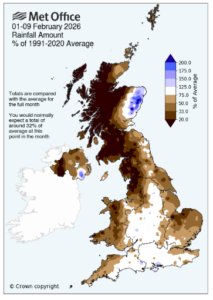
The figure below from the Met Office shows the percentage of monthly rainfall experienced across the UK between the 1st and the 9th of February.
Waterlogged soils, delayed drilling, and disrupted nutrient cycles all raise the stakes for getting spring cropping right. But with careful planning, and a clear understanding of soil nitrogen supply, drilling windows, and fertiliser strategy, there’s still every opportunity to set crops up for a strong season.
Essential agronomic considerations to focus on as spring approaches
1. Review the fundamentals: assess field conditions and soil structure
Wet winters leave a legacy. Before thinking about seed rates or fertiliser applications, it’s worth assessing:
- Soil structure and compaction
Heavy rainfall and machinery use on marginal days can create compaction and surface smearing. Spring crops rely on rapid early root development, so any restriction can limit establishment, nutrient uptake, and yield potential. - Drainage and surface water
Persistent wet patches may delay drilling or require tactical changes in crop choice or field plans. - Soil temperature
Spring crops need warmth for uniform emergence. Cold, saturated soils slow nitrogen mineralisation, germination, and increase the risk of seedling disease.
A simple spade test across fields can reveal the soil’s physical health and help prioritise remedial action. Laboratory analysis can describe the chemical and biological effects of prolonged extreme weather.
2. Drilling dates: how wet weather shapes the spring window
In 2026, drilling dates will be dictated less by the calendar and more by soil workability. Key considerations include:
- Delayed land access
Many fields may not be trafficable until significantly later than usual. For spring cereals, pulses, and maize, this may compress the drilling window. - Seed rate adjustments
Later drilling often means higher seed rates to compensate for reduced tillering or slower establishment. - Variety choice
Some varieties cope better with late drilling than others. Where flexibility exists, consider switching to faster-developing varieties. - Seedbed quality
Rushing onto land too early can cause long-term structural damage and cloddy seedbeds. A slightly later drilling date is often better than compromising the seedbed and soil structure.
The message is simple: drill when the soil is ready, not when the calendar says you should.
3. Soil Mineral Nitrogen (SMN) and Soil Nitrogen Supply (SNS): Why analysis matters more than ever
After prolonged rainfall, nitrogen losses through leaching and denitrification are almost inevitable, especially on lighter-textured soils and/or fields left bare over winter. This makes SMN testing a critical step in spring cropping.
Why measure soil nitrogen this spring?
- To understand what remains after winter losses
Wet conditions can increase SMN leaching down the soil profile or out of the system altogether, leaving crops short at key early growth stages. - To accurately calculate Soil Nitrogen Supply (SNS)
SNS underpins RB209 recommendations and helps tailor fertiliser plans to real field conditions rather than assumed conditions. Measurement increases the accuracy of SNS assessments. - To avoid under or over‑application
Under-application risks yield losses and not meeting quality standards; over-application wastes money and increases environmental risk.
How to measure SMN effectively
- Sample soil for N-Check or N-Check Plus before any manures or fertilisers have been applied, but close to spring drilling.
- If SNS is judged to be higher or variable, consider N-Check Plus, which includes an organic matter analysis to estimate the amount of organic nitrogen that will mineralise during the season.
- Prioritise high leaching-risk fields or select a field which is representative of a block of fields growing the same crop.
In a season like this, relying on “typical” SNS values is risky. Field-specific data gives growers the confidence to adjust fertiliser plans accurately.
4. Adapt fertiliser plans to account for SNS
Understanding the differences between the available soil nitrogen tests is essential when planning fertiliser strategies for spring crops, especially after a winter when leaching and denitrification are likely to have reduced soil reserves.
NRM’s N‑Check and N‑Check Plus services are two analytical tools for assessing soil nitrogen availability and supply, but they provide different levels of insight. The table below outlines the key distinctions.
Table 1 – NRM N‑Check vs N‑Check Plus
| Feature / Purpose | NRM N‑Check | NRM N‑Check Plus |
| Primary aim | Measures soil mineral nitrogen (SMN) to show how much plant-available N is present at sampling | Provides a full Soil Nitrogen Supply (SNS) estimate by combining SMN with an estimate of mineralisable N |
| What it provides | A snapshot of current nitrate-N + ammonium-N levels | A complete picture of the total nitrogen supply that is likely to become available over the course of the season |
| Depth of sampling | Typically 0-15, 0–30, 0–60, 60-90cm. Appropriate depth dependent on crop rooting depth | Same depth, with additional SOM analysis to estimate nitrogen release potential – measured on the shallowest depth if multiple depths are submitted for analysis |
| Best use cases | Checking SMN losses after wet winters, adjusting early N applications, often for high risk fields | Creating accurate RB209-aligned fertiliser plans for soils with higher organic matter contents |
| Key components analysed | Nitrate (NO₃⁻), ammonium (NH₄⁺) | Nitrate (NO₃⁻), ammonium (NH₄⁺), SOM and an estimate of additional mineralisation |
| Output | SMN value reported – advisor to adjust fertiliser rates | Full SNS index reported for RB209 recommendations |
| Why choose it? | Quick, cost-effective, ideal where nitrogen mineralisation is lower | More comprehensive; ideal where soil organic matter is greater than 4%, providing an additional supply |
Bringing accurate soil nitrogen testing into spring planning gives growers a far firmer footing in what is otherwise an unpredictable season. Whether using N‑Check or N‑Check Plus, the insight into soil nitrogen supply helps ensure nutrient plans align with real field conditions rather than assumptions — something especially valuable after a winter of prolonged rainfall and likely nutrient loss. By grounding decisions in measured data, growers can adapt their strategies with confidence, protect yield potential, and make the most of every opportunity as drilling windows finally open.
Once SNS is understood, fertiliser strategies can be adapted to the season’s realities.
Key adjustments to consider
- Avoid front-load loading nitrogen on compromised soils
If soils are cold or poorly structured, early N uptake will be limited. Smaller, split applications can reduce losses and improve efficiency. - Increase total nitrogen where SNS is low
Many growers will find SMN levels lower than average this year. Use N-Check or N-Check Plus to understand how much nitrogen remains in the soil. Adjusting total applied nitrogen accordingly will help to support yield potential. - Consider crop-specific needs
- Spring barley: sensitive to nitrogen rate and timing, which is crucial for balancing yield and grain quality. Target seedbed and the two leaf stage for optimal application.
- Pulses: rely on nodulation; avoid unnecessary nitrogen application that suppresses nitrogen fixation. Ensure that sulphur and micronutrients aren’t limiting.
- Maize: often benefits from starter fertiliser if soils are slow to warm. Always account for nutrients supplied by manures.
- Use inhibitors or protected fertilisers after 31st March
Urea-based fertilisers must be inhibited if applied after 31st March. Inhibitors help to reduce nitrogen losses to the atmosphere as soil and air temperatures rise. - Don’t overlook sulphur
Sulphur is highly mobile in soils and is readily leached during wet winters. Most spring crops now require sulphur for optimal yield and protein formation.
5. Crop protection and weed management after a wet winter
Spring crops may face intense early weed competition, especially when autumn or early spring herbicide programmes are disrupted.
- Use stale seedbeds where drilling is delayed
A well-timed glyphosate pass can significantly reduce weed pressure. - Choose herbicides carefully
Soil moisture affects herbicide performance; some actives require good soil contact, while others risk crop damage in saturated conditions. - Monitor pest pressure
Wet winters can reduce some pest populations but increase others, such as slugs in certain soil types.
6. Flexibility and adaptation is central to effective nutrient management plans
This spring will reward growers who stay adaptable. This means:
- Preparing contingency plans for late drilling
- Being ready to adjust seed rates and fertiliser timings as conditions evolve
- Using real SMN and SNS data to guide nutrient decisions
- Prioritising fields based on soil condition, not crop rotation alone.
Spring cropping is always a balancing act, but with thoughtful preparation and a clear understanding of soil nitrogen dynamics, growers can still achieve strong, resilient crops despite the challenges of a wet winter.
How NRM can help
Our N-Check and N-Check Plus analytical packages measure the amount of available nitrogen in spring. N-Check Plus also estimates the additional organic nitrogen that will be mineralised from soil organic matter during the growing season.
Contact NRM for more information or discuss how to go about soil nitrogen sampling with your agronomist.
Click here to order kits and learn more about our N-Check services.
References
How much rain have we had so far? – Met Office
Visit NRM