


How the weather is shaping winter crop nutrition: what farmers need to know

NRM
Agriculture
As we move further into 2026, UK farmers are increasingly facing unpredictable weather conditions that are influencing soil nutrient dynamics and winter crop nutrition. Understanding how recent weather trends affect soil mineral nitrogen (SMN) can save costs, reduce environmental risk, and inform how we fertilise crops in spring for optimal performance.
The weather since autumn establishment
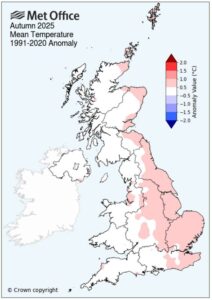
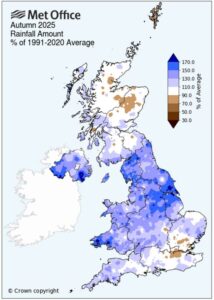
Autumn 2025 was generally warmer and wetter than average across the UK. The Met Office (2025) has reported that autumn temperatures were around 0.4 °C above the 1991-2020 average, especially in eastern England. Rainfall totals exceeded average levels in many regions, with Northern Ireland having its third wettest autumn on record and Wales its tenth.
This period also brought multiple named storms (Amy, Benjamin and Claudia) that delivered heavy rain, strong winds and localised flooding.
What did this mean for autumn crop establishment?
- Some soils were often saturated or slow to drain throughout autumn in the most affected regions. Waterlogged conditions delayed fieldwork impacting on drilling date.
- In many regions where autumn conditions were more favourable, crops were well established and, as a result, have taken up excess nitrogen during the autumn and winter period.
- In regions where significant rain events occurred, particularly on bare ground, there is a risk of nitrate leaching down the soil profile and beyond the rooting depth of any winter-sown crops.
Winter has kicked off with cold waves and wintry conditions in late December and into early January. Temperatures plunged across the UK, prompting widespread snow, ice and cold-health warnings from the Met Office. Snow accumulations and sub-zero nights have been reported in many areas, especially in northern Scotland and high upland areas.
This spike in freezing conditions is in stark contrast to much of 2025, which overall was the warmest and sunniest year on record in the UK. This unpredictable weather variability is an indicator of rapid climate change worldwide.
What’s the weather looking like for the rest of winter?
How long is a piece of string! But the Met office and other forecasts like WeatherQuest (used by Farmers Weekly) suggest that, instead of extreme cold or heat, we’ll see continued changeable weather.
For example, Net Weather (2025) suggests that temperatures are forecast to be above the 1991-2020 long-term average. Rainfall is also likely to be above average, particularly in February. However, cold snaps like the one seen at the beginning of 2026 can’t be ruled out due to atmospheric shifts.
Ultimately, it’s likely to be mild on average, but interspersed with chilly spells, frost, and unsettled rainfall. For farmers looking to optimise crop nutrition amid uncertain conditions, soil measurement has never been more important.
What this means for farmers looking to optimise winter crop nutrition
Testing soils to understand soil mineral nitrogen (SMN) levels is an important step in improving winter crop nutrition. SMN is a combination of nitrate and ammonium and represents the proportion of soil nitrogen that’s immediately available for crop uptake.
For farmers planning spring fertiliser strategies, knowing how much SMN is available in the soil can help:
- Minimise the risk of over-applying nitrogen fertilisers and manures.
- Reduces the spend on inorganic fertiliser where it isn’t needed.
- Minimises the risk of nitrate loss to water and the wider environment.
Weather over the autumn and winter period has a big influence on SMN levels in the spring.
Cold and frost: slow mineralisation
Microbial activity, which converts organic nitrogen to mineral nitrogen, drops to zero when soils are cold or frosted. The process only begins again when soil temperatures reach 6oC and above. This means that soils can retain organic nitrogen over winter. However, in spring, when the mineralisation process resumes, the release of SMN can be delayed, particularly in heavier-textured soils, which typically warm up more slowly than lighter-textured soils.
So, if cold weather persists during the early spring, farmers might find lower-than-expected SMN levels for a time until mineralisation occurs. This is why testing is crucial to determine SMN levels, so the rates and timings of applied nutrients can be refined to properly account for soil supply.
Heavy rain: risks nitrogen losses
Heavy autumn and winter rainfall on already saturated soils increases the risk of nitrate leaching, particularly on lighter-textured soils with good drainage. The heavy rainfall we have seen so far this season may have leached some soil nitrate deeper in the profile below the root zone, limiting crop access, particularly in the early spring.
As well as the risk of increased environmental pollution, it could also mean that farmers have to purchase additional nitrogen fertiliser to account for a lower soil nitrogen supply (SNS).
Dry spots: nutrient immobility
Despite the wet autumn of 2026, the regional drought conditions that persisted through much of 2025 affected the uptake of nutrients due to immobility in the soil. These drought-stressed crops were unable to recover nitrogen from the soil or inputs. This could mean higher than anticipated SNS levels in 2026, but only if autumn crops were sown in good conditions and captured a chunk of the previously unused nitrogen from the previous harvest.
How NRM can help
No matter the weather in your region, testing SMN in spring before you begin applying inputs is crucial. This allows you to:
- Assess the true soil nitrogen supply across your farm
- Optimise input rates and timings
- Avoid buying more nitrogen fertiliser than necessary.
Our analytical services, N-Check and N-Check Plus, will help you understand the nitrogen levels across your farm for the upcoming growing season. Early planning is key to maximising crop productivity and minimising input costs.
Contact NRM for more information or discuss how to go about soil nitrogen sampling with your agronomist.
Click here to order kits and learn more about our N-Check services.
Visit NRM