



Irish soil data analysis 2023-2024 part 1: insights for sustainable agricultural production – pH

IAS
Agriculture
Do you farm in Ireland? Are you interested in the fertility of Irish soils and how it can be improved?
This blog presents IAS Laboratories’ Irish soil data findings from the analysis of 45,000 soil samples collected across Ireland between June 2023 and May 2024. The data reveals critical insights into soil pH and phosphorus levels, both of which are essential for optimising agricultural productivity and ensuring environmental sustainability.
Key findings include:
- Soil pH: The average soil pH was 6.4, close to the ideal range for crop and grass/clover growth (6.2–6.5). However, 37% of samples fell below pH 6.0, indicating a need for liming or other corrective measures in many fields.
- Soil phosphorus: Around 63% of the soils tested were deficient in phosphorus (falling into Index 1 or 2), which can limit grass/crop yields. Only 22% were in the optimal range (Index 3), and 15% had excessive phosphorus levels (Index 4), posing potential environmental risks.
Today, we are looking at soil pH and what our findings mean for Irish farms.
Irish soil data analysis and key findings
Regular soil testing brings many benefits for optimal agricultural and environmental management. It provides crucial insights into the nutrient status of the soil, enabling farmers and land managers to make informed decisions about fertilisation and soil amendments. By knowing the soil nutrient supply, farmers can optimise nutrient applications, reduce waste, and minimise risks to the environment through over supply.
Irish soil data: soil pH
pH is a critical soil attribute because it significantly influences nutrient availability, microbial activity, and overall crop health. The optimal soil pH recommended for grass/clover and crop production ranges from 6.2 to 6.5.
The results collected by IAS in 2023-2024 indicate that pH levels ranged from 4.3 (strongly acidic) to 8.3 (alkaline) which is described by the box and whisker diagram in Figure 1 below.
Low soil pH increases the availability of aluminium (Al) and manganese (Mn), which can reach toxic levels and harm plant roots, reducing their ability to absorb water and nutrients. Also, nutrients such as potassium, calcium, and magnesium become prone to leaching, particularly in areas of high rainfall when the soil is too acidic. On the other hand, soil phosphorus and micronutrients such as boron, copper, iron, manganese and zinc become less available as soil alkalinity increases.
Figure 1 illustrates the distribution of pH results. The chart also highlights the average soil pH (6.4), indicated by the ‘X’ on the boxplot. The figure shows that about 25% of the samples had a pH below 5.8, while 75% of the samples had a pH below 6.8. The dark line in the middle of the shaded box indicates the median pH, 6.3.
Figure 1: Soil pH range of Irish soils 2023-2024
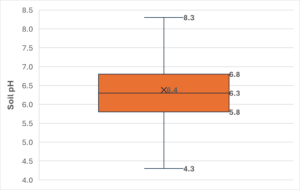
Figure 2 shows that 37% of the samples were less than pH 6.0, which is below the optimal level for crop and grass/clover production. A further 38% of samples were at or around the target pH for grass/clover and crops (between 6.2 and 6.7). The figure also shows that a quarter of the samples were higher than the target pH for crop and grass/clover production.
Figure 2: Percentage distribution of soil pH in Irish soils
Too low (<6.0), optimal (between 6.0 and 7.0) and high (> 7.0 and above)
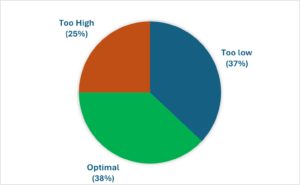
The soil analysis indicates that while the average soil pH is close to the optimal range for crop and grass/clover growth (6.2–6.5), a significant proportion (37%) of samples fall below pH 6.0. To address this, it is recommended that farmers prioritise soil testing to accurately assess pH levels and consider liming to correct the acidity balance.
Adjusting soil pH is essential to regulate nutrient availability and manage crops and soils. Regular monitoring will help maintain pH within the target range, optimising plant health and reducing potential nutrient losses.
How IAS can help
Our various soil analysis suites enable you to benchmark and improve soil health, plan crop nutrition, save money and maximise profitability.
We make the whole process easy for you:
- We provide a free sample kit containing everything you need for analysis including sample bags, a delivery envelope, an analysis request form, and full instructions on taking and sending samples.
- Results are reported within 10 working days from the time of registration, in an easy-to-understand visual format so nutrient adequacy can be determined quickly.
Contact us or speak to your advisor direct to receive your free soil sampling kit today.
Click here to read part 2 of our soil summary, where we talk about phosphorus in Irish soils.