


World Water Week 2024: how soil water is essential to life

NRM
Agriculture
With its intimate relationship to soil physical characteristics, soil water is not a passive element in the ground. It actively supports the survival of biological life and the healthy growth of plants. The soil’s influence on water flow and holding capacity, determined by porosity, is profound. The more water a soil can store, the greater its potential for biological activity and healthy plant growth.
This World Water Week, we’re diving into water and its essential role in soil life. Read on to learn more about the water cycle, how water moves through soil, water use efficiency, and NRM’s analytical services.
The water cycle and soil water
The water cycle is a significant natural process and describes the movement of water around the Earth. Water falls as rain (precipitation) and either evaporates from the surface, is taken up and then transpired by plants, is stored in soil or groundwater, or flows directly into water bodies such as rivers, lakes, and oceans. It then evaporates to form clouds through condensation and potentially falls once more as rain. This cycle significantly impacts the Earth’s climate, and soil and ground cover conditions are vital in ensuring the water cycle’s function.
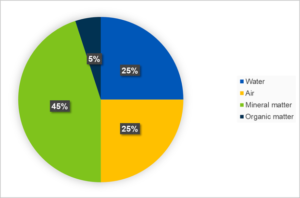
In a healthy, functioning soil, 25% of the soil is water; the other components comprise air, minerals, and organic matter. For life to function and thrive in soil, water and air is required in equal quantities. The mineral composition of soil depends on how it has been derived from which parent material (rock) and the process of weathering which has taken place over millennia.
The amount of water retained in the soil is dictated by several factors, such as soil texture, structure and depth, topography, rainfall and climate, soil chemistry, biology, and the type of above-ground cover. Soil water is better described as a “soil solution,” a term used to describe the water in contact with the soil particles and containing dissolved nutrients. The soil solution is constantly replenished as a dilute nutrient solution that supplies nutrients to plant roots, facilitating healthy growth.
Soil water: how water moves through soil
Each raindrop that makes contact with the land has a limited number of pathways contributing to the cycle. On contact with the soil surface, it may:
- Infiltrate into the soil
- Be taken up by a plant and transpired back to the atmosphere
- Be stored for a while in the soil profile
- Percolate (filter) through to groundwater
- Evaporate directly from the soil surface
- Move across the soil surface as runoff, often carrying soil particles and causing erosion.
There are three primary ways that water moves through or is held in the soil.
Gravitational water
Water infiltrating through the soil from rainfall or runoff drains freely through larger macropores under the influence of gravity. This water does not stay in the soil for long periods and does not directly contribute to plant growth.
Capillary water
Some water entering the soil is retained as a film on the surface of soil particles within aggregates. It is held due to surface tension and can be utilised by plants and soil biota for growth. This pool is referred to as plant-available water.
Hydroscopic water
This water is held tightly to soil particles and between clay layers in small micropores. The soil particles strongly attract this water and compete with plant roots. So, not all soil water is plant-available.
Water is held within soil pores with varying degrees of tenacity depending on the amount of water present and the size of the pore. Contingent on the soil texture, between 25 and 75% of the soil moisture remains after plants have wilted or died due to a lack of water supply.
Different soils have different capacities to hold and release water, depending on their texture, structure, and organic matter content. The role of soil structure and organic matter in water-holding capacity is crucial. Clay soils, for instance, have a greater water-holding capacity than sandy soils, which drain more freely. Organic matter, mainly when present as humus, acts as a sponge in the soil, holding up to four times its weight in water.
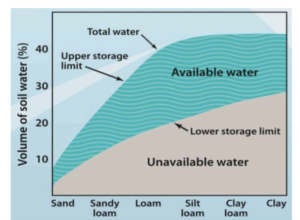
The chart below shows the typical proportions of available and unavailable soil water across different soil types. Light sand soils contain very little of both as opposed to soils with higher clay content, where the total water content and the proportion of both increases.
Improving the structure of soil influences how water behaves within it. For example, increasing the amount of organic matter a lighter soil contains will help to retain water for longer periods of time during periods of drought. How and when you approach cultivating soils can reduce or increase the risk of soil surface capping and/or slumping. Sandy and silt soil textures are at risk of surface capping and can quickly slump, where aggregates lose structure entirely and combine. Avoiding creating super fine tilths and working soils when the weather conditions are likely to be against you can help mitigate against surface capping and reduce the risk of water and soil erosion from these soil textures. Additionally, adopting a controlled traffic farming system to minimise the areas of the field that are driven is a practical approach to reducing soil compaction from field operations on all soil textures. To find out more about this system of operation, click here.
How grazing livestock is managed is also essential. Animals can cause enormous damage to the soil if they are kept too long on the same area of land, mainly if the weather is extreme for an extended time on heavier textured soils. This situation causes soil surface poaching, compacting the land. So, we must be prepared to move animals more frequently, house them earlier, and move supplementary feeding rings more often to reduce the pressure on soil from congregating animals. Even in a grassland system, compacted soil reduces water infiltration into the ground, causing waterlogging and surface run-off.
When water runs off the land, it takes with it soil aggregates, nutrients and other organic compounds, which are deposited into rivers and streams, enriching and degrading the water body.
Soil water and water use efficiency
Water use efficiency measures the effectiveness of converting rainfall into herbage mass. In a crop or grazed pasture, the kilograms of dry matter (DM) produced per millimetre of rainfall are a metric that can be used to assess how well soil water is being used.
To maximise the efficiency with which crops use water, there are two essential components to consider:
Infiltration rate: increase the amount of water entering the soil in any rain event.
Storage capacity: maximise the storage capacity of the soil to store plant-available water.
Soil structure, porosity, and pore size distribution influence water infiltration rate and storage capacity, and soil management significantly impacts all aspects of soil structure. Better water management relies on better soil management, and their interaction determines how sustainable we can produce food now and in the future.
How NRM can help
NRM has a range of soil analytical services to help you benchmark and manage your soils for improved water use efficiency. For example, we provide soil organic matter analysis to help you utilise your results to improve organic matter levels.
Get in contact here or speak to your agronomist.
References
Home | Controlled Traffic Farming
Visit NRM