



The trace element you should watch for in arable crops

NRM
Agriculture
Trace elements are essential to productive and profitable crops. Issues are common, with manganese deficiency more widespread in the UK than most other nutrients. Although many growers often use foliar treatment programs to control manganese deficiencies in crops, numerous crops still suffer. When symptoms are less conspicuous, problems are easier to miss.
The risk of trace element deficiencies is best managed by comprehensive soil analysis to provide a full picture of the likely issues on any one farm. As seen below, 43% of soil samples NRM analysed for manganese in the last eight years were deficient.
| Nutrient | % of soil samples deficient between 2013 & 2021* |
| Boron | 17% |
| Calcium | 44% |
| Copper | 38% |
| Magnesium | 15% |
| Manganese | 43% |
| Molybdenum | 16% |
| Phosphorous | 27% |
| Potassium | 32% |
| Sulphur | 29% |
| Zinc | 46% |
(*samples indexed as deficient according to the RB209)
Manganese deficiency is often accentuated in cold, dry periods, which is when crops are most under stress. The last few weeks have been chillier than usual, with the third coldest April and the coldest Early May Bank Holiday in the UK since records began, and so manganese deficiency must be anticipated in any risk situations. While all crops under stress can exhibit symptoms, barley is more susceptible than wheat crops, and peaty soil and lighter soil types are the most likely to show symptoms. Risk is also high where seedbeds are poorly consolidated, with symptoms seen between wheelings. Soil pH also has a major influence on manganese availability as manganese is rendered less available in alkaline conditions, which can be accentuated following lime applications.
Diagnosis can be difficult, so if in doubt take samples for tissue analysis as soon as early symptoms are seen. The results will be returned quickly, confirming any crop nutrient deficiencies and allowing you to decide the best remedial action.
As soon as deficiencies are evident, there is the potential for yield loss. Action should therefore be taken as soon as symptoms appear as the longer issues are left, the less impact remedial applications will have. So, regular crop inspections are necessary for effective prevention. In severe cases, multiple applications may be needed and, where records show historic problems, preventative foliar applications are advisable.
Symptoms of manganese deficiency are often seen in patches across a field as interveinal chlorosis on the leaf. Here plant tissue turns from pale green to greyish white, and then to brown as the problem progresses. It appears on the youngest leaves first and the central leaves can be kinked or turned down when symptoms are severe.
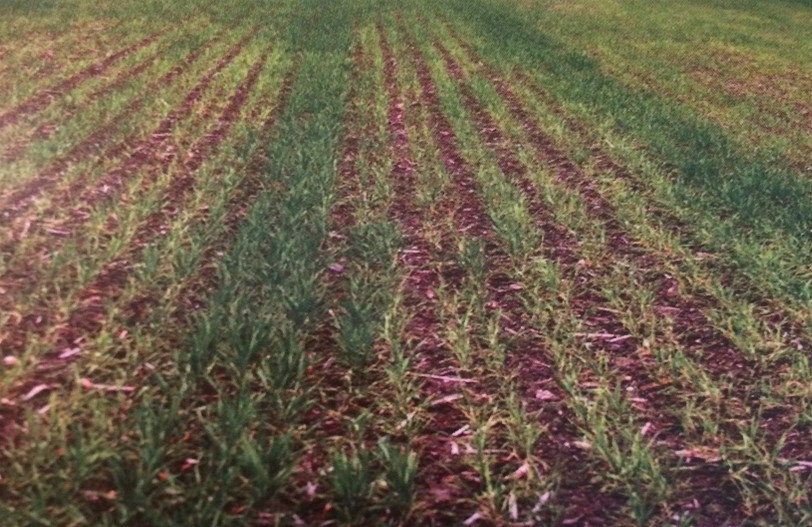
Manganese activates over 35 enzymes in the plant and is vital for effective photosynthesis, and so a lack of manganese results in a significant reduction in soluble sugars. Sufficient manganese is therefore critical for good crop establishment and tiller survival, improved winter survival, improved grain fill and quality, and increased disease resistance. So, although very small quantities in total are needed, manganese plays a key role in crop performance.
With manganese’s sensitivity to high soil pH levels, deficiencies are best confirmed by plant tissue analysis. From here, it should be treated by straight manganese foliar applications or with a broader range of trace elements if needed. Contact your agronomist or NRM directly to arrange for some samples of plant tissue to be tested where diagnosis is in doubt.
Visit NRM