


Why should growers invest in different types of analysis throughout the season?

NRM
Agriculture
Regular soil and plant tissue analysis is not a luxury. Before you write it off as too expensive or an optional extra, it’s worth considering how collecting data to inform decision making could help you improve productivity, use resources more efficiently, and plan more effectively.
Read on to learn more about how seasonal analysis benefits you and your farming system, a breakdown of exactly what and when you should analyse throughout the farming year, and how NRM can help.
Why is it important to analyse throughout the season?
Analysing different factors throughout the season is important to help you monitor progress and adjust management plans in time to maintain and improve crop production. By investing in different types of analysis throughout the season, you can:
- Maintain and improve soil health. Healthy, fertile soil is the foundation for all crops. By establishing a baseline of how your soils are doing and monitoring them regularly with analysis, you can ensure optimal crop growth. Livestock and organic manure inputs add organic matter which improves soil functionality, biological activity, and the retention and turnover of nutrients, so analysing the nutrient content of these resources helps you capitalise on their benefits.
- Adjust crop nutrition plans. If you analyse plant tissues at key growth stages, your results will show where your crop is compared with where it should be. Combining this with other analyses will enable you to adjust crop nutrition plans if necessary to ensure optimal growth and maximise yields.
- Assess management and allow remediation plans to be put in place for ongoing improvement.
- Improve resilience of your farming business by learning how to better withstand challenges such as extreme or unexpected weather. For example, active carbon analysis indicates soil fertility, so benchmarking and improving soil organic matter and carbon levels in the soil will help crops thrive both now and in the future.
- Save money by knowing exactly how much fertiliser to apply. This can be achieved through soil mineral nitrogen (SMN) analysis before nitrogen applications are made in Spring. Those who apply livestock and organic manures can benefit from the nutrients they recycle back to the system by adjusting the balance of fertiliser required for crop production.
- Assess the impact of sustainable farming practices. Soil organic matter analysis highlights the impact of different management techniques in improving soil health over time, whilst carbon testing checks your plans to increase sequestration are succeeding.
- Safeguard the environment by only applying what you need, minimising nutrient leaching and soil surface runoff, and by monitoring and raising soil carbon levels. This means we can keep the nation fed sustainably and ensure that future generations inherit soils that are well functioning.
This investment in different types of analysis throughout the season therefore helps you save money in the long run, increase production and profitability, and assess new practices, which then gives you the confidence to adopt them moving forward. Ultimately, analysis gives an overall idea of exactly how your farm is faring.
When and what should I be analysing?
Whilst dates vary with the weather every year, the farming calendar means growers and advisors are busy all year round. If we are observant and ready to adjust management plans to ensure optimal crop growth, we can make informed, profitable decisions using data. When are the best times to book in your samples for analysis?
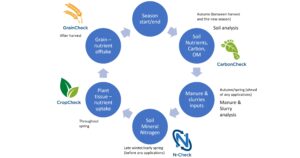
After harvest: GrainCheck
First things first: harvest is in full swing across the country. Harvest marks the end of the season, and is a time to reflect on what went well and what can be done better in future. Whilst no season is the same, it’s important to assess performance so you can learn from experience. Grain testing at harvest will not only confirm the quality of the grain you have produced, but it will also tell you whether your crop nutrition strategy was successful or not.
Our GrainCheck analysis package is suitable for a range of crops, including winter and spring cereals. Our easy-to-use nutrient offtake calculator makes GrainCheck the most innovative grain analysis service out there, giving you a good indication on how well you are managing nutrients.
Between harvest and the start of a new season: soil analysis & CarbonCheck
There’s often not much time between harvest and drilling the next crop, but it’s the best time to book in soil testing before the growing season gets underway and in/organic inputs are applied. With soil testing you can gather fundamental knowledge on the chemical and biological condition of your soils. It gives you the information to adjust the growing environment and provide optimal conditions for healthy crop growth.
Our standard soil analysis package provides data on soil pH, P, K and Mg indices to help you tailor your nutrient plan and ensure crops thrive. Data on soil pH, organic matter, and trace elements can help support the management of the major nutrients and also determine if lime is required.
For those of you aiming to improve soil health or have an eye on carbon markets, soil testing can be expanded with our CarbonCheck service to include specific measures for carbon, such as active and total carbon.
After winter: N-Check & manure and slurry analysis
Just after winter and ahead of your first nitrogen fertiliser application is a great time to test your soils for residual nitrogen levels. Understanding how much nitrogen remains in the soil means you can adjust your fertiliser strategy to apply just the right amount to satisfy crop requirements.
The truth is, you can’t be sure how much fertiliser you need to apply without analysis. If you want to save money, you really don’t want to apply any more than you need to. Nitrogen fertiliser (34.5N%) currently costs around £1/kg (£344/t), so for example reducing nitrogen rates by 25kg N/ha will save around £25 per hectare.
If you haven’t already had your manures and slurries tested, it’s important to do that too. This means you can see how much of your nutrient requirement will be satisfied by any organic applications you’re going to make. The nutrient content of livestock manures/slurries can vary significantly compared to standard RB209 values, and analysis could save more money by reducing the need for inorganic fertiliser. Knowing the nutrient levels of your livestock manures and organic materials helps you to reduce the cost of production and potentially lower the overall carbon footprint of growing the crop. Fertilisers contribute around 70% of the carbon intensity of crop production, so reducing how much we apply also helps reduce our carbon footprint.
In the spring: CropCheck
After fertiliser applications have been made, we recommend monitoring nutrient uptake using plant tissue analysis. This is a step that’s sometimes skipped, unless an issue is seen in the crop, but it’s an important step, as it checks whether the nutrients supplied are making it into the plant. If they aren’t, then you can discuss options with your agronomist and adjust your plans accordingly before it’s too late.
Last year, NRM launched an innovative new tissue testing service for a broad range of cereal crops, CropCheck, which assesses nutrient content in tissue samples at key growth stages. This means you can see whether your crop is performing as it should, allowing further adjustment of crop nutrition plans during the spring.
Data paints a full picture of your farm
All these analyses are available independent of each other, but combining them creates a fuller picture of how your farm and crops are performing. This approach to analysis helps you see in depth how a crop is accessing nutrient supplies and where issues exist in real time. The changing climate is creating pressures and new challenges across the cropping rotation, but analysis can help you build resilience into the system, so crops can better adapt to the changing growing conditions we are more frequently experiencing.
Data allows you to make informed decisions as part of an overall nutrient and soil management plan. With the increased volatility in input costs, crop prices, and the less predictable weather conditions, it’s really worth knowing what’s going on in your soils and how your crops are doing as the season progresses.
NRM offers the full range of agricultural testing services to give you the data you need to make informed decisions and increase yield and profitability. To get started, speak to your advisor or contact us directly.
References
Visit NRM