



The status of arable soil pH: insights from one of the largest datasets in the UK

NRM
Agriculture
As the single most informative measurement made to determine soil characteristics, it’s no wonder soil pH is called the “master soil variable”.
Soil pH holds an important role in many critical soil functions. It influences the physical, chemical and biological properties and processes of the soil that affect plant growth and biomass yield. It is therefore crucial to manage soil pH carefully to maintain and improve soil health, crop yield, and quality.
NRM’s soil summary for 2021-2022 with consolidated data from thousands of soil samples across the UK has reported many interesting key findings and trends. The insights gained from these by our expert agronomists will be useful for farmers and advisors looking to improve soil health and optimise crop production and performance for the coming season.
Read on to find out more about pH and its importance in soil function, key findings from NRM’s soil pH data, how to correct pH imbalance in the soil, and how NRM can help.
How does pH affect soil function?
pH affects an assortment of biological, physical, and chemical functions in the soil. These include microbial activity (which is reduced in acidic soil, affecting the soil’s ability to solubilise and mineralise nutrients), and nutrient availability, where some nutrients (especially phosphate) are restricted at high and low pH levels. Soils that are more acidic increase the solubility of plant toxic metals such as aluminium, which also leads to impeded growth.
Maintaining an optimal soil pH is vital to ensure all nutrients are available to the crop whenever it needs them. This practice is useful to help growers save money on expensive fertilisers, as too high or low soil pH has a considerable adverse impact on nutrient use efficiency. A neutral pH is also better for the environment, protecting against erosion and nutrient leaching and improving soil structure.
Soil pH is based on a logarithmic scale, where pH 6 is 10 times more acidic than pH 7. Small changes in soil pH can have big implications on nutrient mineralisation and availability. If soil pH falls to 5.5, for example, wheat yields can be reduced as much as 25%.
Figure-1 below details which functions are affected by pH in the soil.

Key findings from NRM’s soil pH data
At NRM, we receive more than half a million soil samples across all farm types every year. This has allowed us to gather a large amount of data for representative results, enabling us to draw meaningful comparisons.
Figure-2 below shows the data analysed from arable soil samples collected between 2018-2023. This data shows that nearly a quarter of the samples received had either low or very low pH, ranging between pH 5 and 6. Only around 3.5% of the samples analysed in the past five years were at pH 6.5, nearly 41% of samples were below, and 56% of samples were above.
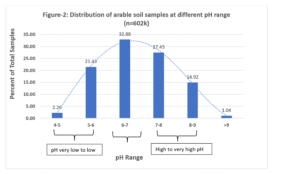
Most crops prefer a pH of close to neutral to encourage optimal growth. The recommended soil pH for growing most arable crops on mineral soils is 6.5 (Nutrient Management Guide, RB209). At this pH, most mineral nutrients are sufficiently available for ideal crop growth and yield.
Soils at a neutral pH can generally become acidic through rainfall, growing crops, and application of manures, slurry, and fertilisers (Ammonium Nitrate, Ammonium Sulphate, etc). However, soils over limestone are generally unaffected by the aforementioned factors unless the soil remains undisturbed, in which case it may reduce the soil pH of the top 2-3 inches.
Lower pH increases the solubility of some micronutrients, such as Aluminium (Al), Iron (Fe), and Manganese (Mn). These minerals can be toxic to plants at high concentrations in the soil solution. Excessive amounts of Al and Fe can react with soil Phosphorus (P), rendering it unavailable for plant uptake. Regular soil testing, followed by lime application if required, can cost-effectively remedy this problem.
Did the trends change when we look at the data in greater detail?
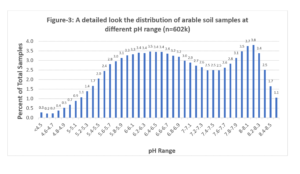
NRM’s data was further analysed to determine any interesting trends for soil pH at a higher resolution. Figure-3 below shows two peaks for the sample distribution. The first peak (3.5% of total samples) is between pH 6.3-6.4. The second peak (3.8%) is between pH 8.1-8.2, which indicates a more alkaline soil.
The higher number of soil samples from alkaline pH could be due to the lab’s proximity to agricultural lands, the majority of which are present over chalk, with a high amount of calcium carbonate. It is expected that samples from agricultural soils such as these would have a higher pH, so this is not surprising.
Although Nitrogen (N), Potassium (K), Magnesium (Mg), Calcium (Ca) and Sulphur (S) are not greatly affected by relatively high soil pH, soil P is directly affected. At pH values greater than 7.5, phosphate ions tend to react with Ca and Mg to form less soluble compounds. This will directly impact crop growth, showcasing the need to correct soil pH before yield is impacted.
How do I correct soil pH?
Conditioning the soil regularly is recommended to effectively manage soil pH, improving soil health, nutrient availability and crop productivity. It’s worth investing in regular soil analysis to check the pH levels on your farm and determine whether you need to take corrective action.
NRM, the UK’s largest provider of agronomic analysis for the land-based industries, offers expert soil analysis services to help you determine the pH levels of your soils.
Once your results are back, you can make insightful management decisions to optimise crop production. This could include lime applications, which will help neutralise acidic soils and provide the perfect base for optimal crop production.
Bear in mind that pH can vary significantly across your farm, so regular soil mapping and analysis can help you target corrective measures only where they are needed. This will help save you money through improving nutrient use efficiency and prevent you from creating more of a problem by over or under liming an area.
We provide insightful information alongside results to help you make the best management decisions for your farm. Contact us or speak to your agronomist to see how your soils are faring.
Visit NRM