


Soil Organic Matter #9: Future decisions for agricultural policy in the Republic of Ireland

NRM
Agriculture
The Republic of Ireland (ROI) remains part of the European Union (EU). It is therefore duty bound to adopt the programme of rules associated with agricultural policy in order to keep receiving basic payment support.
In the past, the Basic Payment Scheme (BPS) was an income support scheme paid to farmers per hectare of eligible land used for farming. The payment was not related to sustainable production, but was paid purely on the eligible hectares of land and the number of entitlements held by the applicant. Payments were made once each year. You can click here for more information on the BPS. This is now changing and you can read more below.
What is the CAP Strategic Plan? What does it mean for farmers in the Republic of Ireland?
The EU has now overhauled the basic payment scheme and the ROI, like the rest of the EU 27, is now in the process of adopting new measures for the 2023-2027 period. The ROI has published a “CAP Strategic Plan” (CSP), which is designed to underpin the sustainable development of the farming and food sector in Ireland.
A large part of the plan is to support and contribute to achieving environmental and climate objectives at both the national and EU level. The CSP will also take a more holistic approach, incorporating interventions under both Pillar I (Direct Payments and Sectoral Interventions) and Pillar II (Rural Development) into one overall plan. Instead of the familiar compliance-based approach, a new performance-based approach will be adopted. This will be supported by a ‘New Delivery Model’, under which member states’ performance will be judged on outputs and results, and on how their CSPs contribute to CAP (Common Agriculture Policy) objectives at EU level. Click here to access the full CSP.
What is the Green Architecture of the CSP?
To manage the demands on our natural resources, the ROI CSP has a clear emphasis on achieving a higher level of climate and environment ambition with measures that focus on improving biodiversity, water quality, carbon sequestration and mitigation. These are designed to contribute towards national and EU climate and environmental targets to help meet these objectives, which were created in close collaboration with other government departments/agencies and external stakeholders.
The environmental and climate ambitions outlined in the CSP will be achieved through the CAP’s new ‘Green Architecture.’ There are three core elements within the Green Architecture:
- Conditionality – sets a minimum baseline that recipients of CAP payments must meet. This replaces cross compliance in the current CAP system and relates to the following areas:
- Climate and the environment
- Public health, animal health and plant health
- Animal welfare
Conditionality is implemented using two mechanisms:
-
- Statutory Management Requirements (SMR) – legislative requirements applicable to all farmers, not just those claiming CAP
- Good Agricultural & Environmental Conditions (GAEC) – 9 standards relating to soil, climate mitigation, habitats, and water.
- Pillar 1: Eco Scheme – a new voluntary annual Agri-Environment scheme named “The Eco Scheme”. Designed to build on baseline conditionality requirements, it is aimed at maximising farmer engagement to achieve climatic and environmental improvements across all farmed land.
There are 8 agricultural practices for the Eco scheme and a farmer will have to undertake at least 2. These are:
- Space for nature – at least 7% of land must be dedicated to biodiversity, natural habitats, or landscape features.
- Extensive livestock production – adherence to a minimum stocking rate of 0.1 and maximum stocking rate of 1.4lu/ha.
- Limiting nitrogen fertiliser usage – in accordance to stocking rate if livestock based or a reduction of 10% if an arable producer.
- Planting native trees or hedges – commitment to plant 3 native trees per eligible hectare or 1 metre of hedgerow.
- Use of GPS controlled spreader and sprayer equipment – all inputs applied via precision applicators.
- Soil sampling and liming across eligible land – sample land every three years.
- Planting break crops – at least 20% of eligible land must be planted in the year of commitment, with either oilseed rape, oats, peas or beans, or a combination.
- Establishing a multispecies ley – across a minimum of 7% of eligible land.
The Eco scheme is open to individual active farmers or groups of active farmers.
- Pillar 2: Climate and environment interventions – ambitious long-term environmental improvements through mass farmer participation and collaboration, with individuals committing to make significant environmental improvement.
A broad range of interventions will build on outcomes delivered in conditionality and through the Eco Schemes and these actions will be supported by new CAP networks to communicate best practice, knowledge and innovation.
For more details and to understand more about the proposed intervention outlines, please click here.
Pillar 2 focus: the Agri-Climate Rural Environment Scheme
The Agri-Climate Rural Environment Scheme (ACRES) proposes to deliver significant long-term environmental improvement through mass farmer participation, engagement, and collaboration. It also relies on individual farmer commitment to extensive environmental improvement across their own farms. ACRES uses a “habitats-based approach”, delivered through both multi-functional prescriptions and results-based actions. The scheme aims to contribute towards improved biodiversity, climate, air, and water quality outcomes.
This will be achieved through two approaches:
- ACRES general: offers a range of both targeted and more general measures for individual farmers.
- Co-operative approach: available to farmers in identified “high priority geographical areas”. They must opt to undertake measures that include bespoke farm, landscape, and river catchment measures. Farmers participating in this approach will have input from a local Cooperation Project (CP) Team to assist with implementation at the local level.
The ACRES scheme will replace the current Green Low Carbon Agri Environment (GLAS) scheme and existing European Innovation Projects (EIP). It will be allocated over time and targeted to ensure that the scheme engages with the farmers who have committed to undertake the most environmentally ambitious actions to help maximise the potential benefits.
Agri-environment climate training is available to farmers participating in the ACRES scheme. The training is designed to improve on farm knowledge around climate change mitigation, the impact of farming on natural resources and biodiversity, and illustrate how the scheme tackles these issues. It will equip participating farmers with the necessary skills to deliver the promised environmental benefits and help them manage their ongoing environmental commitments.
Pillar 2 includes:
- Straw incorporation – to help arable farmers improve soil carbon.
- Organic farming – support for farmers wishing to transition to organic production.
- Areas facing natural constraints (ANC), including mountain areas, areas facing significant natural constraints other than mountains, and those affected by specific constraints – these all need extra support.
- Early-stage support for producer organisations.
- Suckler carbon efficiency programme – support to beef farmers to improve the environmental sustainability of the national beef herd.
- Includes training to implement the suckler carbon efficiency programme.
- Dairy beef welfare scheme – welfare improvements to male dairy calves.
- Sheep improvement scheme – animal health and welfare in the sheep sector.
- European innovation partnership (EIP-Agri) operational groups.
- On-farm capital investment scheme – support for on-farm capital investment.
- Collaborative farming grant – support for mature farmers to encourage succession planning and generational renewal.
- Continuous professional development for advisors.
- Knowledge transfer programme – providing farmers with a platform to share knowledge and experiences.
- LEADER programme – support for community led local development.
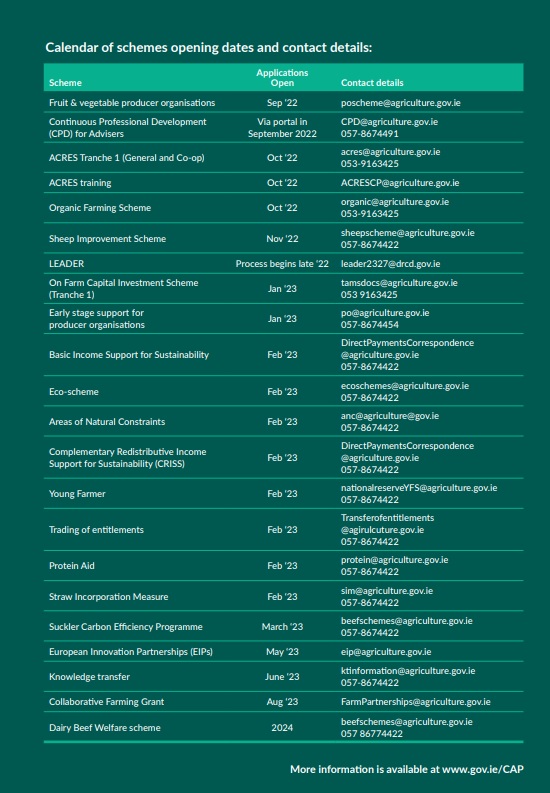
See the calendar of dates for schemes in the table below. For more detail concerning CSP, please click here to visit the department website.
Cawood is the UK’s leading provider of agricultural analysis for the land-based industries. The laboratory services we offer, including standard soil and carbon analysis, provide evidence that farmers are adhering to the above schemes and changing how they farm to help meet their climate and environmental objectives.
For more information on our services, contact NRM directly.
Visit NRM