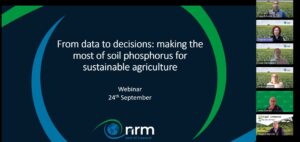
One size does not fit all when it comes to managing phosphorus (P). This, as well as the overwhelming importance of data when making nutrient management decisions, were the key takeaways from NRM and Natural England’s recent webinar, “From data to decisions: making the most of soil phosphorus for sustainable agriculture.”
“Phosphorus imbalances are widespread across the UK. From our extensive database of 170,000 fields analysed over the last 5 years, we found that nearly 30% of soils were deficient, while over 40% contained more than multiple crops over a rotation realistically need. This is a big problem,” said Dr Sajjad Awan, Soil & Crop Nutrition Agronomist at NRM. “Without phosphorus, roots cannot develop, leaves cannot form, and yields collapse. Essentially, no phosphorus means no growth. However, too much phosphorus means increased risk of losses to the environment.
“What we must remember is that phosphorus rarely acts alone. Crops require a balanced diet, and phosphorus interacts closely with nitrogen, potassium, sulphur, and other key nutrients. P imbalances reduce efficiency and hold back yield potential. So, it’s incredibly important to analyse throughout the year and make full use of your data to make the best decisions for your farm and the environment.”
NRM’s data revealed that regional differences in P levels were significant. Whilst Northeastern arable regions tended to show deficiencies, the livestock-intense northwest region often tested above target. According to Dr Awan, this is likely due to soil pH, as well as varying tillage and sampling methods.
“When pH drifts above or below the optimal range, phosphorus can bind with iron, aluminium, or calcium, reducing availability and preventing crops from achieving optimal yield,” said Dr Awan. “Additionally, many farmers may not realise that different tillage methods and required sampling depths may have an effect on P levels. For example, if fields are ploughed, we advise sampling to the traditional 15cm. If they are min-tilled, we advise sampling to 23cm to avoid overestimating soil P content, which tends to accumulate nearer the soil service. Sampling to the correct depth prevents inaccuracies in the assumed content of P in the soil, giving farmers a clearer indication if they need to supplement with fertiliser or not.”
Nigel Simpson, Catchment Sensitive Farming (CSF) Agricultural Lead at Natural England, placed phosphorus within a broader environmental and practical context.
“Only around 0.2% of soil phosphorus is immediately available to crops,” said Nigel. “This availability relates to soil pH, but as phosphorus losses to water in soil particles are also a major environmental issue, we can’t just apply more fertiliser. Excess phosphate fuels algal blooms, which strip oxygen from lakes and rivers, threatening biodiversity, fish stocks, and rural livelihoods. In England and Wales, an estimated two million tonnes of soil and organic matter are lost to water each year, much of it carrying phosphorus with it. Losses can be especially severe on sloping clay soils, where runoff and sheetwash erosion risk can be high.”
To avoid these issues, Nigel suggested adopting more careful management practices.
“Buffer strips, beetle banks, grassed tramlines, cover crops, and sediment ponds will help limit phosphorus loss to the environment,” Nigel said. “Additionally, avoiding applications on high-index soils, applying manure and fertiliser when the crop is going to use the nutrients they supply, and regularly analysing organic manures for accurate nutrient values before applying are all fantastic ways to help limit losses and balance crop productivity with environmental stewardship.”
The webinar, held on Wednesday 24th September 2025, attracted over 135 attendees from across the agricultural industry. It featured engaging discussions, an interactive Q&A session, and valuable expert recommendations.
“The opportunity lies in using data not just as evidence, but as a guide to smarter, more sustainable farming,” Dr Awan concluded. “By prioritising routine testing and managing phosphorus effectively, growers can optimise management plans and support sustainable farming practices.”
Key takeaways from the webinar include:
- Many soils are off target for P in the UK
- Data, rather than intuition, is required to guide and drive management decisions
- Balancing yield targets with environmental risk is crucial to optimise crop development and minimise losses
- One size does not fit all: different soils require different management plans to build, maintain, or decrease P levels
- Environmental concerns means that sustainable P management is more of a regulatory and public interest issue than ever before, so adopting data-driven strategies are required to satisfy both agronomic and environmental goals
- Year-round soil, tissue, and grain analysis is vital in tracking phosphorus levels, adjusting fertiliser plans effectively, and better managing crop productivity whilst protecting the environment.
For those who missed the live session, you can watch the full webinar recording here.
Thank you to all who attended and contributed to this successful webinar!

Our recent webinar, “From data to decisions: making the most of soil phosphorus for sustainable agriculture”, was a resounding success, attracting 150 attendees from across the agricultural industry. Hosted by experts from NRM and Natural England on 24th September, this informative session provided crucial insights into the latest soil analysis data and how it can guide phosphorus nutrition planning to support optimal crop yield whilst minimising environmental impact.
Key highlights include:
- Expert presentations from Dr Sajjad Awan (NRM) and Nigel Simpson (Natural England), who shared fantastic insights on optimising phosphorus nutrition for both improved crop yields and sustainable agriculture.
- An interactive Q&A session, where attendees engaged with our experts, asking insightful questions about regional phosphorus data, best practices, and environmental schemes.
- A strong industry response, with many attendees submitting their BASIS details to receive 1 CPD point for their participation.
- All questions from the webinar have been compiled and will be published to ensure the entire agricultural community benefits from the discussion.
For those who missed the live session, you can watch the full webinar recording here.
‘Without up-to-date analysis data, you can’t make informed decisions for your farm,’ said Dr Sajjad Awan, Soil & Crop Nutrition Agronomist at NRM. ‘What’s become clear from our webinars is just how strong the appetite is among farmers for reliable information. The data provides that foundation, and it shows us that informed decisions simply aren’t possible without it. The enthusiasm we’re seeing is proof of how essential accurate, timely data has become in modern farming.’
Stay tuned for more events and insights, and thank you to all who attended and contributed to this successful webinar!