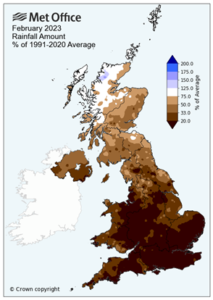
With England seeing its driest February in 30 years, agronomic analysis laboratory NRM advises farmers that they undertake soil mineral nitrogen analysis for more careful fertiliser application planning this season. This will help growers save money on expensive nitrogen fertiliser, improve nitrogen use efficiency (NUE), and optimise crop yield.
‘The Met Office has confirmed that we have had the driest February since 1993,’ said Sajjad Awan, Soil and Crop Nutrition Agronomist at NRM. ‘Drier weather during winter is not necessarily a bad thing, as fewer nutrients are lost through leaching or surface runoff. However, if you’re thinking about nitrogen fertiliser applications, it’s important to consider soil moisture content and soil temperature, as applying at the wrong time can mean failing to get the most out of your fertiliser. It should only be applied when there’s sufficient soil moisture available or there is a chance of (light) rainfall within the next couple of days.’
Although February was the 5th mildest since records began in 1884, March has started off chillier. Sajjad suggests not applying nitrogen when the soil is frozen or there is a high risk of snow or freezing conditions in the coming days.
‘Ideally, the soil in the root zone should be 5oC or higher for rapid uptake of nutrients,’ said Sajjad. ‘This also helps to minimise any nitrogen lost to the environment, improving nitrogen use efficiency (NUE).
‘We also need to ensure that we are putting on the right amount of fertiliser,’ continued Sajjad. ‘These unusual conditions mean that we shouldn’t apply fertiliser without checking nitrogen levels first, as they may be significantly different from what we expect. Measuring your soil mineral nitrogen content before application helps farmers save money on nitrogen fertiliser, improve NUE, and optimise yield.’
NRM’s N-Check services analyse soil for Nitrate-Nitrogen, Ammonium-Nitrogen, soil mineral nitrogen, and give a total value for the combined soil depth. N-Check Plus adds soil organic matter (SOM) analysis to estimate mineralisable nitrogen, Spring crop N to determine the soil nitrogen supply (SNS), and the SNS index based on RB209 guidelines. These services help farmers understand the nitrogen content of their soil to enable informed decision-making about land and crop management.
‘It is important to our customers that they understand the context of their results to help them reach their goals and optimise their crop nutrition plans,’ said Sean Stevenson, Commercial Director of Cawood Agriculture. ‘The expertise of our agronomists, Sajjad and Alli Grundy, means that our customers can tap into the invaluable agronomic experience that they need to have a good understanding and interpretation of their results and make better decisions. This, coupled with our innovative suites of tests, helps to cement our position as the UK’s leading agronomy analysis laboratory.’
NRM’s N-Check services help farmers determine how much nitrogen is left in the soil after harvest and therefore much fertiliser needs to be used, saving unnecessary costs. Learn more and contact us today.